Types of Gas Heaters for Garages Compared
Types of gas heaters for garages compared by how heat moves, where exhaust goes, which fuel they burn and how they mount, with stated BTU figures.

On this page
Cold concrete and numb fingers turn a simple brake job into slow work, and heat is what makes winter garage time usable. The types of gas heaters for a garage split by how they move heat and where their exhaust goes: vented forced-air unit heaters hung from the ceiling or wall, direct-vent wall heaters that vent through the wall, infrared and radiant heaters that warm objects and people in their path, and portable forced-air propane heaters for ventilated work areas. Fuel, venting and mounting separate these types more than size alone.
As an Amazon Associate I earn from qualifying purchases. GarageToolHQ earns a commission when you buy through links on our product pages, at no extra cost to you. Read our affiliate disclosure.
Below: how each type heats, what fuel and venting it needs, and how to choose by garage, ceiling and power on hand.
Types of gas heaters at a glance
| Type | How heat moves | Exhaust | Fuel in the examples here |
|---|---|---|---|
| Vented forced-air unit heater | Fan blows heated air across the space | Flue vent carries combustion gases outside | Natural gas |
| Direct-vent wall heater | Sealed burner heats the room from the wall | Vents directly through the wall, no chimney | Natural gas |
| Infrared or radiant heater | Radiates heat to objects and people in its path | Depends on model; check the manual | Natural gas or propane |
| Portable forced-air propane heater | Fan pushes heated air toward the work zone | Unvented; ventilated areas only | Propane |
Read the manual for the exact model you are considering. Fuel type, vent pipe, clearances and ventilation openings differ by model, and the label decides where a heater may run.
Vented forced-air unit heaters
Unit heaters hang from the ceiling or mount on a wall bracket and use a fan to move heated air through the space. The Reznor UDXC examples here are natural gas forced-air units rated at 45,000 BTU, 60,000 BTU, 75,000 BTU and 150,000 BTU, each with a maker-rated 83% thermal efficiency rating. The maker lists threaded-nut retainers at four suspension points for ceiling mounting, with mounting sold separately, and venting with category 1 double wall B-vent pipe vertically through a roof; horizontal venting through a sidewall uses category 1 double wall B-vent pipe on the 150,000 BTU model and category 3 single wall vent pipe on the 45,000, 60,000 and 75,000 BTU models. A fan, circuit board and built-in disconnect mean these units need electrical power as well as gas piping and a vent run, so plan on a licensed gas installer and a licensed electrician. Warranty terms stated for these units cover the heat exchanger, burner and flue collection box assembly for 9 years, with 4 years on electrical and mechanical components. See our ceiling mounted garage heater picks for this mounting style.
Direct-vent wall heaters
Direct-vent heaters mount on a wall and vent straight through that wall, with a sealed burn system and no chimney. The Comfort Glow examples here list 8,000 BTU and 17,000 BTU natural gas models, the larger rated by the maker to heat up to 500 square feet. Stated features include a safety pilot with a built-in pressure regulator that stops gas flow if the pilot goes out, piezo ignition on the smaller model and electronic ignition with thermostatic control on the larger model. Both list no electricity required, an included vent kit with heat shield, vent pipe, air intake pipe, vent cap, flashing and connection rod, and installation on walls from 4.5 to 10 inches thick. The maker lists a limited 2 year warranty for both models. Because the burner is sealed and vented, this type suits a finished garage wall where a ceiling unit does not fit.
Infrared and radiant heaters
Infrared and radiant heaters warm objects and people in their path rather than heating all the air in the room. The Dyna-Glo infrared wall heater here is a natural gas model rated at up to 30,000 BTU per hour for up to 1,000 square feet, with a LOW-MED-HI variable control knob and no electricity required. The maker states fuel conversion is not permitted, and lists an optional fan and optional base legs sold separately for floor mounting. The Mr. Heater radiant model here lists 40,000 BTU for up to 1,000 square feet, a maker-listed 99.9% efficiency figure, use in buildings with 12 to 15 foot ceilings, and no electricity or direct venting required. It includes a 24 volt thermostat, hanging brackets and chains, and the maker lists no moving parts to service. Unvented radiant heat still needs the ventilation the manual calls for and a working carbon monoxide alarm, and it must never run in a closed garage.
Portable forced-air propane heaters
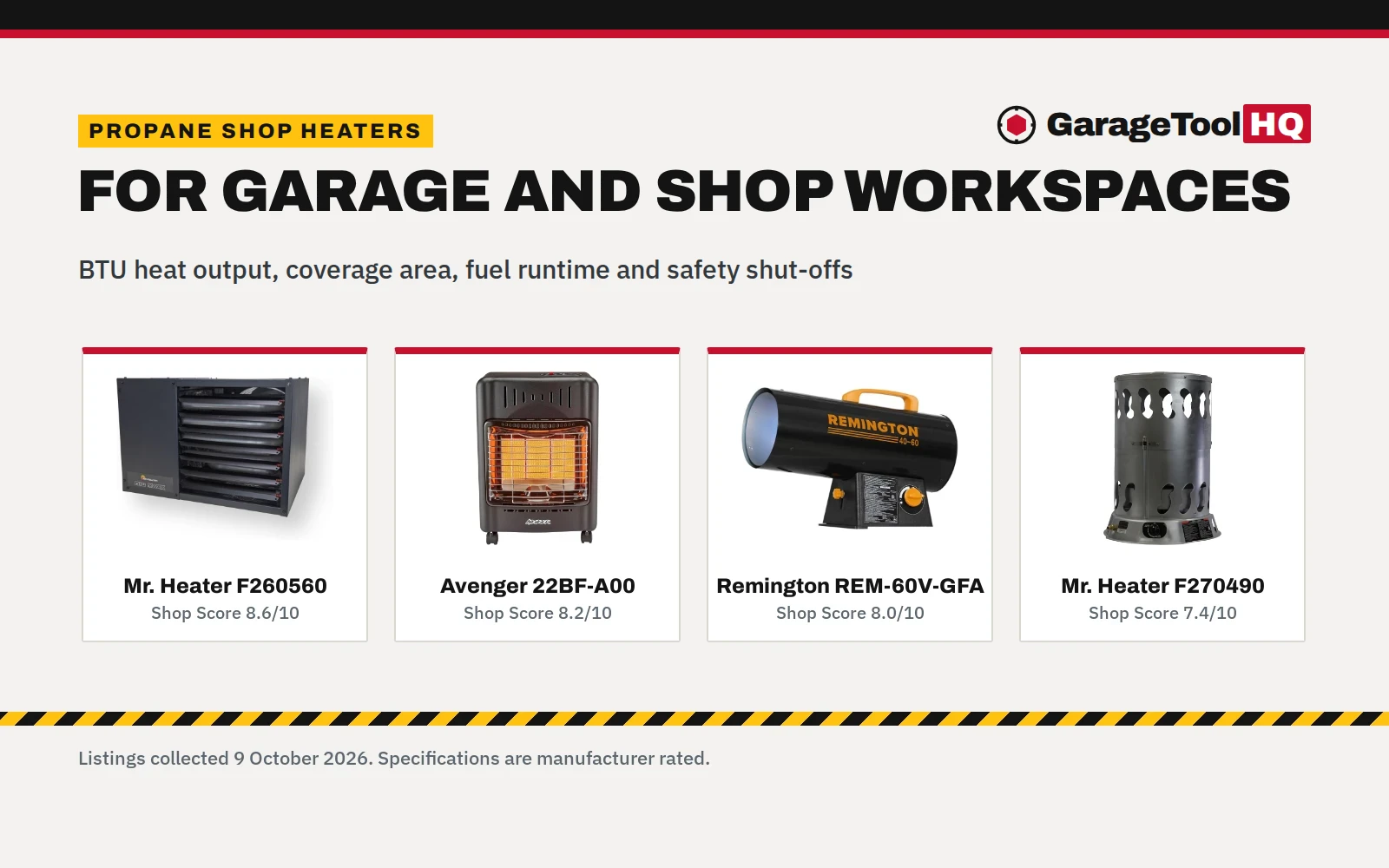
Portable forced-air propane heaters, often called torpedo heaters, blow heated air toward a work zone and move from job to job. The SPECRAFT example here lists 60,000 BTU for work areas up to 2,000 square feet, a manual gas valve to regulate heat output, adjustable tilt, continuous spark ignition, and a 10 foot hose and regulator included, with the propane tank not included. The maker lists ETL certification and an 80 degree C overheat auto shutoff, and states use only in ventilated work areas, with manual cooldown steps before unplugging. That ventilated-only limit is the key point for garages: this type fits open workshops and jobsites, not a closed garage. For propane models by stated output and controls, see our propane heater for shop picks.
How to choose among types of gas heaters
Work through fuel, venting, mounting and power in that order. If a natural gas line reaches the garage, vented unit heaters, direct-vent wall heaters and natural gas infrared models are all in play, and the choice turns on ceiling height, wall space and whether power is on hand for a fan. If propane is the fuel, radiant models and portable forced-air models are the types here, and the choice turns on ventilation and whether the heater stays in place or moves. Match the stated BTU rating and square foot coverage to your space with our guide to what size garage heater you need, then compare stated models in our natural gas garage heater picks. Keep clearances from cars, fuel cans and solvents exactly as the manual lists, fit a carbon monoxide alarm, and have gas piping, venting and electrical work done by licensed installers.
Never run a fuel-burning heater, generator or engine in a closed garage: carbon monoxide builds up fast and has no smell. Fit a CO alarm, keep clearances to cars and storage, use vented gas heaters installed to code, and put 240V electric heaters on a dedicated circuit. See CPSC carbon monoxide guidance. Read our Safety Disclaimer.
FAQ: garage tools
What are the main types of gas heaters for a garage?
The main types here are vented forced-air unit heaters, direct-vent wall heaters, infrared and radiant heaters, and portable forced-air propane heaters. They differ in how heat moves, where exhaust goes, which fuel they burn and how they mount.
Do gas garage heaters need venting?
It depends on the type and the model. Vented unit heaters and direct-vent wall heaters send exhaust outside through a flue or wall vent. Unvented models rely on the ventilation opening the manual specifies, and portable forced-air propane models here state ventilated areas only.
Can I run a portable propane torpedo heater in a closed garage?
No. Never run an unvented fuel heater in a closed garage. The portable forced-air example here states use only in ventilated work areas. Fit a carbon monoxide alarm, keep the ventilation the manual calls for, and shut the heater down by its cooldown steps.
Natural gas or propane: which gas heater type fits my garage?
Start with the fuel already on hand. A natural gas line suits vented unit heaters, direct-vent wall heaters and natural gas infrared models. Propane suits radiant models and portable forced-air models. Check the stated fuel on the exact model, since the Dyna-Glo example states fuel conversion is not permitted.
Do gas heaters need electricity?
Some do and some do not. Forced-air unit heaters need power for the fan and controls. The direct-vent wall heaters and the infrared and radiant examples here list no electricity required. The Dyna-Glo and Comfort Glow makers state that as backup heat during outages.
Related: garage heater sizing by BTU, the best garage heaters for a 2-car garage, our garage upgrades hub and our portable vs wall mounted garage heater guide.