Scissor Lift Types: Complete Guide for Home Garages
How scissor lift types differ for automotive maintenance and shop tasks: low-rise, mid-rise, and full-rise vehicle lifts, single and double scissor shop carts, and a garage setup checklist.

On this page
Top picks at a glance
As an Amazon Associate we earn from qualifying purchases.
- 1
 QISHIDA 7000 LBS Portable Car Lift Mid Rise Scissor Lift 110V9.6/10View on Amazon
- 2
 KATOOL Portable Car Lift Mid Rise Scissor Lift 110V Electric9.6/10View on Amazon
- 3
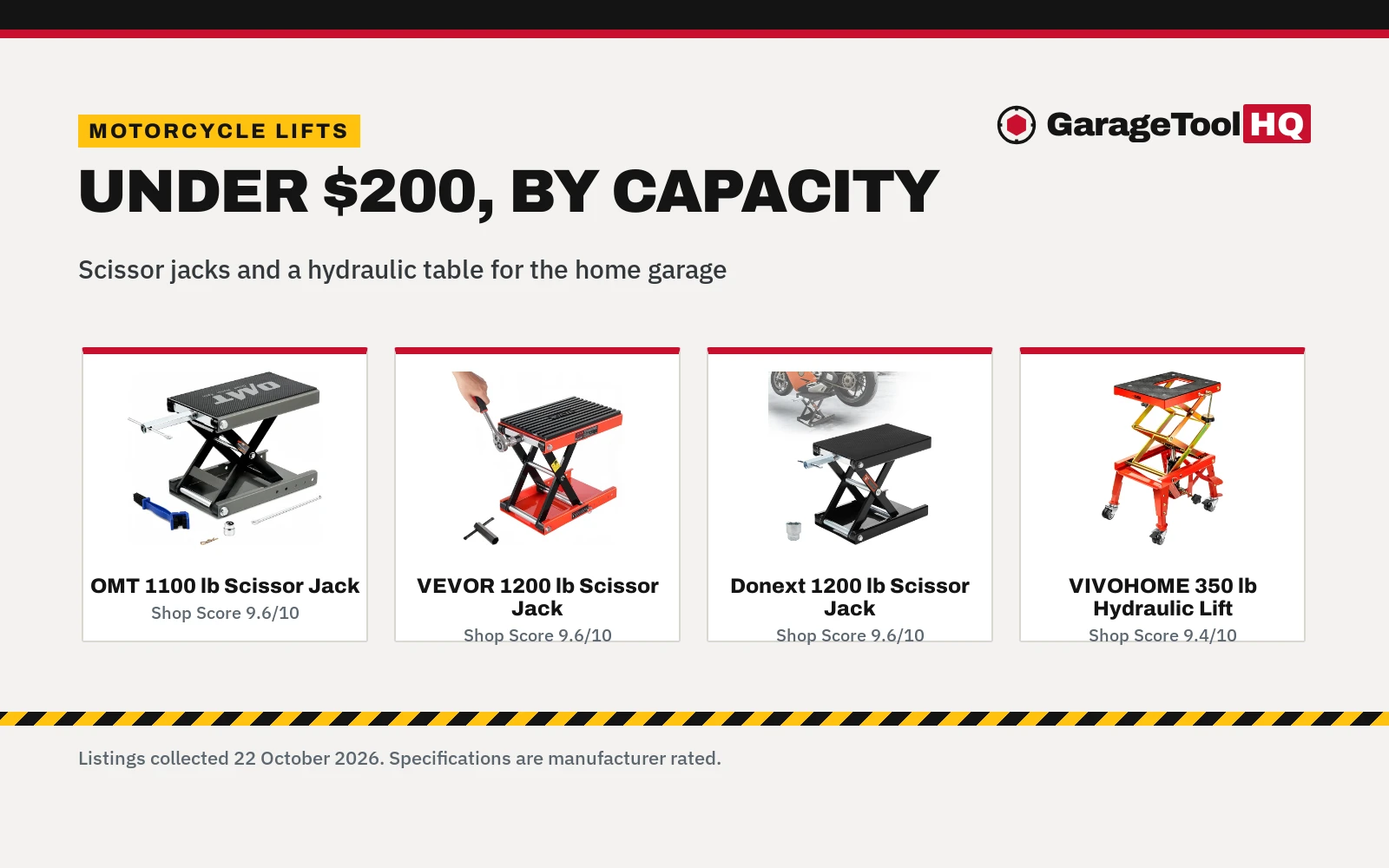
 OMT 1100lb Motorcycle Scissor Lift Jack Wide Deck Hoist Stand9.6/10View on Amazon
When you need to raise a car for a brake job, elevate a motorcycle to clean the drive chain, or roll a transmission across the workshop, choosing among the different scissor lift types ensures you match lift height, capacity, and clearance to the task. Full-vehicle scissor lifts (low-rise, mid-rise, and full-rise models in frame-engaging or drive-on configurations) elevate entire vehicles for wheel and brake service, while mobile lift tables (single-scissor and double-scissor shop carts) use hydraulic foot pedals or electric actuators to position heavy assemblies at bench height. Comparing scissor lift system types helps you pick the right design for your garage floor and ceiling height.
GarageToolHQ earns a commission when you buy through links on our product pages, at no extra cost to you. Read our affiliate disclosure.
Below: vehicle scissor lifts versus shop scissor tables, single and double scissor mechanisms, drive systems, and a setup checklist for your garage floor.
Scissor lift types: how mechanisms and lift heights differ
A scissor lift uses crossed steel arms in a pantograph assembly to convert horizontal force into vertical lift. In automotive workshops, scissor lifts divide into vehicle-lifting systems and component lift tables:
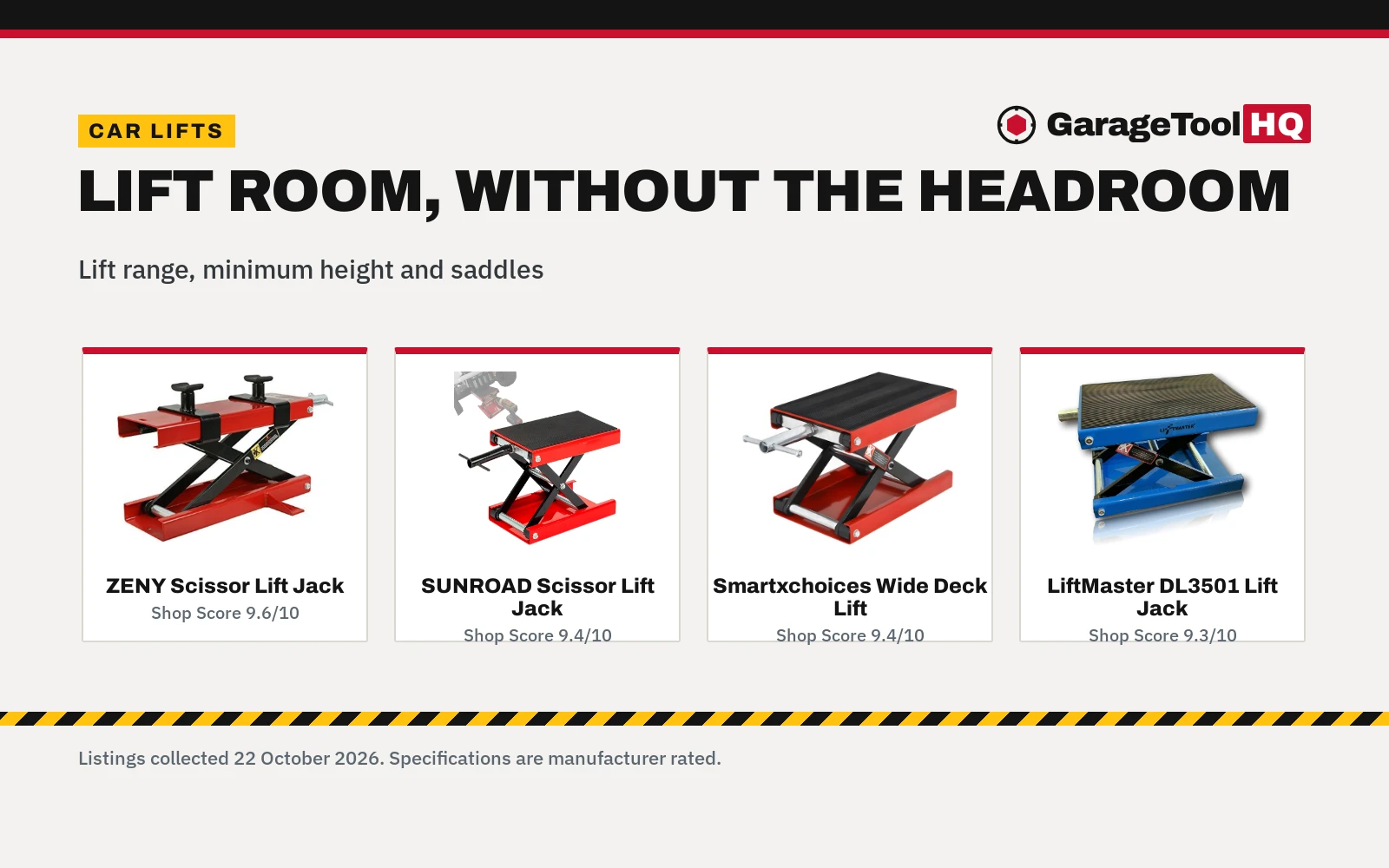
- Low-rise vehicle scissor lifts. Low-rise units raise vehicles just enough to clear wheels from the floor, providing quick access for tire rotations and brake pad swaps in compact spaces.
- Mid-rise vehicle scissor lifts. Mid-rise frames raise vehicles to waist height for suspension rebuilds, brake overhaul, and detailing under standard residential ceilings. See our guide to car lifts for low ceilings or our QuickJack vs scissor lift comparison.
- Full-rise vehicle scissor lifts. Full-rise scissor lifts provide standing working height for underbody service. Twin-platform designs leave an open center corridor, though scissor assemblies sit beneath the tracks. Explore full-size options on our car lifts hub.
- Single-scissor lift tables. Single-scissor platforms use one pair of crossing arms powered by a hydraulic foot pump or electric motor to elevate components and tools to workbench height.
- Double-scissor lift tables. Double-scissor platforms stack two scissor pairs vertically, providing higher reach from a compact base for loading truck beds or high benches.
- Motorcycle scissor lifts. Compact mechanical center jacks that slide under bike frames, using a manual crank shaft to elevate cruisers and street motorcycles for maintenance.
Comparing scissor lift types for garage and workshop use
| Scissor Lift Type | Operating Mechanism | Typical Application |
|---|---|---|
| Single-scissor lift table cart | Single scissor frame; hydraulic foot pump or electric motor (models from CAMMOO, Tera, and VEVOR list heights up to 28 or 28.5 inches) | Moving parts and subframes to bench height |
| Double-scissor lift table cart | Stacked dual scissor frame; hydraulic pump (models from FORGLO and VEVOR list heights reaching 47.2 to 50 inches) | Elevating heavy parts to high workbenches or truck beds |
| Motorcycle scissor lift jack | Manual crank shaft with steel X-frame; 3.7 to 13.8 inches (VEVOR) | Motorcycle wheel removal, chain maintenance, and cleaning |
| Low-rise vehicle scissor lift | Frame-contact hydraulic pads; height per manufacturer specifications | Quick tire rotations and brake pad service |
| Mid-rise vehicle scissor lift | Hydraulic cylinders with mechanical lock bars; mid-level rise per manufacturer specifications | Brake service, suspension overhaul, and detailing |
| Full-rise vehicle scissor lift | Dual hydraulic scissor platforms; flush or surface mounted | Full-height underbody service and vehicle inspections |
Manufacturer listings establish specific capabilities for shop tasks. For component handling, single-scissor carts from CAMMOO and VEVOR list a 500-pound load capacity with a 28.5-inch lifting height. Tera lists a single-scissor model rated for 330 pounds adjusting from 8.3 inches to 28.5 inches, while VEVOR also lists an electric single-scissor table with a 330-pound capacity and an 8 to 28 inch height range. For greater reach, double-scissor carts stack two scissor stages: VEVOR lists a 500-pound model with an 11.8 to 47.2 inch lift height and an item weight of 117.1 pounds. CAMMOO lists a 330-pound double-scissor cart reaching 49.6 inches, FORGLO publishes a 330-pound model lifting from 10.6 inches to 49.6 inches, and VEVOR lists a 330-pound model reaching 50 inches. For two-wheel service, VEVOR publishes a motorcycle center jack rated for 1100 pounds (0.5 tons) with an adjustable height between 3.7 inches (95 mm) and 13.8 inches (350 mm) on a 14.4 by 9 inch deck.
How to choose and set up a scissor lift safely: the checklist
- Identify vehicle lifting points. Consult the vehicle owner’s manual for designated structural lift points before positioning lift pads. Never lift on floor pans or steering linkages.
- Inspect concrete floor thickness and strength. Vehicle lifts require a solid foundation. Check the lift maker’s concrete and ceiling requirements before installation, and see our guide on concrete thickness for a car lift.
- Verify overhead ceiling clearance. Measure floor-to-ceiling clearance, accounting for overhead doors and lights. Compare vehicle roof height at full rise using our guide on ceiling height for a car lift and review installing a car lift in a residential garage.
- Check for certified safety standards. When buying an automotive lift, verify certification through the Automotive Lift Institute. Read what ALI certified means for car lifts for details.
- Engage mechanical safety locks. Hydraulic pressure raises the load, but mechanical lock bars support the weight during service. On the VEVOR motorcycle scissor lift jack, insert the 6-position safety pin. On hydraulic table carts, set the maintenance safety bar before cart servicing.
- Never get under a vehicle on a jack alone. Always support raised vehicles with rated stands on solid level ground before working underneath.
- Confirm load capacity ratings. Never exceed the rated load capacity on the manufacturer data plate.
- Use a licensed electrician for power units. For electric-hydraulic lifts requiring dedicated circuits, use a licensed electrician to wire the power unit safely.
- Lock rolling casters during lifting. On mobile hydraulic carts, engage the wheel locks on the polyurethane casters before pumping the pedal or loading heavy parts.
Hydraulic fluid raises a scissor lift, but mechanical lock bars hold the vehicle while you work. Never get under a vehicle supported only by hydraulic pressure. Always lower the lift onto solid mechanical lock stops.
Check the lift's rated capacity against your heaviest vehicle, and its ceiling and concrete requirements (thickness and strength) before you buy. Install it exactly as the manufacturer specifies, use the mechanical locks before you go under, and look for ALI certification on the model. See the Automotive Lift Institute (ALI). Read our Safety Disclaimer.
Scissor lift system types: hydraulic, mechanical and electric drive
Scissor lift system types are classified by how their drive mechanisms generate lifting force:
- Manual hydraulic systems. Manual scissor carts use a foot pedal pump to extend hydraulic cylinders and a hand release lever to control lowering speed. The CAMMOO single-scissor cart (500 pounds capacity, 28.5 inches lift height) and FORGLO double-scissor cart (330 pounds capacity, 10.6 to 49.6 inches lift range) operate without power cords or hoses for total shop mobility.
- Electric-hydraulic and motorized systems. Electric scissor tables use electric motors to drive hydraulic pumps or linear actuators. VEVOR lists an electric single-scissor table with a 330-pound load capacity, an 8 to 28 inch height range, and 6000N thrust power, offering a wired controller and wireless remote operating within 10 meters at a 5mm/s load speed and 10mm/s no-load speed. For vehicle lifts, electric-hydraulic power units wire into dedicated circuits to raise vehicles quickly.
- Mechanical screw and crank systems. Mechanical scissor lifts replace hydraulics with a central threaded screw shaft. The VEVOR motorcycle scissor lift jack uses a detachable metal handle to rotate a central shaft through a steel X-frame, lifting up to 1100 pounds from 3.7 inches to 13.8 inches. With no hydraulic fluid or pump seals to leak, it locks securely using a 6-position safety pin.
- Pneumatic and air-hydraulic systems. Pneumatic lifts use compressed shop air to actuate heavy-duty air bags or intensifier pumps for rapid lifting in tire and motorcycle shops.
Selecting the right scissor lift for your garage layout
Match your scissor lift to your ceiling height, vehicle types, and primary repair tasks:
- For routine vehicle maintenance: In garages with standard ceiling heights, a mid-rise vehicle scissor lift elevates cars for brake work and suspension service without hitting ceiling joists. Learn operating procedures in our guide on how to use a scissor lift.
- For component handling and bench work: A 500-pound capacity single-scissor hydraulic table from CAMMOO or VEVOR allows you to transport heavy subframes, transfer cases, and parts across the shop floor and raise them to bench height without back strain.
- For motorcycle service: A center-hoist stand like the 1100-pound capacity VEVOR motorcycle jack provides a stable, rubber-padded 14.4 by 9 inch deck for chain maintenance and tire changes.
Frequently Asked Questions
What are the primary scissor lift types for home garages?
The main scissor lift types include vehicle lifts (low-rise, mid-rise, and full-rise models for cars and trucks), mobile hydraulic lift tables (single-scissor and double-scissor carts for moving heavy components), and mechanical motorcycle scissor jacks.
What is the difference between a single-scissor and a double-scissor lift table?
A single-scissor table uses one pair of crossing arms for moderate rise, reaching 28.5 inches on models from CAMMOO, Tera, and VEVOR, or 28 inches on VEVOR’s electric model. A double-scissor table vertically stacks two scissor pairs, reaching 47.2 to 50 inches on models from VEVOR, CAMMOO, and FORGLO.
Can a scissor lift replace a post lift in a residential garage?
A mid-rise scissor lift is ideal for brake jobs, suspension work, and detailing under low residential ceilings. However, its central frame restricts center underbody access, making a two-post lift preferable for major exhaust or transmission removals.
How do mechanical scissor jacks differ from hydraulic scissor lifts?
Mechanical scissor jacks use a threaded screw shaft and manual crank rather than hydraulic fluid, as seen on the VEVOR motorcycle jack rated for 1100 pounds. Hydraulic lifts use pressurized fluid from a foot pedal or electric motor to lift heavier loads with less effort.
Do scissor lifts need to be anchored to the garage floor?
Full-rise automotive lifts typically require concrete anchoring per manufacturer specifications. Portable mid-rise vehicle frames, motorcycle center jacks, and mobile hydraulic table carts operate safely on level concrete without anchor bolts.
Related: our car lifts category hub, how to use a scissor lift, our recommendations for car lifts for low ceilings, our comparison of QuickJack vs scissor lift, our breakdown of what ALI certified means for car lifts, concrete thickness for a car lift, ceiling height for a car lift, and putting a car lift in a residential garage.