Thermal Imaging Camera Uses in the Garage
A thermal imaging camera turns heat into a picture, and in the garage that picture points at drag, leaks, bad connections and cold spots before a wrench comes out.

On this page
Thermal imaging camera uses in the garage all come back to seeing heat the eye cannot see. A thermal camera paints a picture where warm parts glow and cool parts stay dark, so a dragging brake, a tired bearing, a loose connection or a cold cylinder shows up on screen before a wrench comes out. Point the camera, read the picture, and let the heat pattern say where to look next.
As an Amazon Associate I earn from qualifying purchases. GarageToolHQ earns a commission when you buy through links on our product pages, at no extra cost to you. Read our affiliate disclosure.
Below: the garage jobs where a heat picture earns its keep, how to read one, and the mistakes that make a good camera lie.
Thermal imaging camera uses in the garage: reading heat like a gauge
Heat is a symptom. A part that runs warm is working hard, rubbing, resisting current or leaking, and a part that stays cold while its neighbors warm up is not pulling its weight. A thermal camera turns that symptom into a picture, so the eye can compare parts side by side instead of guessing by touch. The table below lists the jobs where that picture pays off most.
| Job | What the camera shows | What to do next |
|---|---|---|
| Dragging brake | A wheel that glows warmer than the rest after a drive | Check the caliper, slides and hose on that corner |
| Wheel bearing | A hub that runs warmer than the hub across from it | Listen for a growl and check for play before driving far |
| Electrical connection | A terminal or fuse that glows against cool wiring | Kill the power, clean and tighten the joint, then recheck |
| Cooling system | A radiator with cold patches or a hose that stays cool | Look for a stuck thermostat, a clog or low coolant flow |
| Exhaust and misfire | A manifold runner that stays cool while the rest warm up | Suspect a cylinder that is not firing and confirm with a scan tool |
| Catalytic converter | An outlet that runs cooler than the inlet | Suspect a clogged or dead core and have the exhaust checked |
| Air leaks | Cold streaks around doors, windows and duct joints | Seal the gap and scan again on a cold morning |
| Battery and charging | A post or cable end that runs warmer than the rest | Clean the terminal and check the charging circuit |
Brakes and bearings: heat that means friction
A brake that drags turns motion into heat at the wheel, and a bearing that is worn does the same at the hub. After a drive, point the camera at each wheel in turn and compare the picture from side to side. A wheel that glows warmer than its match on the other side is telling the truth about a caliper that does not release, a slide that sticks or a hose that holds pressure. A hub that runs warm while the rest stay cool points at a bearing on its way out, and the sooner it is caught the less it costs in parts around it.
Electrics: loose connections glow
Current through a loose or corroded joint makes heat at the joint, and the camera sees it as a bright spot on a cool wire. Scan fuse boxes, battery posts, ground straps and trailer plugs with the circuit under load, and any terminal that glows against its neighbors has earned a closer look. Kill the power before touching a connection, clean the metal, tighten the joint and scan again. For mains wiring and anything past the fuse box, use a licensed electrician.
Cooling and exhaust: follow the warm trail
A cooling system moves heat from the engine to the radiator, and the camera shows where that flow stalls. Scan the radiator face for cold patches that point at a clog or low coolant flow, and scan the hoses to see which side of the thermostat is warm. On the exhaust side, scan the manifold runners at idle: a runner that stays cool while the rest warm up belongs to a cylinder that is not firing. Scan the converter too: a healthy converter runs hotter at the outlet than the inlet, so an outlet that runs cooler than the inlet points at a core that is clogged or no longer working.
How to read a heat picture: the checklist
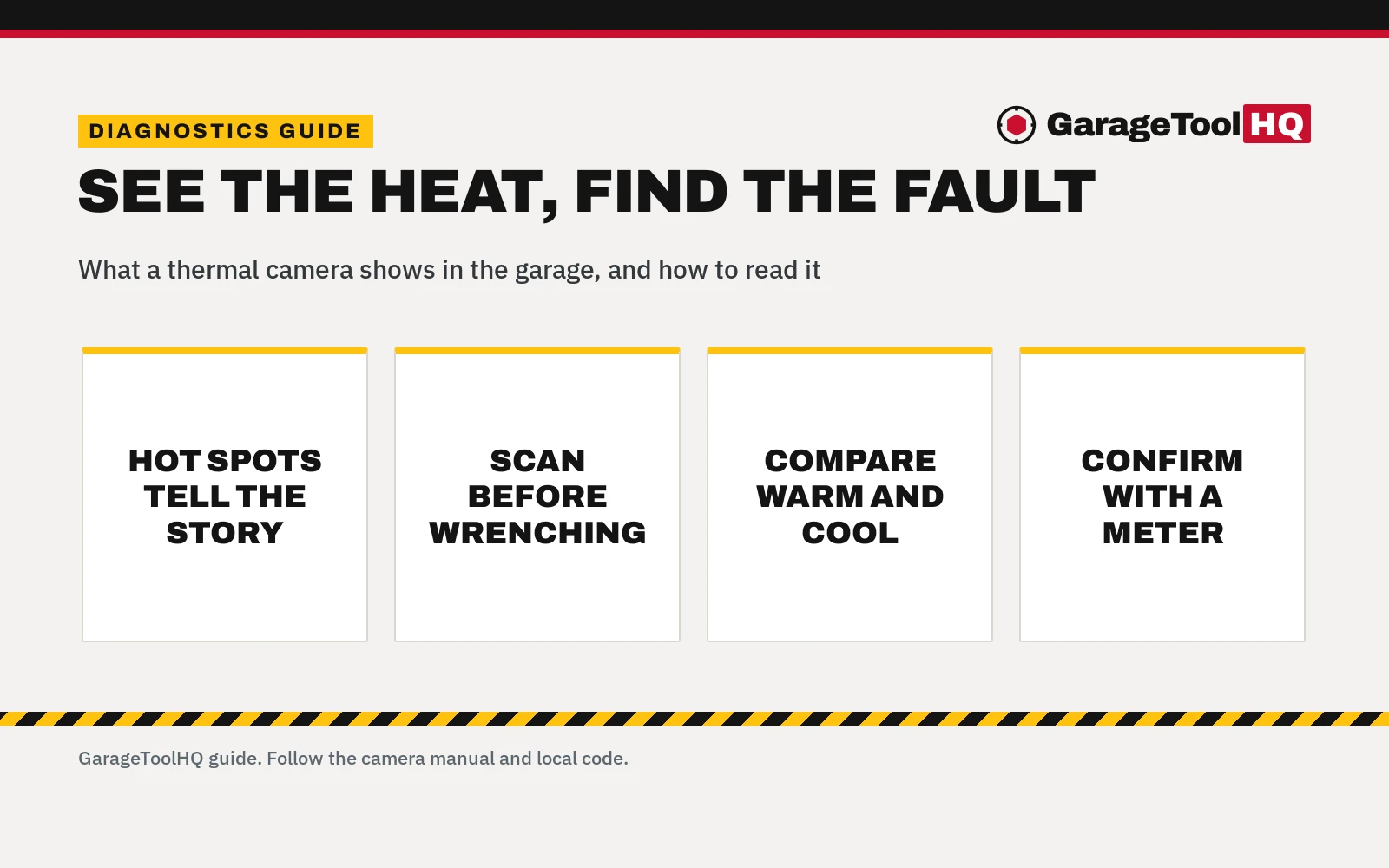
- Compare side to side. A warm part means little on its own; the same part on the other side of the car is the baseline. Scan the other side and look for the odd one out.
- Scan with the car warm. Most heat patterns show up after a drive, not on a car that has sat cold in the driveway. Run the job that makes the fault appear, then scan at once.
- Watch shiny metal. Bare metal reflects heat from nearby parts, so a bright patch can be a reflection rather than a hot spot. Change the angle and scan again before trusting the picture.
- Look for patterns, not dots. A fault spreads heat along a hose, a wire or a brake disc. A lone bright dot is often a reflection or a bit of trim in the sun.
- Confirm before ordering parts. A heat picture points at the fault; a meter reading confirms it. Never order a part on a picture alone.
A thermal camera shows relative heat, not a lab reading. Shiny metal reflects heat from nearby parts, and a bright spot can be a reflection. Confirm the finding with a meter before ordering parts.
Read the manual before first use, wear eye protection, keep the work area clear and ventilated, and stay within every stated rating. Read our Safety Disclaimer.
Thermal camera vs infrared thermometer
An infrared thermometer reads a spot, and a thermal camera paints the whole scene. The spot reader is fine for checking a hose or a hub when the target is known, but it reads one spot at a time, so a pattern across a radiator face or a fuse box does not show up in a single reading. The camera shows more, which is why it earns its keep on jobs where the fault could sit anywhere in a wide area. See the thermal camera vs infrared thermometer comparison and the infrared thermometer uses guide for the spot reader side of the job.
Air leaks and the garage itself
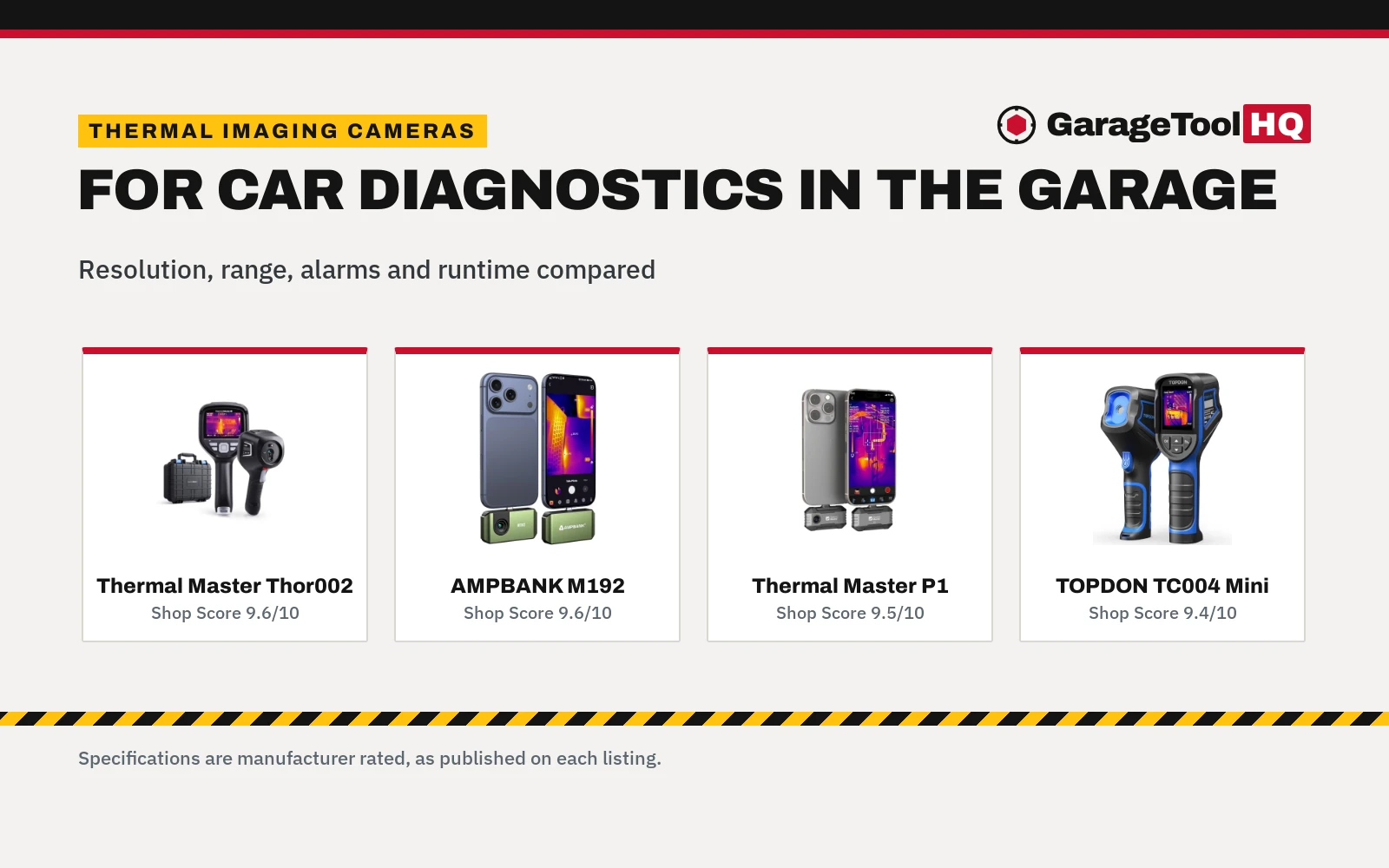
The same camera that finds a dragging brake finds a draft. Scan door seals, window frames and duct joints on a cold morning and the leaks show as cold streaks against warm walls. A garage door that leaks air wastes heat all winter, and a scan shows where the seal has failed. For a sense of what a camera costs to own, see the cost of thermal cameras guide, and for a camera that fits garage work, see the best thermal cameras for the garage.
FAQ: garage tools
Can a thermal camera find a dragging brake?
Yes. After a drive, scan each wheel and compare side to side. A wheel that glows warmer than its match points at a caliper that does not release, a slide that sticks or a hose that holds pressure.
Will a thermal camera show a bad wheel bearing?
Yes, as heat at the hub. A hub that runs warmer than the hub across from it, along with a growl or play in the wheel, points at a bearing on its way out.
Can a thermal camera find an electrical fault?
Yes, where the fault makes heat. A loose or corroded connection glows against cool wiring, and a fuse or relay that runs warm against its neighbors has earned a closer look. Kill the power before touching the joint, and use a licensed electrician for mains wiring.
Does a thermal camera work on a cold engine?
Not well. A heat picture needs heat, so scan after a drive or after the job that makes the fault appear. On an engine that has not run, the picture is flat, and the fault hides until the parts warm up.
Is a thermal camera better than an infrared thermometer?
For finding a fault in a wide area, yes. The camera shows a whole scene at once, so a pattern across a radiator or a fuse box is plain to see. The thermometer reads a spot, which suits a known target such as a hose or a hub.
Related: thermal camera vs inspection camera, the thermal imaging cameras for car diagnostics, the phone attachment vs handheld thermal camera comparison and the diagnostics and electrical hub.