Thread Pitch Gauge Chart: Sizes and Pitches
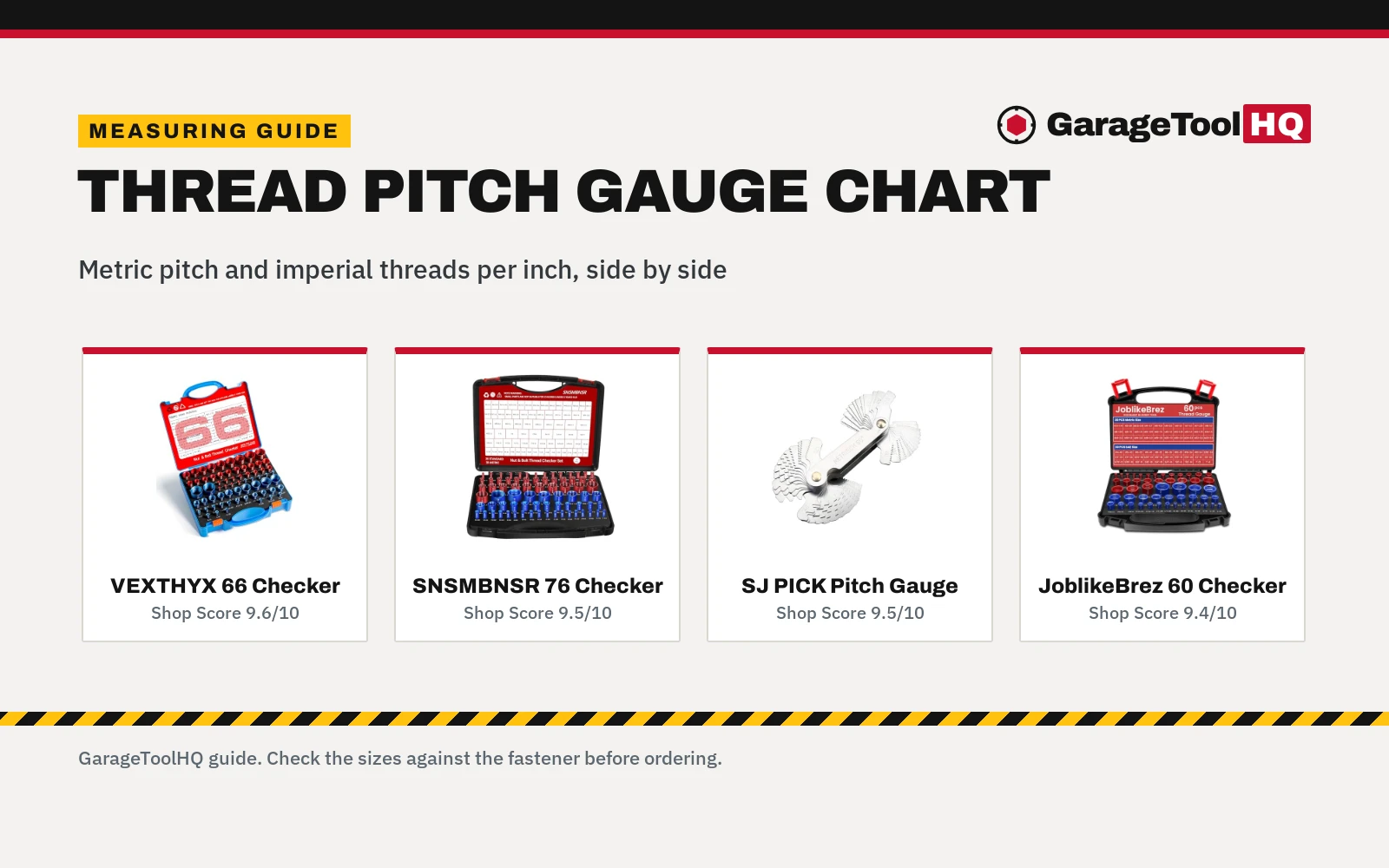
A thread pitch gauge chart matches metric pitch and imperial threads per inch to real fastener sizes, so the right gauge names the thread before a nut or bolt is ordered.

On this page
Top picks at a glance
As an Amazon Associate I earn from qualifying purchases.
- 1
 VEXTHYX 66 Nut and Bolt Thread Checker with 329.6/10View on Amazon
- 2
 76Pcs Thread Checker, Nut and Bolt Thread Checker9.5/10View on Amazon
- 3
 SJ PICK Thread Gauge Metric & Imperial & US Screw9.5/10View on Amazon
- 4
 JoblikeBrez Thread Checker9.4/10View on Amazon
A stripped bolt hole and a bin of mixed fasteners start the same job: a nut that looks right but binds on the way in, and a bolt that spins without biting. A thread pitch gauge chart answers the question before the hardware store trip, by matching the pitch of a thread to the size listed beside it, so the replacement nut or bolt threads on clean. Read the chart, match the gauge to the fastener, and the size is settled.
GarageToolHQ earns a commission when you buy through links on our product pages, at no extra cost to you. Read our affiliate disclosure.
Below: how to read a thread pitch gauge chart, what metric pitch and threads per inch mean, and which gauges cover home garage sizes.
VEXTHYX 66 Nut and Bolt Thread Checker with 32
A 66-piece nut and bolt thread checker with 34 standard and 32 metric gauges in a foam case, CNC-machined to Go and No-Go Class 2B ANSI Standard.
Pros
- 66 gauges: 34 standard and 32 metric sizes
- CNC-machined to Go and No-Go Class 2B ANSI Standard
- Male and female threads on each size
- Gauges lift out of the foam case for narrow spots
Cons
- Metric sizes end at M24x3.0
- Standard sizes start at 2-56
- No warranty term is stated
- Loose gauges in foam can mix if the case tips
76Pcs Thread Checker, Nut and Bolt Thread Checker
A 76-piece thread checker with 38 standard and 38 metric gauges in a storage box, made from aluminum with laser-engraved sizes.
Pros
- 76 gauges: 38 standard and 38 metric sizes
- Most gauges here: 38 standard and 38 metric sizes
- Aluminum gauges with laser-engraved sizes
- Sizes read by engraving, foam print and sticker
Cons
- Metric sizes end at M22
- Standard sizes end at 1-12
- 76 loose gauges take time to sort when mixed up
- Fine and coarse pitches share a box, so read the engraving with care
SJ PICK Thread Gauge Metric & Imperial & US Screw
A blade-style thread pitch gauge covering metric, British Whitworth and US threads, with stainless steel blades.
Pros
- Covers metric, Whitworth and US threads
- Metric blades from 0.25 to 6.0 pitch
- Stainless steel blades resist rust
- Compact: 2.56 by 0.78 by 0.53 inches
Cons
- US list covers 8, 10, 11, 14, 19 and 28 only
- Metric blades stop at 6.0 pitch
- Blade gauge checks pitch, not diameter
- Whitworth blades run from 4G to 62G only
JoblikeBrez Thread Checker
A 60-piece nut and bolt thread checker with 30 standard and 30 metric gauges in a black box with a foam rack, made from aluminum.
Pros
- 60 gauges: 30 standard and 30 metric sizes
- Blue standard and red metric color coding
- Laser-engraved sizes, plus a printed chart
- Aluminum gauges in a foam rack in a black box
Cons
- Standard sizes start at #4-40
- Metric sizes end at M22-2.5
- No warranty term is stated
- Covers common sizes only, so odd pitches fall outside the set
Thread pitch gauge chart: how to read it
A thread pitch gauge chart lists thread sizes with the pitch beside each size. Metric rows give the pitch in millimetres, the distance between threads, while imperial rows give threads per inch. Find the diameter of the fastener, read across to the pitch, and the chart names the thread.
The rows below list metric and imperial sizes side by side for reading, not as swaps for each other.
| Metric thread | Pitch (mm) | Imperial thread | Threads per inch |
|---|---|---|---|
| M6 | 1.0 | 5/16-24 | 24 |
| M8 | 1.25 | 3/8-16 | 16 |
| M10 | 1.5 | 3/8-24 | 24 |
| M12 | 1.75 | 1/2-13 | 13 |
| M20 | 2.5 | 3/4-10 | 10 |
On a checker set with a printed foam holder or chart sticker, the size sits beside each gauge, and the gauge that threads onto the fastener names the size. With blade gauges, the leaf whose teeth mesh with the thread, with no light showing through, gives the pitch.
Metric pitch vs threads per inch
Metric pitch is the distance between threads, stated in millimetres, so a larger pitch number means coarser threads. Imperial threads are counted per inch, so a larger count means finer threads. The scales run in opposite directions, which is why a chart keeps them apart.
Thread angle matters too. Metric and US threads use a 60 degree angle, while British Whitworth threads use a 55 degree angle, and the SJ PICK gauge below covers metric, Whitworth and US threads.
How to check a thread with a gauge
Clean the threads, since rust and grime hide the profile and stop a gauge seating right. Hold the fastener steady, press a blade gauge against the threads, and hold it to the light: the leaf that meshes with no light showing through gives the pitch.
For nuts, screw the gauge into the nut; for bolts, thread the gauge onto the bolt. The checker sets here carry male and female threads on each size, so the same set checks nuts and bolts. On the JoblikeBrez set, blue means standard and red means metric.
Thread pitch gauge chart picks for the garage
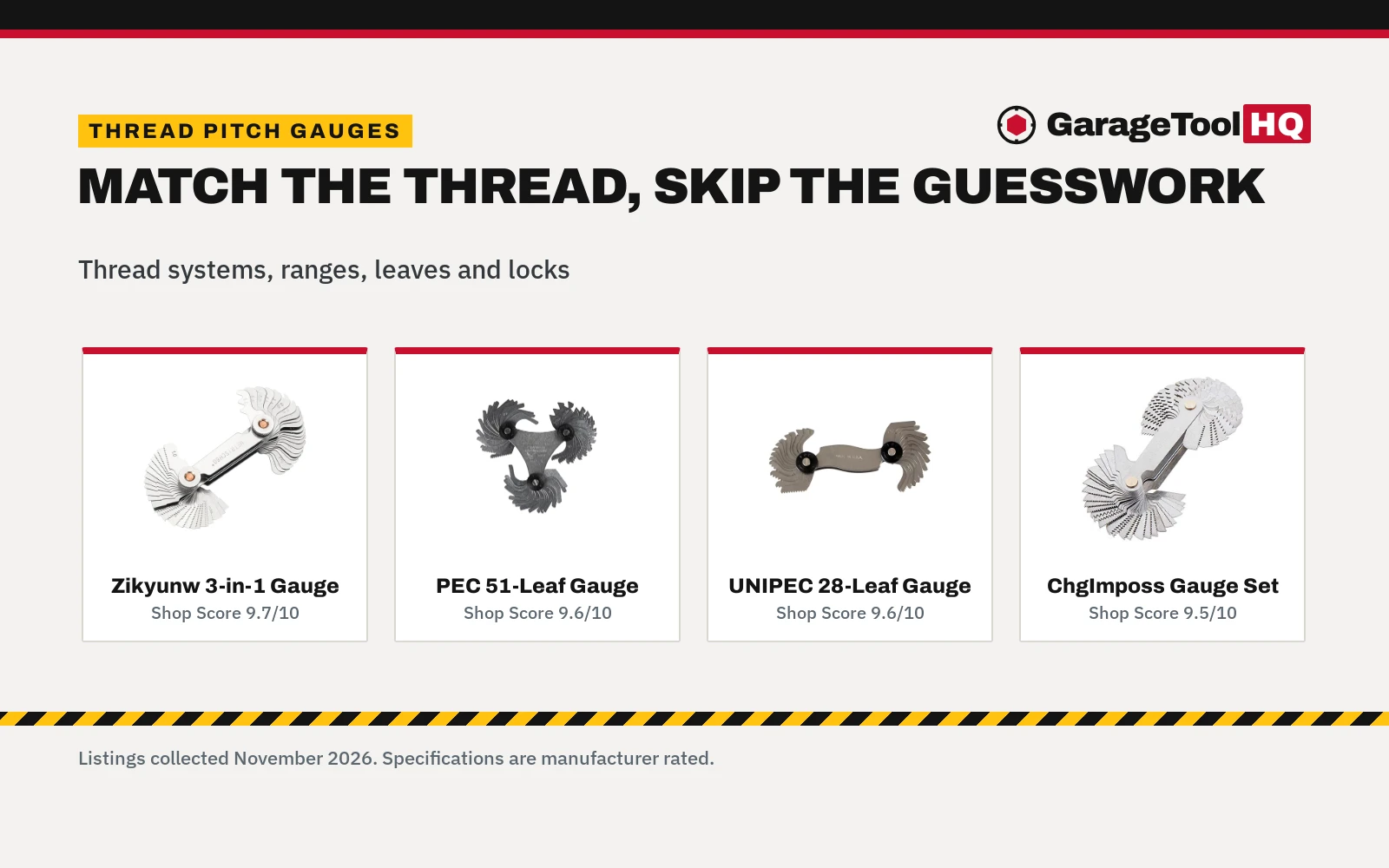
The gauges below turn the chart reading into a size in hand, with blade leaves for pitch and checker sets for nuts and bolts.
Read the manual before first use, wear eye protection, keep the work area clear and ventilated, and stay within every stated rating. Read our Safety Disclaimer.
FAQ: garage tools
How do you read a thread pitch gauge chart?
Find the diameter, read across to the pitch, and match the gauge to the thread. Metric rows list pitch in millimetres and imperial rows list threads per inch.
What does M10-1.5 mean on a chart?
M10 names a metric thread of 10 mm diameter and 1.5 is the pitch in millimetres. M8-1.25, M12-1.75 and M20-2.5 follow the same pattern.
How do you check a bolt with a thread checker?
Thread the checker gauge onto the bolt and read the size off the gauge that fits without rocking.
What is the difference between metric pitch and threads per inch?
Metric pitch measures the distance between threads in millimetres, while threads per inch counts threads along an inch of fastener. A larger metric pitch means coarser threads; a larger threads-per-inch count means finer threads.
Which gauge covers metric and standard threads?
Each gauge here covers metric and standard threads: the checker sets run from 60 to 76 pieces, and the SJ PICK blade gauge covers metric, Whitworth and US threads.
Can a thread pitch gauge measure Whitworth threads?
Yes, when the gauge lists Whitworth blades. The SJ PICK gauge covers Whitworth threads from 4G to 62G at a 55 degree angle.
Related: how to use a thread gauge, the best thread pitch gauge picks, and the engine and shop equipment hub.