Tire Repair Sealant: How It Works and What to Buy
Tire repair sealant seals tread punctures so you can reach a professional, and this guide covers how it works, its limits, and the kits to keep on hand.

On this page
A flat tire rarely waits for a good moment. It shows up on a dark road, in the rain, or halfway to work, and the choice is between a roadside fix and a long wait for help. That is the job tire repair sealant is made for: a liquid sealant that goes into the tire through the valve stem, finds the puncture, and plugs it from the inside so the tire holds air long enough to reach a professional. The Slime sealants here are a temporary fix, not a permanent repair, and the tire still needs inspection or replacement after.
As an Amazon Associate I earn from qualifying purchases. GarageToolHQ earns a commission when you buy through links on our product pages, at no extra cost to you. Read our affiliate disclosure.
Below: how tire repair sealant works, what it can and cannot fix, and the sealant kits to keep in the trunk.

Slime 10011 Emergency Flat Tire Puncture Repair
A 16 oz bottle of temporary flat tire repair sealant for cars, trucks, SUVs, RVs, and trailers that seals tread area punctures up to 1/4 inch (6mm), with a valve core removal tool built into the cap.
Pros
- Seals tread punctures up to 1/4 inch (6mm)
- TPMS safe, non-toxic and non-corrosive formula
- Valve core removal tool built into the cap
- No jack or tools required for the roadside fix
Cons
- Temporary fix only; the tire still needs professional inspection
- Listed for tread area punctures only
- Sold as a single 16 oz bottle
- Needs an air source to reinflate the tire after the sealant goes in

TireJect Full-Size Truck/SUV Instant Tire Repair
A 2-pack kit with an injector that seals bead leaks and tread punctures up to 1/4 inch on full-size truck and SUV tires, with two 10 oz auto pouches, a valve core tool, an injector application tool and a valve stem cap.
Pros
- Seals bead leaks and tread punctures up to 1/4 inch
- Safe for TPMS tire sensors and gentle on rims
- Kit includes an injector, valve core tool and valve stem cap
- Two 10 oz pouches, with one pouch sealing a truck or SUV tire in the listed size range
Cons
- No warranty term is stated in the listing
- Listed for full-size truck and SUV tires
- Listed for bead leaks and tread punctures, with no sidewall coverage stated
- Install goes through the valve stem, so the valve core comes out first

Slime 10056W Bike Tube Puncture Repair Sealant
A 16 oz bottle of tube sealant for bicycles that prevents and repairs tube punctures up to 1/8 inch (3mm), with two years of continuous flat tire protection.
Pros
- Seals tube punctures up to 1/8 inch (3mm)
- Doubles as a preventative with two years of continuous protection
- Non-toxic, non-corrosive, non-hazardous and non-flammable
- Water soluble formula for easy cleanup
Cons
- Listed for bicycle tubes, dirt bikes, wheelbarrows and strollers, not car tires
- Seals punctures up to 1/8 inch (3mm), smaller than the car sealants here
- Needs an air source to use as a preventative
- Sold as a single 16 oz bottle

TireJect Off-Road Instant Tire Repair Tire Sealant
A 20 oz off-road tire sealant kit that seals tread and sidewall punctures up to 3/8 inch, bead leaks, slow leaks and minor dry rot on tubeless off-road tires.
Pros
- Seals tread and sidewall punctures up to 3/8 inch
- Also seals bead leaks, slow leaks and minor dry rot
- Liquid rubber with recycled tire particles and Aramid fibers
- Maker claims 70% less sealant per tire than competing products
Cons
- Not compatible with TPMS tire sensors
- Made for tubeless off-road tires, not highway car tires
- Warranty is 90 days, with no longer term listed
- Install uses the included pouch cap through the valve stem
How tire repair sealant works
Sealant goes into the tire through the valve stem after the valve core comes out. Air escaping through the puncture carries the sealant to the hole, where the sealant particles and fibers build up and form a plug that stops the air loss. Driving right away spreads the sealant around the inside of the tire, which is why the instructions on the Slime car sealant bottle call for inflating to recommended pressure and driving right away.
The sealant in these kits is a liquid rubber or a fiber-filled liquid. TireJect describes its formula as liquid rubber with recycled tire particles and Aramid fibers, while Slime describes its sealant as particles that build up and intertwine to form a flexible plug. Both work the same way in practice: the air leak does the work of carrying the sealant to the puncture.
What tire repair sealant can and cannot fix
Tire repair sealant handles small punctures in the tread area, and the off-road kit here is also listed for sidewall punctures. The Slime car sealant is listed for tread punctures up to 1/4 inch (6mm), the TireJect truck and SUV kit is listed for tread punctures up to 1/4 inch, the bike tube sealant is listed for punctures up to 1/8 inch (3mm), and the off-road kit is listed for tread and sidewall punctures up to 3/8 inch. Bead leaks are listed for both TireJect kits, and slow leaks and minor dry rot are listed for the off-road kit.
What sealant cannot do matters more. The Slime sealants here are a temporary fix, and the tire must be inspected, repaired or replaced by a professional after use. Sealant does not fix a damaged rim or a tire that has come completely off the bead, and it does not replace a spare tire or a proper repair. Check the product instructions before use, and follow them exactly.
| Sealant | Seals punctures up to | TPMS safe |
|---|---|---|
| Slime 10011 | 1/4 inch (6mm) | Yes |
| Slime 10056W | 1/8 inch (3mm) | Not stated |
| TireJect Off-Road Kit | 3/8 inch | No |
| TireJect Truck SUV Kit | 1/4 inch | Yes |
Tire repair sealant gear: the picks
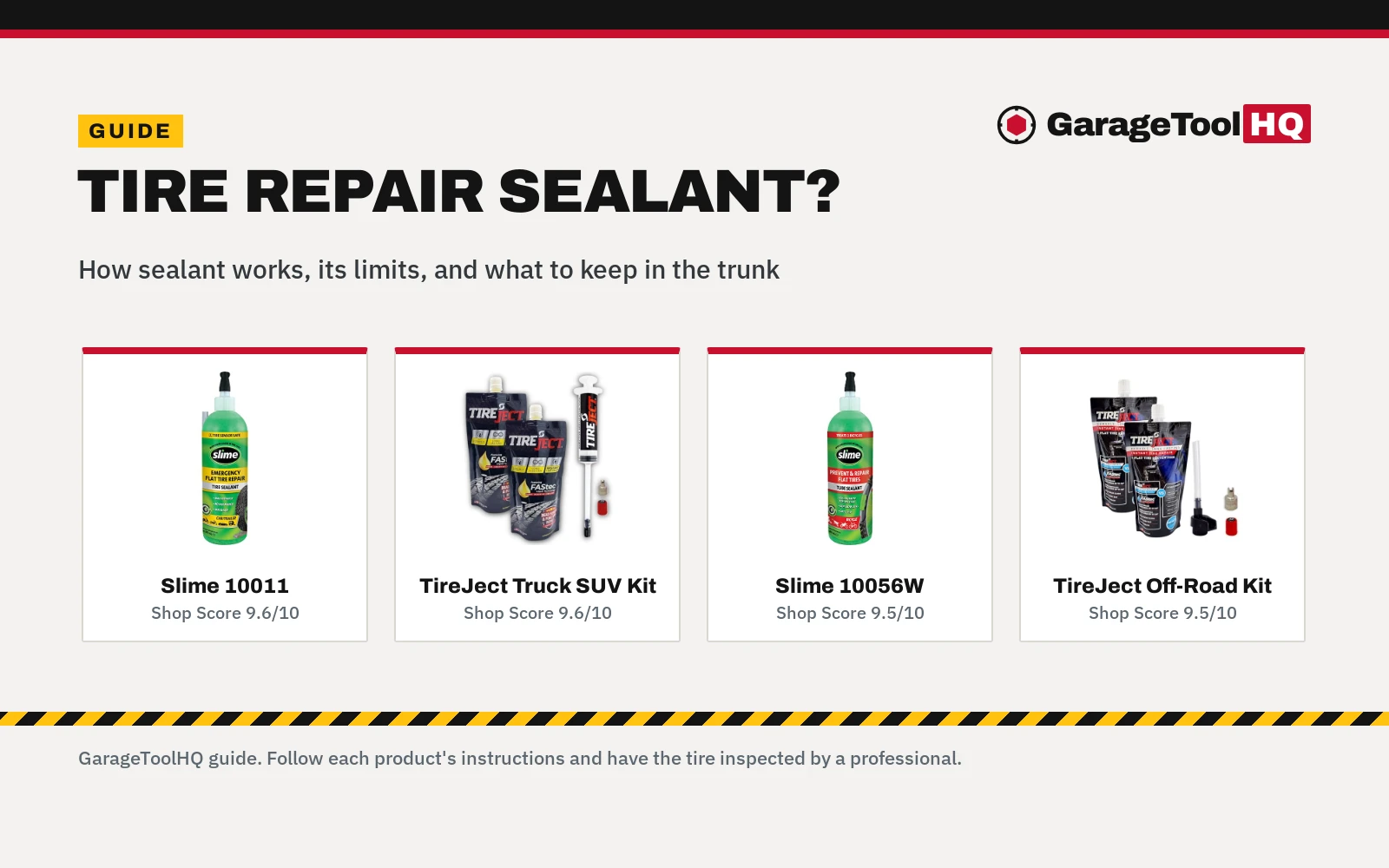
The sealants below cover the steps in the guide above: the car bottle for a highway flat, the tube sealant for bikes, and the TireJect kits for off-road tires and full-size trucks.
Use rated jack stands on solid ground, wear eye protection with power and air tools, keep fuel-burning equipment out of a closed garage, and follow the manual for every tool. Read our Safety Disclaimer.
Tire repair sealant vs a plug kit
A plug kit and a sealant kit solve the same problem in different ways. A plug is pushed through the puncture from the outside, while sealant works from the inside through the valve stem with no jack and no tire removal. Sealant suits a roadside flat where the goal is to get moving again, while a plug kit suits a repair where the puncture can be reached from the outside and the tire inspected. Either way, the tire still needs professional inspection after the repair, and the comparison in tire plug kit vs tire sealant covers the choice in more detail.
An inflator is the other half of the kit. Sealant alone does not put air back in the tire, so a portable inflator or an air source belongs with the bottle. See tire sealant vs tire inflator for how the two work together, and how to use a tire pressure gauge for checking the pressure after the fix.
FAQ: garage tools
Does tire repair sealant fix a flat tire permanently?
Not for the Slime sealants here. They are a temporary fix that seals the puncture so the tire holds air long enough to reach help, while TireJect describes its off-road seal as a permanent seal. The tire must be inspected, repaired or replaced by a professional after use.
How big a puncture can tire sealant seal?
It depends on the product. The Slime car sealant is listed for tread punctures up to 1/4 inch (6mm), the TireJect truck and SUV kit is listed for tread punctures up to 1/4 inch, the bike tube sealant is listed for punctures up to 1/8 inch (3mm), and the off-road kit is listed for tread and sidewall punctures up to 3/8 inch. Anything larger needs a professional repair.
Is tire sealant safe for TPMS sensors?
It depends on the product. The Slime car sealant and the TireJect truck and SUV kit are listed as safe for TPMS sensors, while the TireJect off-road kit is listed as not compatible with TPMS sensors. Check the listing before use if the vehicle has TPMS.
Can I use car tire sealant in a bicycle tube?
Use the sealant made for the job. The Slime tube sealant is listed for bicycle tubes, dirt bikes, wheelbarrows and strollers, while the Slime car sealant is listed for highway vehicles and trailers and the TireJect truck and SUV kit is listed for full-size truck and SUV tires. The Slime tube sealant also works as a preventative when used with an air source, giving two years of continuous flat tire protection as listed.
Do I need a jack to use tire repair sealant?
No, not for the Slime car sealant, which the listing states needs no jack or tools: remove the valve core with the tool in the cap, attach the hose, squeeze the sealant in, reinstall the core, inflate to recommended pressure, and drive right away. The TireJect kits apply through the valve stem with the included injector or pouch cap.
What should I do after using tire sealant?
Drive to a professional and have the tire inspected, repaired or replaced. Tell the shop that sealant was used, since the sealant is inside the tire. Keep the sealant in the trunk or roadside kit so it is on hand for the next flat.
Related: tire plug kit vs tire sealant, manual tire bead breaker, tire pressure gauge how to use and the how we pick page.