Torque Wrench vs Breaker Bar: Which One Should You Buy?
Torque wrench vs breaker bar explained by job, with 4 breaker bars compared by drive, length, flex head, material and finish.

On this page
Top picks at a glance
As an Amazon Associate I earn from qualifying purchases.
- 1
 toolant 13-Piece 1/2" Torque Wrench Set9.8/10View on Amazon
- 2
 WORKPRO 16-inch Dual Drive Breaker Bar9.7/10View on Amazon
- 3
 3/8" Drive Inch Pound Torque Wrench 20-240 in.lb9.6/10View on Amazon
- 4
 EPAuto 1/2-Inch Drive by 24" Length Breaker BarView on Amazon
- 5
 DURATECH 3-Piece Breaker Bar Set with 180° Rotatable Head 1/4"View on Amazon
- 6
 TEKTON 3/8View on Amazon
- 7
 DURATECH 1/2" Drive 17.5-Inch Heavy Duty Breaker Bar withView on Amazon
- 8
 WORKPRO 24-inch Dual Drive Breaker BarView on Amazon
- 9
 Professional Grade 1/2" x 18" Breaker Bar CrV Mirror ChromeView on Amazon
A lug nut that will not move with a ratchet is the moment the garage asks for a different tool, and the torque wrench vs breaker bar question comes down to what the job needs: force to break it free, or a set value to finish it. A breaker bar gives leverage for loosening. A torque wrench sets tightening force. Use the breaker bar to break a stuck fastener free, then the torque wrench to tighten it to its value. The gear section below covers breaker bars only, since every listing compared here is a breaker bar.
Other tools worth a look
 EPAuto 1/2-Inch Drive by 24" Length Breaker BarCheck price on Amazon
 DURATECH 3-Piece Breaker Bar Set with 180° Rotatable Head 1/4"Check price on Amazon
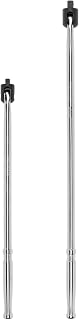 TEKTON 3/8Check price on Amazon
 DURATECH 1/2" Drive 17.5-Inch Heavy Duty Breaker Bar withCheck price on Amazon
 WORKPRO 24-inch Dual Drive Breaker BarCheck price on Amazon
 Professional Grade 1/2" x 18" Breaker Bar CrV Mirror ChromeCheck price on Amazon
GarageToolHQ earns a commission when you buy through links on our product pages, at no extra cost to you. Read our affiliate disclosure.
Torque wrench vs breaker bar: the short answer
Short answer: reach for the breaker bar when a fastener is stuck, rusted or over-tight, and reach for the torque wrench when a fastener must be tightened to a set value. A breaker bar is a long bar with a flex head and no measuring scale in these listings; it turns force at the handle into force at the socket. A torque wrench measures and signals a set tightening value. They are partners, not rivals: break free with the bar, finish with the wrench.
For the ratchet side of the toolbox, see our breaker bar vs ratchet comparison, and for the measuring side, see ratchet vs torque wrench.
What a torque wrench does
A torque wrench tightens a fastener to a set value and tells the user when that value is reached. That matters where a maker calls for a specific tightening value, because guessing risks a fastener that is too loose or too tight. No torque wrench listing is included in the gear section below, so this guide states no torque wrench sizes or ranges; the torque wrench side is explained by its job, not by a listing.
Think of the torque wrench as the finishing tool. It does not exist to win a fight with a rusted nut; it exists to make sure the nut ends up exactly as tight as it should be, no more and no less. That is why garages that do their own brake, suspension and tire work tend to own both tools rather than choosing between them.
What a breaker bar does
A breaker bar is a long, non-ratcheting bar that gives leverage for loosening. The DURATECH and WORKPRO listings describe breaking and loosening rusted, stuck or stubborn nuts and bolts for car and motorcycle maintenance and repair and for industrial, construction and mechanic work, while the EPAuto listing focuses on a stuck lug nut. The bar has a flex head that turns at an angle, and a spring-loaded ball that holds the socket on the bar while the user works. It does not measure torque, so it cannot set a tightening value.
The breaker bar earns its place on the first turn of a stuck fastener, not the last. Once the fastener moves freely, the job passes to a ratchet for speed and then to a torque wrench for the final value. A garage that only owns a torque wrench will reach for it on stuck nuts anyway, which is exactly the job the breaker bar is made for.
The breaker bars compared
| Bar | Drive | Length | Flex head | Material |
|---|---|---|---|---|
| WORKPRO dual drive bar | 3/8 and 1/2 inch | 24 inches | 360-degree | Chrome vanadium steel, CR-MO head |
| DURATECH 17.5-inch bar | 1/2 inch | 17.5 inches | 240-degree | Chrome alloy |
| EPAuto 24-inch bar | 1/2 inch | 24 inches | 180-degree | Chrome vanadium steel |
| DURATECH 3-piece set | 1/4, 3/8, 1/2 inch | 6, 10, 15 inches | 180-degree | Chrome alloy steel |
In the order above, the WORKPRO bar leads on versatility, with two drive ends and the widest flex head range in this group. The DURATECH 17.5-inch bar follows, as the only listing here that states a maximum torque figure, at 500 N m. The EPAuto bar is a long single-drive bar with a chrome plated finish, and the DURATECH set trades length for range, with three drives and three lengths for tight spaces.
Materials are chrome vanadium steel on the EPAuto bar and the WORKPRO bar body, chrome alloy steel on the DURATECH bars, and a CR-MO head on the WORKPRO bar. Finishes differ too: chrome plated and mirror polished on the EPAuto bar, polished on the DURATECH 17.5-inch bar, powder coated on the DURATECH set, and black phosphate on the WORKPRO bar. Handles are round-profile and smooth on the DURATECH and WORKPRO listings, which the makers link to a comfortable grip and less fatigue.
Length and leverage
Length is the leverage story in these listings. The EPAuto and WORKPRO bars measure 24 inches, the DURATECH 17.5-inch bar measures 17.5 inches, and the DURATECH set offers 6, 10 and 15 inches. The listings describe longer handles as giving extra leverage and extended reach, and the set trades that reach for short bars that fit tight spaces. Pick the length that fits the space around the fastener, not just the longest bar on the list.
Drive size and sockets
Drive size decides which sockets fit the bar. The EPAuto and DURATECH 17.5-inch bars use a 1/2 inch drive, the WORKPRO bar uses both 3/8 inch and 1/2 inch drives, and the DURATECH set covers 1/4 inch, 3/8 inch and 1/2 inch drives. Match the bar to the sockets already in the toolbox, or pick the set or the dual drive bar for more drive sizes in one purchase. A bar with the wrong drive is a bar that sits unused, whatever its length.
Flex head range
Flex heads let the bar work at an angle instead of straight on. The EPAuto bar and the DURATECH set list 180-degree heads, the DURATECH 17.5-inch bar lists a 240-degree head, and the WORKPRO bar lists a 360-degree head. A wider head range helps in tight spaces; the DURATECH listings name reaching around tight spaces, and the WORKPRO listing names bypassing narrow spaces, as reasons for flex heads. If the fastener sits behind a suspension part or under a fender edge, head range matters as much as length.
Read the listing twice
Breaker bar listings mostly agree with themselves, but a few lines deserve a second look:
- EPAuto: the spec table lists a jaw capacity of 0.5 inches, a figure that fits a wrench jaw rather than a breaker bar; the title and bullets give the drive and length instead.
- DURATECH set: the spec table gives a single length of 15 inches, which is the longest bar in the set; the title gives all three lengths.
- DURATECH 17.5-inch: the included components list a socket wrench, while the title and bullets describe a breaker bar.
- WORKPRO: the title, bullets and spec table agree on the dual drive ends and the 360-degree head.
Where a listing gives two figures, trust the title and bullets over the spec table.
Use rated jack stands on solid ground, wear eye protection with power and air tools, keep fuel-burning equipment out of a closed garage, and follow the manual for every tool. Read our Safety Disclaimer.
FAQ: garage tools
Can a breaker bar tighten a bolt to a set value?
No. A breaker bar has no measuring scale in these listings, so it cannot set a tightening value. The DURATECH 17.5-inch listing states a maximum torque of 500 N m, which is a limit for the bar, not a setting to tighten to.
Can a torque wrench loosen a stuck bolt?
A torque wrench is built for tightening to a set value, not for breaking fasteners free. For a rusted or stuck nut, the listings here point to a breaker bar, which is made to break and loosen with leverage.
What drive size should a breaker bar have?
Match the sockets in the toolbox. These listings cover 1/2 inch alone, 3/8 inch and 1/2 inch together, and a set covering 1/4 inch, 3/8 inch and 1/2 inch.
Does a longer breaker bar give more leverage?
The listings describe longer handles as giving extra leverage and extended reach. The EPAuto and WORKPRO bars measure 24 inches, while the DURATECH set tops out at 15 inches, so length is a real difference between these listings.
What does a flex head do on a breaker bar?
A flex head turns at an angle, so the bar can work where a straight bar cannot swing. These listings offer 180-degree, 240-degree and 360-degree heads, with the WORKPRO bar offering the widest range.
More garage guides
Related: the tool storage hub. Also see our breaker bar vs ratchet, ratchet vs torque wrench, torque wrench vs torque angle gauge and socket set vs torque wrench.