Waste Oil Heater Parts: Common Replacements
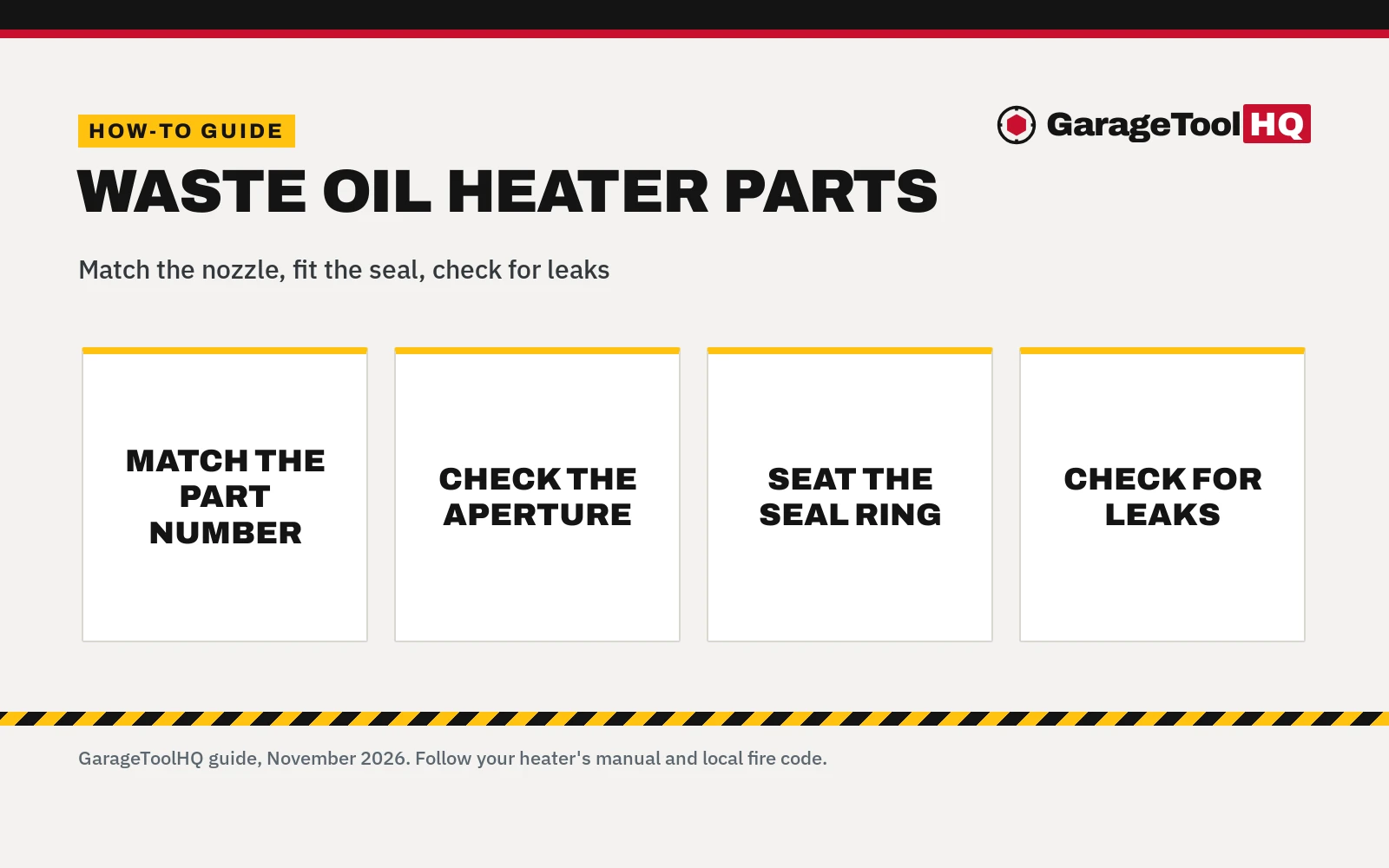
Waste oil heater parts wear at the burner nozzle: match the part number, aperture and seal, then fit the new nozzle and check for leaks.

On this page
When a shop heater starts burning dirty, smoking, or will not light at all, the fault is often a worn part rather than a dead heater. Waste oil heater parts are the replaceable pieces that keep a used-oil burner running: the burner nozzle that turns oil into a fine spray, the seal that keeps oil from leaking at the joint, and the fitment details that match a new part to the heater it serves. This guide explains which parts wear out, how to match a new nozzle to the old nozzle, and how to fit it.
As an Amazon Associate I earn from qualifying purchases. GarageToolHQ earns a commission when you buy through links on our product pages, at no extra cost to you. Read our affiliate disclosure.
Below: the parts that wear out on a waste oil heater, the nozzle sizes and part numbers to match, the steps to fit a new nozzle, and answers to the questions that come up most.
Waste oil heater parts: what wears out
A waste oil heater burns used engine oil, so its burner parts live in heat, soot and dirty fuel. The nozzle is the part that wears, because it meters the oil through a small aperture and shapes the spray. The black rubber seal at the nozzle joint hardens with heat over time and then leaks, so it is replaced with the nozzle. A blocked fuel filter or a tired pump shows up as a weak flame or a heater that will not stay lit, and the igniter and flame sensor foul with soot in the flame path.
The listings in this guide center on the nozzle, because it is the part with a size and a part number to match. MorningRo lists brass nozzles in 0.3 mm, 0.5 mm and 0.8 mm apertures, each with a 0.7 inch outer diameter and a black rubber seal. Vicue and Gxcdizx list nozzles that replace part number 30609-5, also known as Reznor 102997, for Reznor, Clean Burn, EnergyLogic and Shenandoah waste oil heaters. Alpha Rider lists a 0.5 mm 30609-5 nozzle for Reznor heaters. AUTOVIC lists a replacement part for Lanair HI MX 140/200/240/250/300/320 heaters that replaces part numbers 9899 and 9522.
Nozzle sizes and part numbers
| Aperture | Part number | What the listing states |
|---|---|---|
| 0.3 mm (0.012 inch) | 30609-3 | MorningRo brass nozzle, black rubber seal, 2 pack |
| 0.5 mm (0.020 inch) | 30609-4 | MorningRo brass nozzle, black rubber seal, 2 pack |
| 0.5 mm | 30609-5 | Alpha Rider siphon nozzle, 0.50 GPH SNA, Reznor RA140, RA150, RA235, RA250, RV225, RV325 |
| 0.8 mm (0.032 inch) | 30609-5 | MorningRo brass nozzle, black rubber seal, 2 pack |
| 0.7 mm | 30609-7 | USonline911 nozzle, also for Delavan nozzle adaptor 17147 |
Listings cite 30609-5 with different apertures, so the part number alone does not settle the size. Match the aperture as well as the part number.
Flow and spray change with air and lift, not with the part number alone. Vicue states that flow rates, spray angles and droplet sizes can be modified, with limitations, by variations in air, lift, and related factors, and that its 30609-5 nozzle produces a solid cone spray pattern with extremely fine particle size at low air pressures and low CFM. The same listings state the nozzle is typically used on furnaces up to 280,000 BTU per hour, which is equal to 2 GPH.
The outer diameter matters as much as the aperture. The MorningRo nozzles list a 0.7 inch outer diameter and fit standard industry connections, so a nozzle with the right aperture and the wrong outer diameter still does not fit.
How to match a nozzle to your heater
- Verify the part number on the existing nozzle before ordering. The numbers the listings in this guide cite are 30609-3, 30609-4, 30609-5 and 30609-7, with 102997 as the Reznor number for 30609-5.
- Match the heater model. The 30609-5 listings name Reznor RA140, RA150, RA235, RA250, RV225 and RV325, plus Clean Burn, EnergyLogic, Shenandoah, Lanair and Omni heaters. The Lanair part replaces 9899 and 9522 on HI MX 140/200/240/250/300/320 heaters.
- Match the aperture. The aperture sets how much oil the nozzle passes at a given air setting: 0.3 mm, 0.5 mm, 0.7 mm and 0.8 mm appear in the listings. Do not swap in a different aperture to change the heat output; the heater manual and the part number decide the size.
- Match the outer diameter and the seal. The MorningRo nozzles list a 0.7 inch outer diameter and a black rubber seal. A nozzle that matches on aperture but not on outer diameter does not seat, and a seal that is not seated leaks.
- Buy the pack size the job needs. MorningRo lists its nozzles in packs of 2, while most other listings here include 1 nozzle.
How to fit a waste oil burner nozzle
- Shut the heater down and let it cool. Work on a cold burner with the fuel off, so no oil feeds the nozzle while it is out.
- Remove the old nozzle and clean the equipment interface of residual oil. Wipe the joint clean so the new seal seats on bare metal.
- Seat the black sealing ring in the new nozzle’s groove. Press it fully into the groove without displacement, so it sits flat all the way around.
- Align the nozzle with the equipment interface and tighten it. Rotate clockwise to tighten, or press to lock, depending on the interface type.
- Run a small flow of waste oil and check for leaks before full operation. Watch the joint while oil flows; a leak at the seal means the ring is not seated, so stop the flow and seat it again.
- Check the spray pattern when the burner runs. A solid cone spray with extremely fine droplets is what the listings describe.
A waste oil heater burns fuel, so it needs the ventilation its maker specifies and a working carbon monoxide alarm in the shop. Never run an unvented heater in a closed garage, and never burn fuel in a space with gasoline, solvents or other flammable vapors nearby. Follow the heater manual and local fire code.
Never run a fuel-burning heater, generator or engine in a closed garage: carbon monoxide builds up fast and has no smell. Fit a CO alarm, keep clearances to cars and storage, use vented gas heaters installed to code, and put 240V electric heaters on a dedicated circuit. See CPSC carbon monoxide guidance. Read our Safety Disclaimer.
Other waste oil heater parts to check
The nozzle is the part with a size to match, but it is not the only part that wears. The fuel filter strains dirty oil before it reaches the nozzle, so a filter that has never been changed starves the burner. Hoses and fittings weep at the joints when they age, and the pump and the air supply also shape the flow and the spray. The igniter and the flame sensor sit in the burner and foul with soot, so they are cleaned or replaced when the burner will not light or will not stay lit.
FAQ: garage tools
Which waste oil burner nozzle does a heater need?
Verify the part number on the existing nozzle before ordering. The listings in this guide cite 30609-3, 30609-4, 30609-5 and 30609-7, with 102997 as the Reznor number for 30609-5, then match the heater model: Reznor RA140, RA150, RA235, RA250, RV225 and RV325 for the 30609-5 listings, and Lanair HI MX 140/200/240/250/300/320 for the part that replaces 9899 and 9522.
What does the nozzle aperture change?
The aperture is the hole the oil passes through: 0.3 mm, 0.5 mm, 0.7 mm and 0.8 mm appear in the listings, each tied to a part number. Flow rates, spray angles and droplet sizes can also be modified, with limitations, by variations in air, lift and related factors, so the aperture alone does not fix the flow.
How can a new nozzle be kept from leaking?
Seat the black sealing ring fully in the new nozzle’s groove without displacement, then run a small flow of waste oil and check for leaks before full operation. The MorningRo listings state the black rubber seal is oil-resistant and prevents leaks when seated. If oil weeps at the joint, stop the flow and seat the ring again.
Can a 30609-5 nozzle fit different heater brands?
Yes, when the part number matches. The 30609-5 listings name Reznor, Clean Burn, EnergyLogic and Shenandoah waste oil heaters, and the Gxcdizx listing also names Lanair and Omni. Check size compatibility before ordering, as the listings state.
What size waste oil heater does a 30609-5 nozzle suit?
The Vicue and Gxcdizx listings state the 30609-5 nozzle is typically used on furnaces up to 280,000 BTU per hour, which is equal to 2 GPH. The Alpha Rider listing gives a 0.50 GPH SNA configuration for its 0.5 mm nozzle, which is the nozzle’s own flow rating, so read the flow figure on the listing you buy.
Related: the guide to what size garage heater you need, the best garage heater for a 2-car garage, the cost to heat a garage and the garage upgrades hub.