120v vs 240v Garage Heater: Which One Should You Buy?
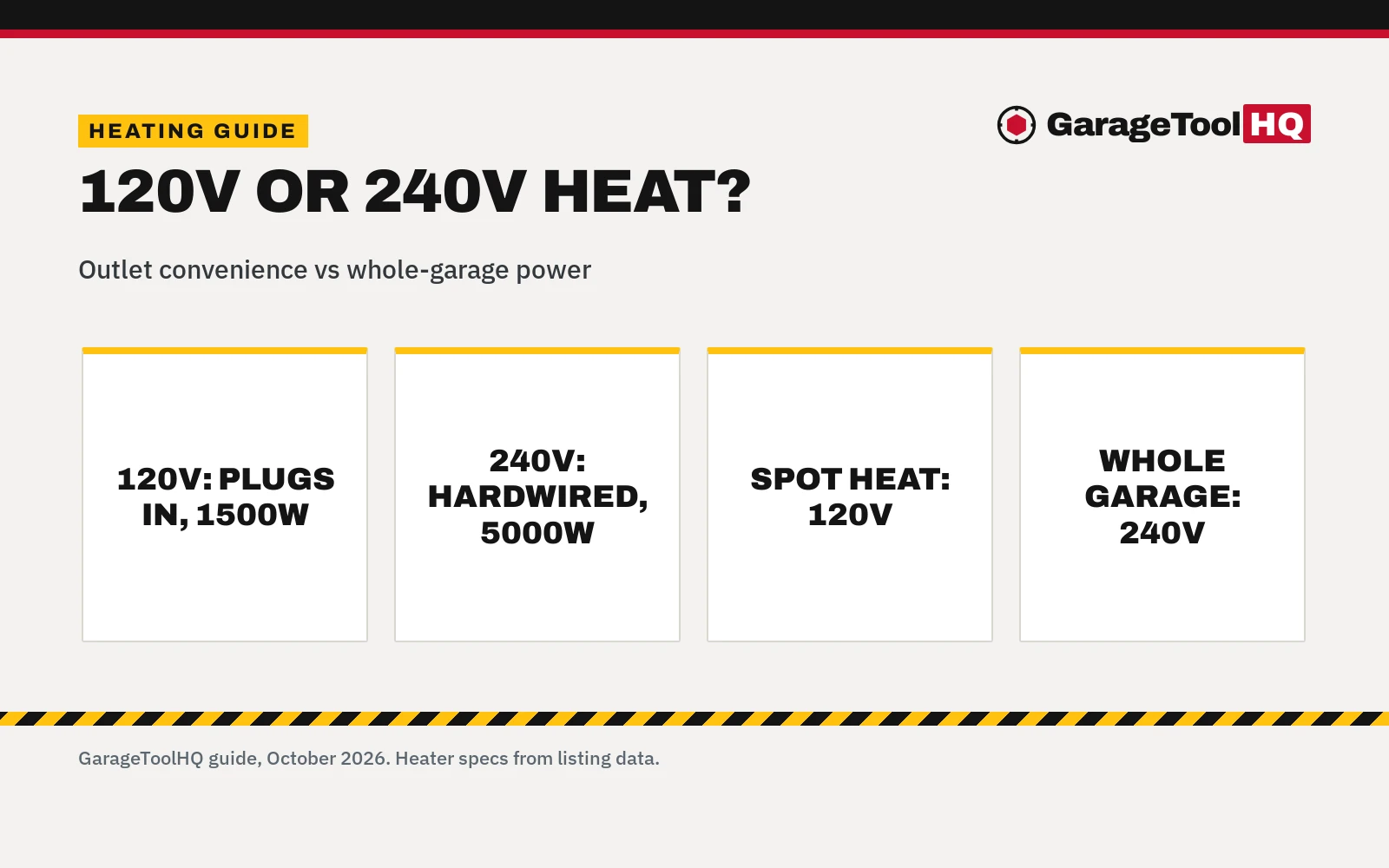
120V heaters plug into any outlet and top out at 1500W; 240V heaters need a dedicated circuit but deliver 5000W and up. Which one fits your garage.

On this page
Top picks at a glance
As an Amazon Associate we earn from qualifying purchases.
- 1
 Shinic 120V Electric Garage Heater9.7/10View on Amazon
- 2
 DR. INFRARED HEATER DR-910F 109.7/10View on Amazon
- 3
 CTSC 8500W Garage Heater Electric9.7/10View on Amazon
- 4
 NewAir NGH160GA00View on Amazon
- 5
 Shinic 2-Pack 120V Electric Garage HeaterView on Amazon
- 6
 Shinic Remote Control 120V Electric Garage HeaterView on Amazon
- 7
 Diesel Heater 8KW 12V/24V/110V/120VView on Amazon
The job is an oil change in February, the garage door is cracked for air, and the question is 120v vs 240v garage heater: which voltage actually warms your space. A 120V heater plugs into any standard outlet and every 120V listing in our sample tops out at 1500W, which suits spot heat and small spaces. A 240V heater needs a dedicated circuit and usually an electrician, but the 240V listing here delivers 5000W of fan-forced heat for a whole workshop. Quick comfort at the bench: 120V. Serious winter heat for the whole garage: 240V.
More options to compare
 NewAir NGH160GA00Check price on Amazon
 Shinic 2-Pack 120V Electric Garage HeaterCheck price on Amazon
 Shinic Remote Control 120V Electric Garage HeaterCheck price on Amazon
 Diesel Heater 8KW 12V/24V/110V/120VCheck price on Amazon
GarageToolHQ earns a commission when you buy through links on our product pages, at no extra cost to you. Read our affiliate disclosure.
Below: what the voltage changes about power and hookup, where each one wins, and what the listings say about watts, amps and coverage.
120v vs 240v garage heater: what the voltage changes
Voltage sets the ceiling on power, and power sets how much space the heater can warm. All seven plug-in listings in the sample list 1500W: the JNDRO wall mount, the DR218, the NewAir portable, the BEYOND HEAT ceiling mount, the blessny, the thermomate and the shinic. The single 240V listing, the VEVOR wall and ceiling mount, lists 5000W with two adjustable power levels. More watts means more heat per hour, which is why the 240V heater lists 50 sq.m. of coverage against 80 to 300 sq ft on the 120V examples. The trade is the hookup: 120V plugs into a standard outlet, as the NewAir listing states outright, while the VEVOR is a hardwired heater that needs its own circuit.
| 120V | 240V | |
|---|---|---|
| Power in the sample | 1500W on every listing | 5000W on the VEVOR listing |
| Current draw listed | 12.5A on the DR218, NewAir, BEYOND HEAT, thermomate and shinic | 20.83A on the VEVOR |
| Hookup | Plugs into a standard outlet | Hardwired on a dedicated circuit |
| Coverage listed | 80 to 300 sq ft across the sample | 50 sq.m. on the VEVOR |
| Install | Hang it or set it down and plug in | An electrician runs the circuit; then mount and wire the heater |
| Heat output listed | 1500 watts of radiant or fan-forced heat | 17,064 BTU fan-forced on the VEVOR |
| Best for | Spot heat, small garages, renters | Whole-garage winter heat, big shops |
The amp figures tell the same story as the watts: 12.5A at 120V against 20.83A at 240V. That is why the 240V heater cannot share a normal household circuit and why the 120V ones can.
When 120V is the better choice
- You rent or you move. No panel work, no electrician, no landlord conversation. The NewAir plugs into any standard outlet and the DR218 weighs 11.5 lb.
- Spot heat at the bench. Warming the work area for a few hours, not the whole building all winter. The shinic lists 300 sq ft of radiant coverage from a ceiling mount with a remote.
- Small or mild-climate garages. The JNDRO covers 200 sq ft with a thermostat and ECO mode; the thermomate covers 80 to 100 sq ft at 4.6 lb.
- Zero install fuss. The blessny and thermomate hang on a wall bracket with a remote and a 24-hour timer, and several listings carry ETL certification with overheat protection.
When 240V is the better choice
- The whole garage, all winter. 5000W of fan-forced heat with two power levels moves serious air; the VEVOR lists 50 sq.m. of coverage and a 9-hour timer.
- You already have the circuit. A garage wired for a welder or compressor may already have 240V available, which makes the heater the easy part.
- You want it mounted and forgotten. Wall or ceiling mount, remote control, overheat protection and ETL listing: the VEVOR is built to live there.
The electrical work, honestly
The 240V decision is really an electrical decision. A hardwired 240V heater needs a dedicated circuit run to the heater location, which means a licensed electrician, a permit in most areas, and a panel with room to spare. Do not wire it yourself off a dryer outlet or an extension cord. The 120V side has no such hurdle: plug in, aim, and work. If the panel work costs more than the heater, that tells you which voltage your garage actually wants. Our electric vs propane garage heater comparison covers the non-electric alternative, and the garage heaters for a 2-car garage picks compare real models.
Never run a fuel-burning heater, generator or engine in a closed garage: carbon monoxide builds up fast and has no smell. Fit a CO alarm, keep clearances to cars and storage, use vented gas heaters installed to code, and put 240V electric heaters on a dedicated circuit. See CPSC carbon monoxide guidance. Read our Safety Disclaimer.
Frequently Asked Questions
Can I plug a 240V heater into a regular outlet?
No. A 240V heater needs a 240V circuit; a standard outlet cannot supply it, and adapters or rewiring tricks are a fire risk. Have an electrician run a dedicated circuit.
Is 1500W enough for a 2-car garage?
For spot heat at the bench, often yes. For holding the whole garage warm through winter, usually not: that is the job the 5000W 240V class exists for. Run your space through our sizing guide before you decide.
Does a 240V heater cost more to run?
It draws more power per hour, but it also heats the space faster and cycles off sooner. Your bill depends on your local electricity rate and how long the heater runs, not on the voltage alone.
Can I install a 240V garage heater myself?
Mounting the heater, yes, by the manual. Running the 240V circuit, no: that is licensed-electrician work with a permit in most areas. The heater end is easy; the panel end is not.
Why is every 120V heater 1500W?
Because that is where the sample tops out: all seven plug-in listings state 1500W. It is the practical ceiling for a heater that plugs into a standard household outlet, which is exactly why the step up in heat means a step up in voltage.
Do electric garage heaters need venting?
No. Electric heaters make no combustion gases, so there is nothing to vent and no carbon monoxide risk. That is the whole appeal over fuel heat; see infrared vs forced air for the heat-delivery choice.
Related: forced air vs radiant heater, our infrared garage heater picks, the heater sizing guide.