2 Post Lift Cost: The Factors That Set the Price
What sets 2 post lift cost: capacity, height, power, concrete and installation, explained with the figures the makers list.

On this page
Top picks at a glance
As an Amazon Associate I earn from qualifying purchases.
- 1
 KATOOL KT-4H120px 12000 lbs Pneumatic 4-Post Car Lift with9.7/10View on Amazon
- 2
 18pcs Metal Auto Lift Leveling Shims Kit For 2/4 Post Car Lift9.7/10View on Amazon
- 3
 XK 2 Post Auto Car Lift 9000 lb Capacity Truck Hoist 220V9.6/10View on Amazon
You have a brake job coming up and you are tired of working on your back under jack stands, so you start pricing a lift. 2 post lift cost depends on the lift and the garage, not on a single figure: capacity, height, power and installation set what you pay. The lift itself is only part of the job, and the rest comes from the floor it stands on, the power it needs and the truck that delivers it.
GarageToolHQ earns a commission when you buy through links on our product pages, at no extra cost to you. Read our affiliate disclosure.
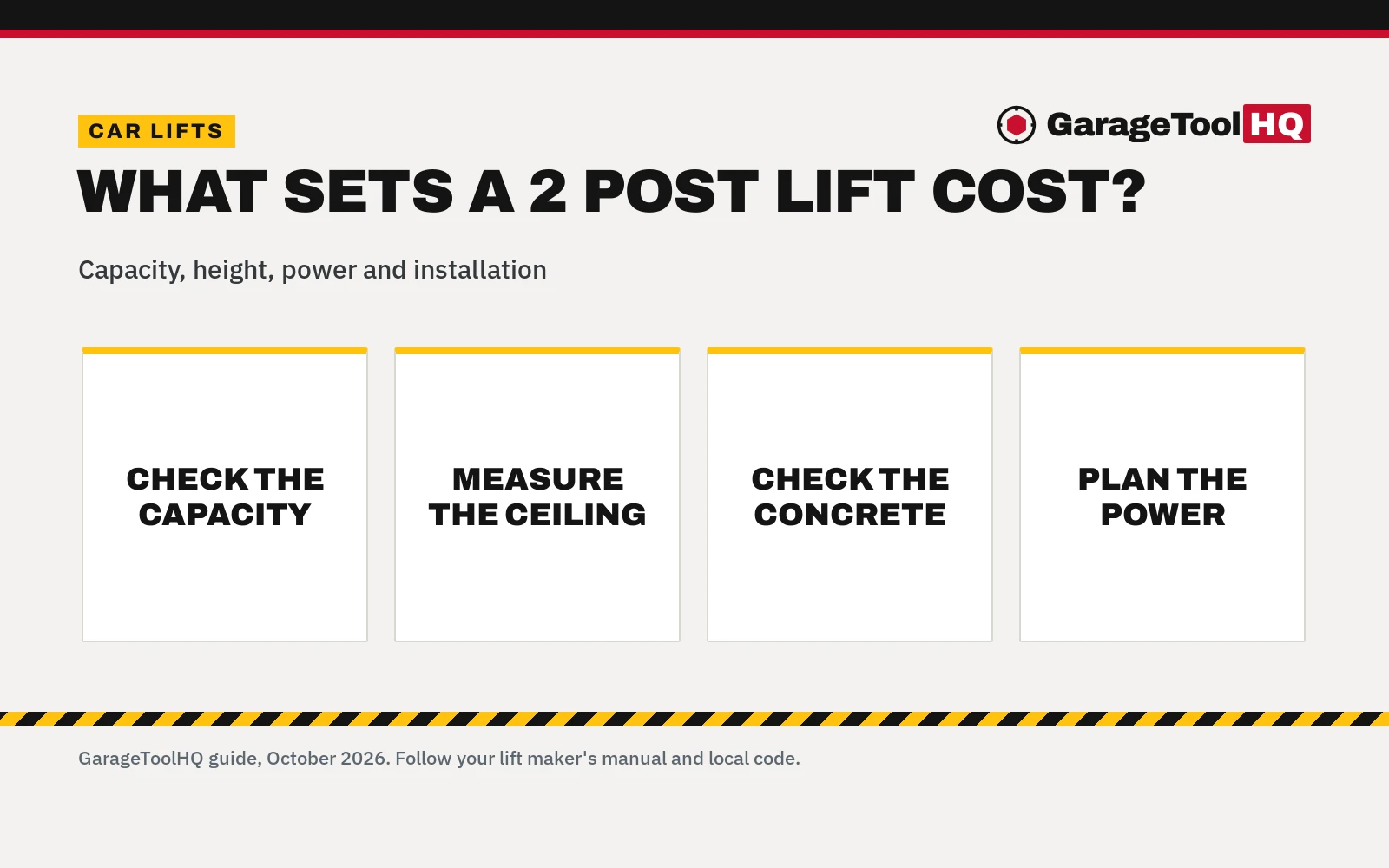
Below: what moves the cost, the capacities and heights the makers list, and a checklist to run before you order.
2 post lift cost: what sets the figure
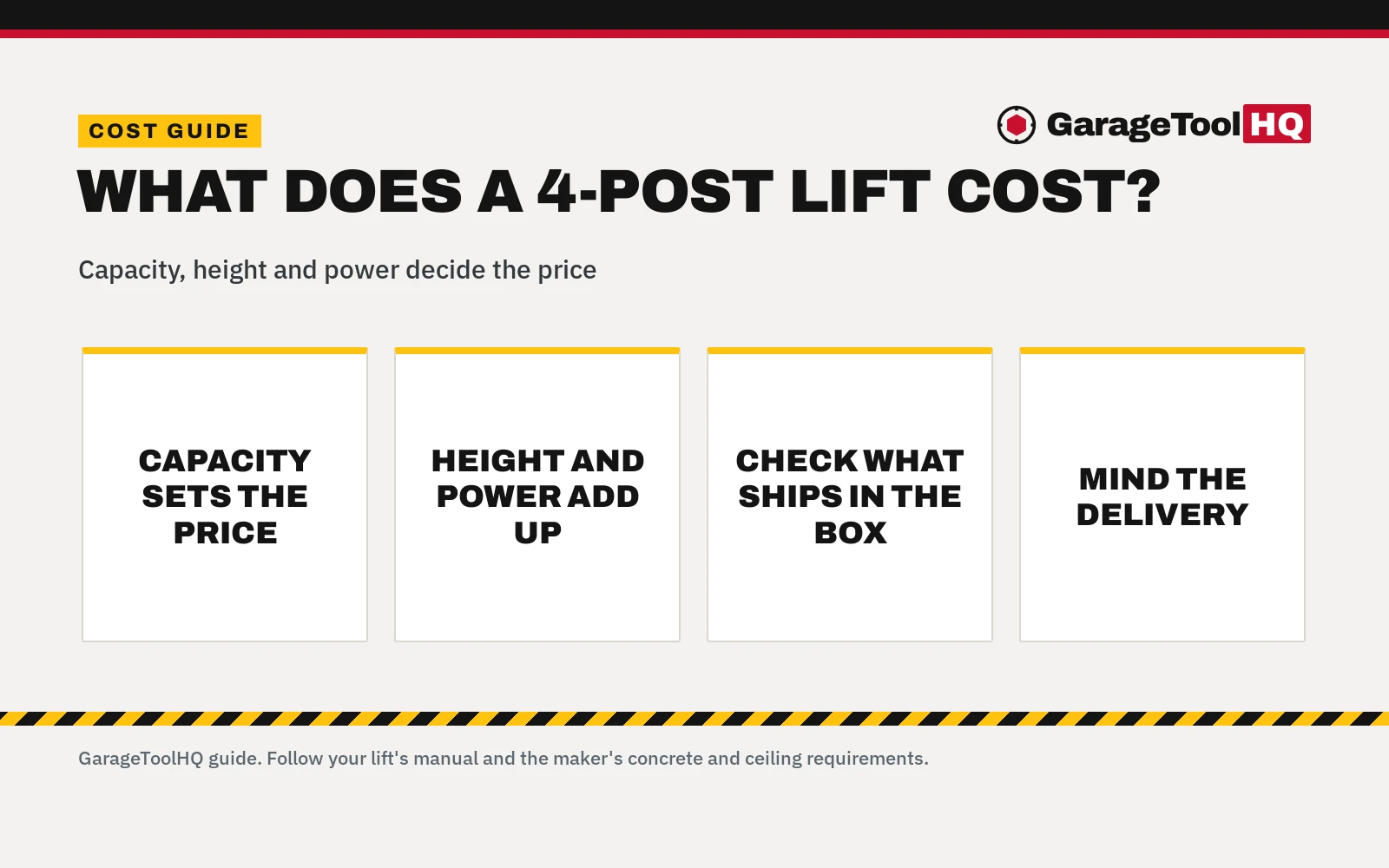
A 2 post lift is a pair of columns with arms that pick a vehicle up by its frame or lift points, and the cost follows the size of the job it can do. The reference lifts here range from 8,000 lbs to 13,000 lbs of capacity, with motors rated at 3 HP to 4.0 HP or 2.2kW and lifting heights from 55.12 inches to 73 inches. A lift rated for heavy trucks and SUVs costs more than a lift rated for sedans, because the columns, arms, cylinders and motor all grow with the rating. The table below lines up the figures.
| Lift | Capacity | Max lifting height | Motor |
|---|---|---|---|
| Albott 8,000 lb lift | 8,000 lbs | 55.12 in | 3 HP |
| AUTOKATO AM120SD | 12,000 lbs | 70.87 in | 4.0 HP |
| KATOOL 11,000 lb lift | 11,000 lbs | 70.75 in | 4.0 HP |
| KATOOL M120 12,000 lb lift | 12,000 lbs | 73 in | 4 HP |
| KATRAX ME-LM110S | 11,000 lbs | 70.75 in | 2.2kW |
Power and installation sit on top of the lift itself. Most reference lifts run on a 220V motor, and the XK lift lists a 30A minimum circuit breaker current, so the garage needs the right outlet and circuit before the lift arrives. Concrete matters as well: the XK lift calls for 6 inches of concrete at 3500 psi, or 4 inches for vehicles below 9,000 lb. Delivery is part of the job too: the makers that state delivery terms make the buyer responsible for unloading, with a forklift required and terminal pickup as the other option.
Capacity: match the rating to your vehicles
Capacity is the first figure to settle, because it decides which vehicles the lift can pick up. The Albott lift (on Amazon) supports up to 8,000 lbs for sedans, SUVs and pickups. The XK lift is rated at 10,000 lbs for trucks and SUVs. The KATRAX lift (on Amazon) at 11,000 lbs suits trucks, SUVs and commercial vehicles, and the KATOOL 11,000 lb lift covers vehicles from compact cars to heavy SUVs and vans. The AUTOKATO ME-1220-SM at 12,000 lbs suits trucks, SUVs and commercial vehicles with more headroom. The KATOOL ME lift (on Amazon) is rated at 13,000 lbs for heavy trucks and SUVs, and the Kzoo ME-M130 is rated at 13,000 lbs for large rigs and tall vehicles. Never lift more than the rated capacity, and use the lift points in the vehicle owner’s manual for every lift. Size the rating for the heaviest vehicle you plan to work on.
Height and ceiling: measure before you order
Height decides whether the lift fits the garage and whether you can stand under the vehicle. Maximum lifting height across the reference lifts runs from 55.12 inches on the Albott lift to 70.87 inches on the AUTOKATO lift, 70.75 inches on the KATOOL and KATRAX lifts, and 73 inches on the KATOOL M120 (on Amazon). Overall height is a separate figure: the Albott lift stands 92.91 inches tall, while the Kzoo ME-M130 stands 166.73 inches tall and the KATOOL M120 stands 167 inches tall. Measure the ceiling height and compare it with the overall height of the lift you want, not just the lifting height. Minimum heights matter at the other end: the AUTOKATO and KATRAX lifts list a 4.25 inch minimum lifting height, and the XK lift lists a 3-7/8 inch minimum pad height. Passage width is worth a look as well: the Albott lift lists 107.48 inches of passage width, and the Kzoo lift lists 133.46 inches.
Power, concrete and delivery: the rest of the job
The motor is only part of the power story. The Albott lift runs on a 3 HP hydraulic motor at 220V, while the AUTOKATO AM120SD (on Amazon), the KATOOL 11,000 lb, ME and M120 lifts and the Kzoo lift run on 4.0 HP or 4 HP motors at 220V, and the KATRAX and AUTOKATO ME-1220-SM lifts run on 220V motors rated at 2.2kW. The XK lift lists a 30A minimum circuit breaker current. A licensed electrician should install or check the outlet and circuit. Concrete is the other hidden job: the XK lift calls for 6 inches of concrete at 3500 psi, or 4 inches for vehicles below 9,000 lb, and the lift maker’s concrete and ceiling requirements decide whether the floor is ready. Delivery rounds out the cost: on the lifts that state it, the buyer is responsible for unloading, a forklift is required, and terminal pickup is the option when no forklift is on hand. Most reference lifts list a 1 year warranty, and the AUTOKATO AM120SD states no warranty term, so check the warranty on the lift you order.
What to check before you order
- Confirm the capacity. Match the rated capacity to the heaviest vehicle you plan to lift, from 8,000 lbs for sedans, SUVs and pickups up to 13,000 lbs for heavy trucks and SUVs.
- Measure the ceiling. Compare the ceiling height with the overall height of the lift, from 92.91 inches to 167 inches across the reference lifts.
- Check the concrete. The XK lift calls for 6 inches at 3500 psi, or 4 inches for vehicles below 9,000 lb, and the lift maker’s requirements decide the floor.
- Confirm the power. Most lifts run on 220V motors, and the XK lift lists a 30A minimum circuit breaker current, so have a licensed electrician check the outlet and circuit.
- Arrange unloading. On the lifts that state it, the buyer is responsible for unloading and a forklift is required, or arrange terminal pickup instead.
- Read the manual. Follow the lift maker’s manual for setup, lift points and maintenance, and check the warranty term, which is 1 year on most of the reference lifts.
A 2 post lift is not a jack, and the rules are not the same. Never get under a vehicle on a jack alone. Use rated stands on solid level ground, use the lift points in the vehicle owner’s manual, and follow the lift maker’s concrete and ceiling requirements before the first lift.
Check the lift's rated capacity against your heaviest vehicle, and its ceiling and concrete requirements (thickness and strength) before you buy. Install it exactly as the manufacturer specifies, use the mechanical locks before you go under, and look for ALI certification on the model. See the Automotive Lift Institute (ALI). Read our Safety Disclaimer.
2 post lift vs 4 post lift
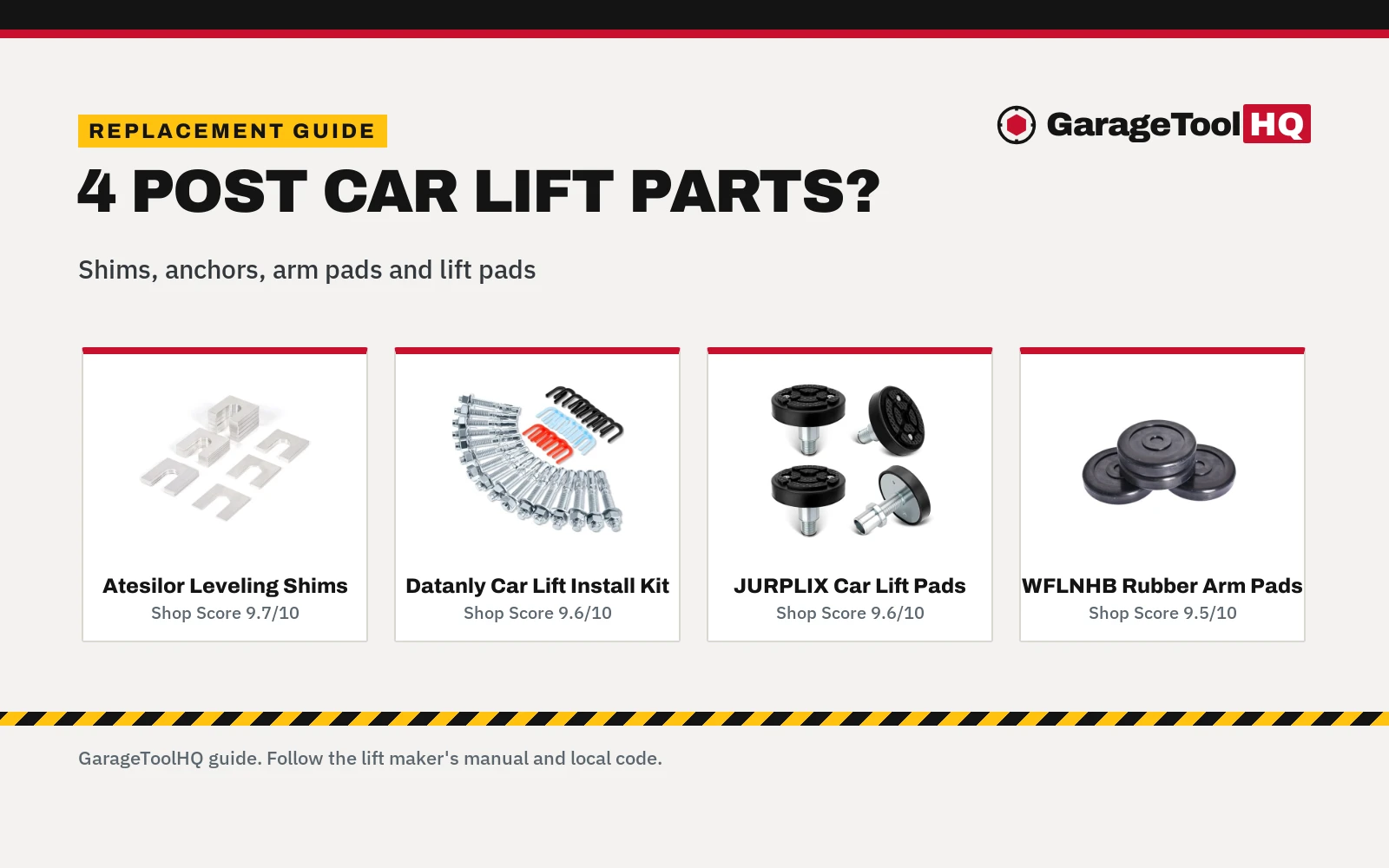
A 2 post lift holds the vehicle by its frame or lift points with the wheels hanging, which suits brake, suspension and driveline work where the wheels need to come off. A 4 post lift drives the vehicle onto runways, which suits storage and quick service where the wheels stay on. See the 2-post vs 4-post lift guide for the full comparison, and the 4 post lift cost guide for what sets the cost on the other side.
FAQ: garage tools
How much capacity do I need for a home garage?
The Albott lift at 8,000 lbs covers sedans, SUVs and pickups, which is enough for many home garages. Trucks and heavier SUVs call for the 10,000 lb, 11,000 lb, 12,000 lb or 13,000 lb ratings in the reference set. Size the rating for the heaviest vehicle you plan to lift, and never lift more than the rated capacity.
How tall does my ceiling need to be?
It depends on the lift. Overall height runs from 92.91 inches on the Albott lift to 166.73 inches on the Kzoo lift and 167 inches on the KATOOL M120. Measure the ceiling height and compare it with the overall height of the lift you want, then check the maximum lifting height, from 55.12 inches to 73 inches, for working room underneath.
What power does a 2 post lift need?
Most reference lifts run on 220V motors, from 3 HP on the Albott lift to 4.0 HP or 4 HP on the larger lifts, and 2.2kW on the KATRAX and AUTOKATO ME-1220-SM lifts. The XK lift lists a 30A minimum circuit breaker current. A licensed electrician should install or check the outlet and circuit.
What concrete does a 2 post lift need?
The XK lift calls for 6 inches of concrete at 3500 psi, or 4 inches for vehicles below 9,000 lb. Concrete needs vary by lift, so follow the lift maker’s concrete and ceiling requirements for the model you order.
Do I need a forklift to receive a lift?
Where the maker states delivery terms, yes, unless you arrange terminal pickup. The buyer is responsible for unloading, a forklift is required, and the makers offer pickup at a local terminal when no forklift is on hand. If the lift arrives damaged, photograph it, contact the maker and mark damaged on the receipt.
What does installation add to the cost?
Installation adds delivery and unloading, concrete work where the floor needs it, electrical work for the circuit the lift needs, and assembly of the columns and arms. The listings give no installation figure, so get the scope in writing from the installer before you order.
Related: car lifts, our 2-post vs 4-post lift guide, how to use a 2 post lift, and the 4 post lift cost guide.