Can Air Compressors Explode? What You Need to Know
How air compressor explosions happen, why internal tank rust and stuck relief valves cause ruptures, and how to inspect your compressor to stay safe.

On this page
Top picks at a glance
As an Amazon Associate we earn from qualifying purchases.
- 1
 Stealth Air Compressor 2 Gallon9.7/10View on Amazon
- 2
 Ingersoll Rand P1.5IU-A9 2 HP Single-Stage Air Compressor9.7/10View on Amazon
- 3
 Campbell Hausfeld 80-Gallon Vertical Electric Air Compressor9.7/10View on Amazon
You are halfway through a Saturday tire rotation, running an impact wrench on stubborn lug nuts, when the compressor kicks on with a rattle. Looking over at the steel tank, the question hits: can air compressors explode? Yes, air compressors can explode if severe internal rust compromises the steel tank, or if a faulty pressure switch keeps pumping while the relief valve fails to open. While catastrophic ruptures are rare with proper maintenance, compressed air stores tremendous energy that can tear through weakened metal. Here is how rust develops, how safety valves protect you, and how to keep your shop safe.
GarageToolHQ earns a commission when you buy through links on our product pages, at no extra cost to you. Read our affiliate disclosure.
Below: why compressor tanks rupture, how relief valves prevent overpressure, and an inspection checklist for your garage.
Can air compressors explode? Where the risk comes from
An air compressor does not explode like fuel vapors. Instead, it suffers a mechanical rupture when stored pneumatic energy exceeds the strength of the steel vessel. Compressing atmospheric air concentrates moisture, heat, and pressure inside the tank. Primary hazards include:
- Internal tank rust. Air drawn into the pump carries humidity. As air cools inside the receiver, water condenses and pools along the bottom. This moisture reacts with bare steel, creating rust pits that eat away wall thickness from within until the shell can no longer hold operating pressure.
- Pressure switch failure coupled with a stuck relief valve. The pressure switch cuts motor power at cutoff pressure. If its contacts weld shut, the pump runs continuously. Normally, the mechanical relief valve vents this excess air safely. However, if the relief valve is stuck shut or corroded, pressure climbs beyond design limits toward the burst threshold.
- Seized safety relief valve. Every receiver relies on a spring-loaded brass pop-off valve as a mechanical fail-safe. If corrosion or dirt glues the valve shut, the system loses its emergency overpressure protection.
- Unauthorized welding or modifications. Pressure vessels are engineered and heat-treated under strict standards. Drilling holes or welding over rust spots alters the metallurgy, creating brittle zones that can split violently under pressure cycling.
- Mechanical impact and metal fatigue. Heavy dents from dropped equipment or years of cyclic expansion weaken the welded seams over time.
Air compressor tank designs and safety pressure ratings
| Compressor type and model | Tank capacity and material | Maximum pressure | Pressure relief and safety design |
|---|---|---|---|
| DEWALT stationary vertical | 60 gallons, ASME certified steel tank | 175 PSI | Safety relief valve, automatic pressure shut-off |
| VEVOR portable workshop | 15 gallons, Q235B structural steel | 125 PSI | Automatic pressure relief protection, overheating shut-off |
| RyanTek portable vertical | 15 gallons, alloy steel | 125 PSI | Mechanical safety valve, twin-cylinder pump |
| Baococo compact wheeled | 3 gallons, alloy steel | 115 PSI | Automatic shut-off, sealed pressure vessel |
| VELPAX quiet portable | 2.4 gallons, oil-free pump | 115 PSI | Safety valve opens at 128 PSI (0.88 MPa), overload protection |
| CRAFTSMAN portable tire inflator | Direct drive without storage tank | 150 PSI | Digital gauge with automatic shut-off |
The manufacturer ratings above show how relief systems match each unit design. The stationary DEWALT 60-gallon compressor uses an ASME certified tank built for 175 PSI. Portable garage units like the VEVOR 15-gallon and RyanTek 15-gallon models list a maximum pressure of 125 PSI using structural steel and safety valves. Compact Baococo 3-gallon and VELPAX 2.4-gallon models list 115 PSI maximum working pressure. Notably, the VELPAX listing states its emergency safety valve opens at 128 PSI (0.88 MPa), showing how relief valves protect the tank above working limits. Direct-drive units like the CRAFTSMAN 150 PSI inflator pump straight into tires without a storage vessel, eliminating tank rupture hazards entirely.
How to inspect and maintain an air compressor safely: the checklist
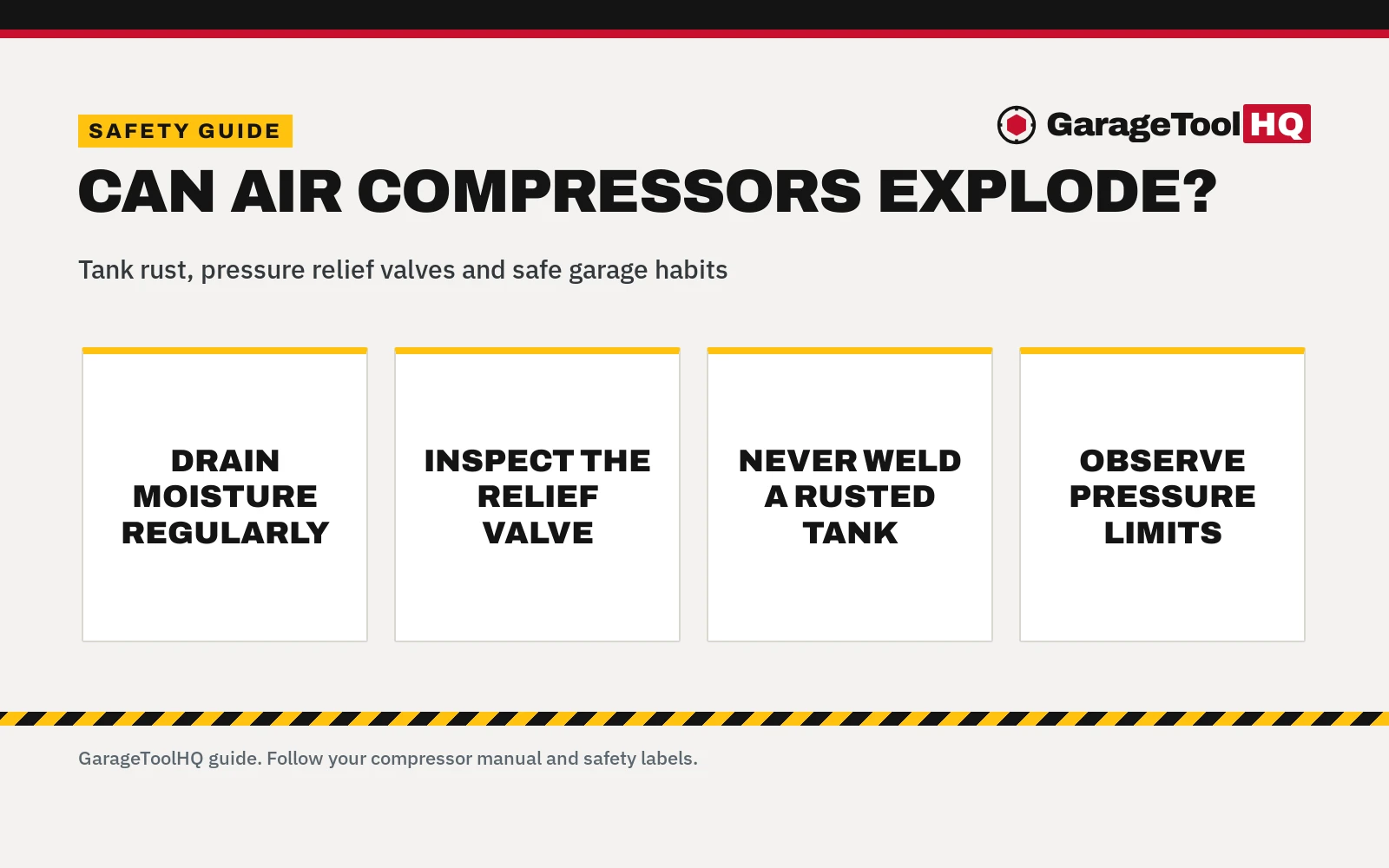
- Drain accumulated tank moisture regularly. Condensation is the primary cause of tank failure. Open the bottom drain valve after each garage session to blow out water and rust silt before it settles along the bottom seam.
- Inspect the safety relief valve manually. With the tank depressurized or at low pressure, pull the brass valve ring. The stem should move smoothly and snap closed. Replace any valve that is stuck or corroded.
- Confirm automatic shut-off at cutoff pressure. Watch the gauge as the pump fills from empty. Ensure the motor cuts off at the rated limit, such as 115 PSI on the Baococo or 175 PSI on the DEWALT.
- Inspect the tank shell for rust and bubbling paint. Check the belly and base weld seams. Blistering paint, flaking scale, or damp weeping along a weld indicates severe thinning and an immediate structural hazard.
- Never weld, solder, or drill a receiver tank. Welding destroys the steel temper and creates brittle spots prone to sudden failure. A leaking or cracked pressure vessel cannot be repaired; discard it.
- Keep air intake filters clean and clear. Drawing dust or paint overspray into the pump fouls internal valves, restricts airflow, and drives up operating temperatures.
- Check hoses and fittings for pressure ratings. Verify that all air hoses, quick couplers, and regulators are rated to meet or exceed compressor cutoff pressure.
- Depressurize the system before storage. Do not leave a compressor fully pressurized for weeks. Vent stored air and turn off power when work wraps up.
If a safety relief valve vents air, never plug or cap it. The valve is protecting the vessel because the pressure switch failed or pressure spiked. Replace faulty switches or relief valves with parts matching maker specifications.
Drain the tank after use so water does not rust it from the inside, never exceed the tool's rated pressure, wear eye protection, and run 240V units on the circuit the manual calls for. Do not run a gas engine compressor in a closed garage. Read our Safety Disclaimer.
Oil-free vs oil-lubricated compressor safety
Comparing pump designs helps you manage garage safety and maintenance:
- Crankcase lubrication and oil mist: Oil-lubricated compressors require regular oil level checks. As piston rings wear, oil vapor can enter the air stream. Oil-free designs, including MZB and VELPAX models, eliminate crankcase oil and avoid oil mist entirely.
- Condensation and moisture management: Both designs compress ambient air and generate tank condensation as hot discharge air cools. Regular draining remains necessary for both to prevent bottom rust.
- Operating noise levels: Loud machinery masks warning sounds like air leaks. Reference listings show varying sound levels: RyanTek 15-gallon lists 66 dB, Baococo 3-gallon and MZB list 70 dB, and DEWALT 60-gallon lists 70 dB. The MZB listing notes standard shop compressors typically run 80 to 90 dB.
- Routine maintenance: Oil-lubricated pumps require oil changes, while oil-free units eliminate oil upkeep. Both require regular moisture draining, intake cleaning, and relief valve checks.
Explore pump configurations in our guide to oil-free vs oil-lubricated air compressors. To maintain your equipment, read our guide to air compressor maintenance or compare shop units in our roundup of the best air compressors for home garages.
Never use PVC pipe for compressed air lines
A dangerous mistake in home garages is running PVC plumbing pipe for compressed air distribution. PVC is rated for liquid plumbing, not compressed gas. Water is incompressible, so a burst water line simply cracks. Air compresses under high pressure and stores massive energy. When pressurized PVC cracks, it shatters into flying plastic shrapnel.
Compressor heat and trace oils also degrade PVC, accelerating brittleness. Always plumb air distribution lines with materials rated for compressed air, such as black iron pipe, copper, or certified aluminum piping. For installation practices, read our guide on how to plumb compressed air lines in a garage.
Frequently Asked Questions
Can an air compressor explode without warning?
Rarely. Internally corroded tanks usually give warning signs, such as brown drainage water, paint bubbling along lower weld seams, or pinhole air leaks. Retiring tanks when these signs appear prevents ruptures.
Can a small portable air compressor explode?
Yes. Any steel pressure vessel can rupture if rust thins the shell or emergency relief fails. For example, Baococo 3-gallon and VELPAX 2.4-gallon units operate at 115 PSI. Moisture left inside a small tank causes rust just as quickly as in a large tank.
What does an air compressor safety valve do?
The safety relief valve is a mechanical fail-safe that prevents overpressure if the pressure switch fails. The spring-loaded valve pops open to vent excess air. On VELPAX, for example, it is calibrated to open at 128 PSI (0.88 MPa) to protect the 115 PSI vessel.
How do I know if my air compressor tank is rusting inside?
Look for brown, muddy water from the drain valve, flaking paint, or weeping moisture along the lower weld seams. A hissing pinhole leak means the wall has rusted through; retire the vessel immediately.
Can you weld or patch a leaking air compressor tank?
No. Never weld or patch a leaking tank. Heat destroys the structural temper of the steel, creating brittle zones that crack under pressure. A leaking pressure vessel must be replaced.
Does draining water really prevent an air compressor from exploding?
Yes. Draining moisture removes the pool of water that causes internal rust. Purging the tank after each session keeps the vessel sound. Follow our guide on how to drain water from an air compressor tank.
Related: our guide to air compressor maintenance, common air compressor problems and solutions, our main air compressors hub, and how to choose an air compressor. If your unit struggles to build pressure, see why an air compressor does not build pressure.