Best Heavy Duty Bench Vise: 4 Workshop Vises Compared (2026)
Four heavy duty bench vises for garage workshops, compared by jaw width, opening, throat depth, clamping force, ductile iron build and warranty terms.

On this page
Top picks at a glance
As an Amazon Associate we earn from qualifying purchases.
- 1
 Best OverallWilton 880M9.7/10View on Amazon
- 2
 Best Reversible ViseWilton 4800R9.7/10View on Amazon
- 3
 Best Clamping ForceForward CR60A9.6/10View on Amazon
- 4
 Best Rotating HeadForward DT08125A9.5/10View on Amazon
- 5
 Forward 30608 8 Inch Bench Vise Heavy Duty with Anvil andView on Amazon
- 6
 VEVOR Bench ViseView on Amazon
- 7
 VEVOR Bench Vise 8 Inch Jaw Width Multipurpose withView on Amazon
- 8
 Wilton Utility Bench ViseView on Amazon
- 9
 4.5" Heavy Duty Bench Vise with 270° Swivel Locking BaseView on Amazon
- 10
 WORKPRO Bench ViseView on Amazon
When pressing stubborn U-joints out of a driveshaft, bending steel bracket stock, or clamping a seized suspension strut on the workbench, a lightweight vise just flexes or cracks. Finding the best heavy duty bench vise means choosing a model with the jaw width, opening capacity, throat depth and ductile iron strength to hold heavy work without slipping. This guide compares four heavy duty bench vises across jaw dimensions, clamping force, swivel base versatility and warranty coverage.
GarageToolHQ earns a commission when you buy through links on this page, at no extra cost to you. Read our affiliate disclosure.
Quick picks
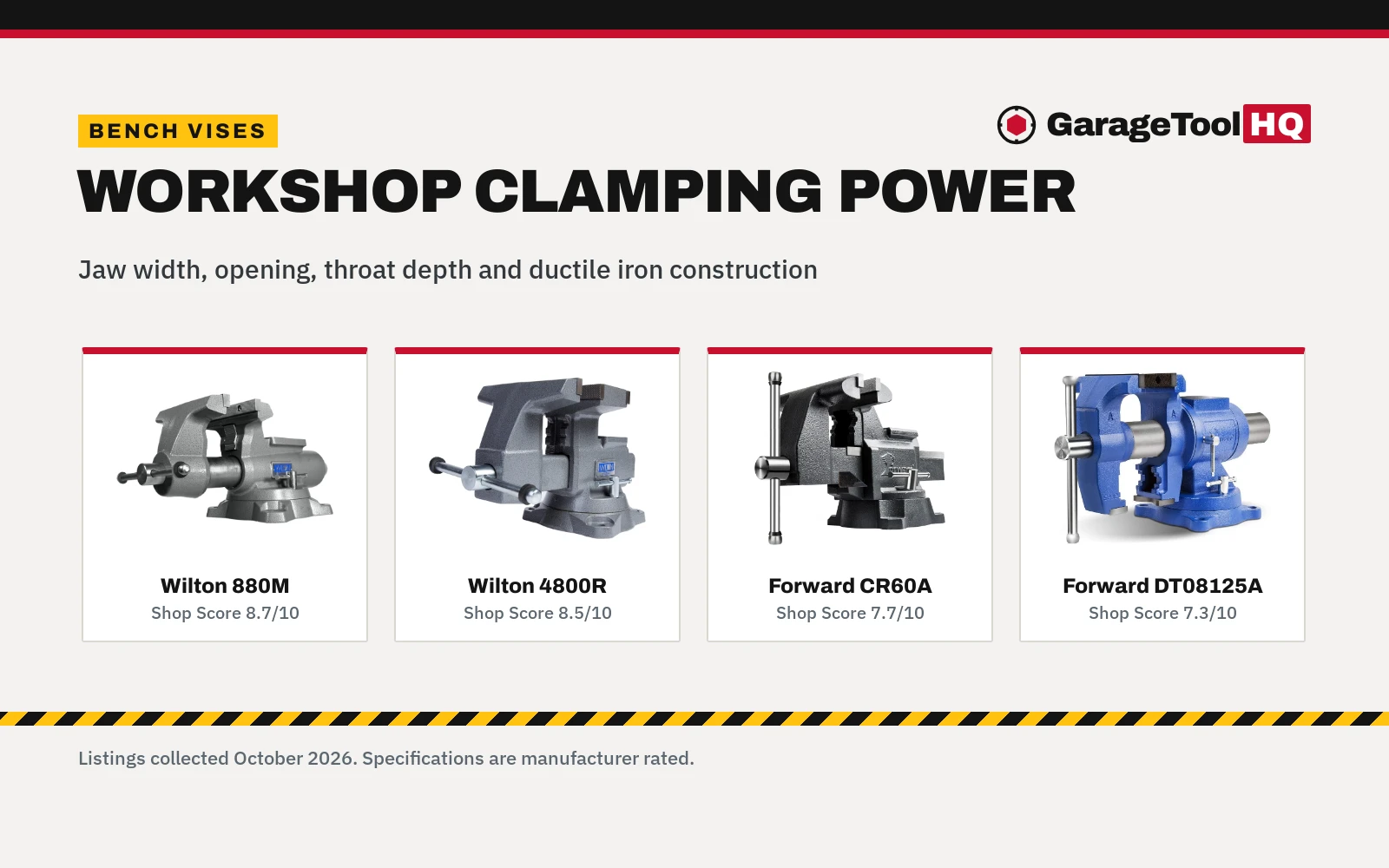
- Best Overall Wilton 880M: 8 in jaw width, 8-1/2 in opening, 4-1/2 in throat depth, 60,000 psi ductile iron build and lifetime warranty. Check price on Amazon
- Best Reversible Vise Wilton 4800R: Reversible jaw opening to 14-1/2 in, 8 in jaw width, 4-3/4 in throat depth, two anvils and lifetime warranty. Check price on Amazon
- Best Clamping Force Forward CR60A: 9,900 lbs clamping force, 6.5 in jaw width, 6 in jaw opening, 3.8 in throat depth and 60,000 psi ductile iron. Check price on Amazon
- Best Rotating Head Forward DT08125A: 360-degree rotating head and swivel base, 5 in jaw width and opening, 3 jaw sets and 5,500 lbs clamping force. Check price on Amazon
The picks

Wilton Mechanics Pro Bench Vise, 8" Jaw Width
An 8 in mechanics vise made from 60,000 psi ductile iron with an 8-1/2 in jaw opening, 4-1/2 in throat depth, enclosed spindle and lifetime warranty.
Pros
- 8 in jaw width with 8-1/2 in max jaw opening
- 60,000 psi ductile iron movable jaw and base
- Enclosed spindle and needle roller thrust bearing
- Manufacturer lifetime warranty against defects
Cons
- Spec table contradicts title on jaw width and opening
- Clamping force in pounds is not stated
- Heavy at 83.1 lbs item weight
- Spec table shows net weight of 31.0 lbs

Wilton Reversible Bench Vise, 8" Jaw Width
A reversible 8 in bench vise featuring an 8 in jaw width, 9-1/4 in normal opening expanding to 14-1/2 in reversed, dual anvils and a lifetime warranty.
Pros
- Reversible jaw opens to 14-1/2 in (9-1/4 in normal)
- 8 in jaw width with 4-3/4 in throat depth
- Two large anvil work surfaces for shaping
- Manufacturer lifetime warranty against defects
Cons
- Spec table contradicts title on jaw width and opening
- Clamping force in pounds is not stated
- Heavy at 74.5 lbs item weight
- Spec table lists net weight of 48.7 lbs

Forward CR60A 6.5 Inch Bench Vise Heavy Duty
A 6.5 in heavy duty bench vise made from 60,000 psi ductile iron delivering 9,900 lbs of clamping force, a 3.8 in throat depth and 210-degree swivel base.
Pros
- 9,900 lbs clamping force
- 6.5 in jaw width with 6 in jaw opening
- 60,000 psi ductile iron construction
- Built-in pipe jaws handle 1/2 to 3 1/2 in pipe
Cons
- No warranty term is stated
- Spec table mislabels clamping force as tensile strength
- Swivel base rotates 210 degrees rather than 360
- Spec table gives weight only as 18.42 kg
Forward DT08125A 5 Inch Heavy Duty Bench Vise
A 5 in multi-purpose bench vise made from 60,000 psi ductile iron with a 360-degree swivel base and rotating head, 3 jaw sets and 5,500 lbs clamping force.
Pros
- 360-degree swivel base and 360-degree rotating head
- 3 sets of jaws including pipe and V-jaws
- 60,000 psi ductile iron body
- Mounting bolts included in the package
Cons
- No warranty term is stated
- Spec table mislabels clamping force as tensile strength
- Throat depth is relatively shallow at 2.6 in
- 5,500 lbs clamping force is lowest in this group
More options to compare
 Forward 30608 8 Inch Bench Vise Heavy Duty with Anvil andCheck price on Amazon
 VEVOR Bench ViseCheck price on Amazon
 VEVOR Bench Vise 8 Inch Jaw Width Multipurpose withCheck price on Amazon
 Wilton Utility Bench ViseCheck price on Amazon
 4.5" Heavy Duty Bench Vise with 270° Swivel Locking BaseCheck price on Amazon
 WORKPRO Bench ViseCheck price on Amazon
Compare the picks
| Model | Shop Score | Jaw Width | Jaw Opening | Throat Depth | Clamping Force | Swivel Base | Warranty |
|---|---|---|---|---|---|---|---|
| Wilton 880M | 9.7/10 | 8 in | 8-1/2 in | 4-1/2 in | Not stated | 360 degrees | Lifetime |
| Wilton 4800R | 9.7/10 | 8 in | 9-1/4 in (14-1/2 in reversed) | 4-3/4 in | Not stated | 360 degrees | Lifetime |
| Forward CR60A | 9.6/10 | 6.5 in | 6 in | 3.8 in | 9,900 lbs | 210 degrees | Not stated |
| Forward DT08125A | 9.5/10 | 5 in | 5 in | 2.6 in | 5,500 lbs | 360 degrees | Not stated |
Specifications are manufacturer rated, as published on each listing and collected 12 October 2026. Where a listing contradicts itself, both figures are shown.
How we scored them
Each vise is scored out of 10 on performance, build, value, safety and warranty, with the weights published on our How We Pick page. None of these listings states a third-party safety certification, so all score zero on safety. The two Wilton models earn points for their stated manufacturer lifetime warranties, while the Forward listings do not state a warranty term.
| Product | Shop Score | Perf. /35 | Build /25 | Value /25 | Safety /10 | Warranty /5 |
|---|---|---|---|---|---|---|
| Wilton 880M | 9.7 | 32 | 22 | 20 | n/a | 5 |
| Wilton 4800R | 9.7 | 30 | 21 | 20 | n/a | 5 |
| Forward CR60A | 9.6 | 29 | 20 | 20 | n/a | 0 |
| Forward DT08125A | 9.5 | 27 | 19 | 20 | n/a | 0 |
Scores run from 9.2 to 9.8: each product’s point total is placed on that range, so more points always means a higher score. Safety counts only for powered gear or where the listing states safety features; where it does not apply, the score is taken over the remaining 90 points.
What the listings tell you
We examined these bench vise listings closely. Both Wilton listings publish stated lifetime warranties against manufacturing defects, while neither Forward listing states a warranty term. Ductile iron with 60,000 psi tensile ratings is featured across all four models, but only Forward lists concrete clamping force numbers: 9,900 lbs on the CR60A and 5,500 lbs on the DT08125A. Both brands exhibit internal listing contradictions in their spec tables, where Amazon data contradicts the primary listing title regarding jaw dimensions or tensile strength.
Buying guide: best heavy duty bench vise
Jaw width and opening capacity
Jaw width determines the contact area on your workpiece, while opening capacity sets the maximum size of stock you can clamp. A 5 in jaw width handles typical automotive brackets and steering links, whereas a 6.5 in or 8 in jaw width provides the surface area needed for wide truck components and heavy structural steel. If you regularly clamp wide assemblies, consider a reversible front jaw design that can expand opening capacity up to 14-1/2 in.
Throat depth and anvil size
Throat depth measures the distance from the top of the jaws to the top of the slide bar beneath them. A deeper throat, such as 3.8 in to 4-3/4 in, lets you position tall parts lower between the jaws for greater stability during cutting or grinding. A shallow throat of 2.6 in requires clamping work higher up, increasing leverage against the jaws. An integrated anvil surface provides a flat striking area for straightening cotter pins, flattening sheet metal tabs, or tapping small pins.
Ductile iron versus gray cast iron
Ductile iron is significantly stronger and more impact-resistant than conventional gray cast iron. All four vises reviewed here utilize ductile iron with a 60,000 psi tensile strength rating. The nodular graphite structure of ductile iron allows the metal to absorb heavy blows from a shop hammer without cracking, making it the preferred casting material for demanding automotive repair and metal fabrication.
Swivel base and head rotation
A swivel base lets you rotate the vise body to align long pipes or awkward workpieces with the clear space in your shop. Swivel ranges of 210 degrees or 360 degrees are common. Dual lockdown handles are essential on heavy vises to prevent the base from creeping under heavy torque. For maximum positioning flexibility, a model with both a 360-degree swivel base and a 360-degree rotating head allows you to orient specialized pipe or V-jaws at any angle.
Mounting to a sturdy workbench
A heavy duty vise is only as rigid as the workbench beneath it. These vises weigh between 33 lbs and 83.1 lbs and can generate 5,500 to 9,900 lbs of clamping force. Mount the vise over a sturdy leg or reinforced corner of your bench using high-strength through-bolts with large backing washers. For further shop mounting options, see our guide to bench vises for garages and our overview of work benches with vises.
Garage Fit Check
- Bench footprint and weight support: The Wilton 880M measures 23.6 x 12.6 x 12.6 inches and weighs 83.1 pounds, while the Wilton 4800R measures 22.8 x 11 x 11.8 inches and weighs 74.5 pounds; ensure your workbench top and legs can support 74.5 to 83.1 pounds of dead weight plus heavy striking forces.
- Mounting hardware: The Forward DT08125A lists mounting bolts included in the package, whereas the Wilton and Forward CR60A listings include only the vise; verify mounting hole spacing and bolt diameter on your bench before drilling.
- Swivel base clearance: Forward CR60A provides a 210-degree swivel base, while the Forward DT08125A and Wilton models offer 360-degree rotation with dual lockdowns; leave clear bench space around the vise to turn the locking levers freely.
- Jaw and spindle inspection: Check that the replaceable serrated jaws, pipe jaws (handling 1/8 to 3 1/2 in pipe across models) and spindle slide smoothly; verify front jaw alignment and lockdown engagement before starting heavy work.
Use rated jack stands on solid ground, wear eye protection with power and air tools, keep fuel-burning equipment out of a closed garage, and follow the manual for every tool. Read our Safety Disclaimer.
Frequently Asked Questions
What is the best bench vise?
The best bench vise depends on the work you tackle. For heavy shop fabrication, mechanics and truck repairs, an 8 in vise made from 60,000 psi ductile iron like the Wilton 880M or Wilton 4800R provides massive jaw openings, deep throats and lifetime backing. For general garage clamping and welding, a 6.5 in model like the Forward CR60A delivers high 9,900 lb clamping force at a lower weight.
What size bench vise is best for home use?
For most home garages and DIY automotive work, a vise with a 5 to 6.5 in jaw width, 5 to 6 in jaw opening, and at least 2.6 to 3.8 in of throat depth handles common tasks like holding suspension parts, cutting exhaust pipe and pressing bushings. Vises with 8 in jaws are suited for heavy truck components and large fabrication.
How to fix a bench vise?
Common bench vise maintenance involves cleaning metal shavings from the slide bar, lubricating the acme screw or enclosed spindle with clean grease, and checking that the swivel base lockdown bolts are tight. If the jaw faces become worn, replace the top jaw inserts using their mounting screws.
What is the difference between ductile iron and cast iron in a bench vise?
Standard gray cast iron is rigid but brittle, meaning it can crack or shatter under sudden hammer strikes or extreme clamping pressures. Ductile iron, rated at 60,000 psi tensile strength in these models, contains nodular graphite that allows the metal to flex slightly without fracturing, making it far better suited for heavy pounding on the anvil.
Why do some vises have built-in pipe jaws?
Built-in pipe jaws sit below the main flat jaws and feature curved, serrated profiles designed to grip round stock and tubing securely without slipping or crushing. Across these models, pipe jaw capacities range from 1/8 in up to 3 1/2 in pipe diameter.
Related: our engine and shop equipment hub, the best bench vise for garage, our best bench vise size guide and our bench vise types guide. Also see our work bench with vise. Also see our best bench grinder for garage. Also see our best mobile workbench for garage. Also see our small workbench for garage. Also see our best engine stand. Also see our best parts washer for home garage. Also see our best parts cleaner for parts washer. Also see our best low speed bench grinder. Also see our best bench grinder wheels. Also see our best bench grinder stands.