Forced Air vs Radiant Heater: Which One Should You Buy?
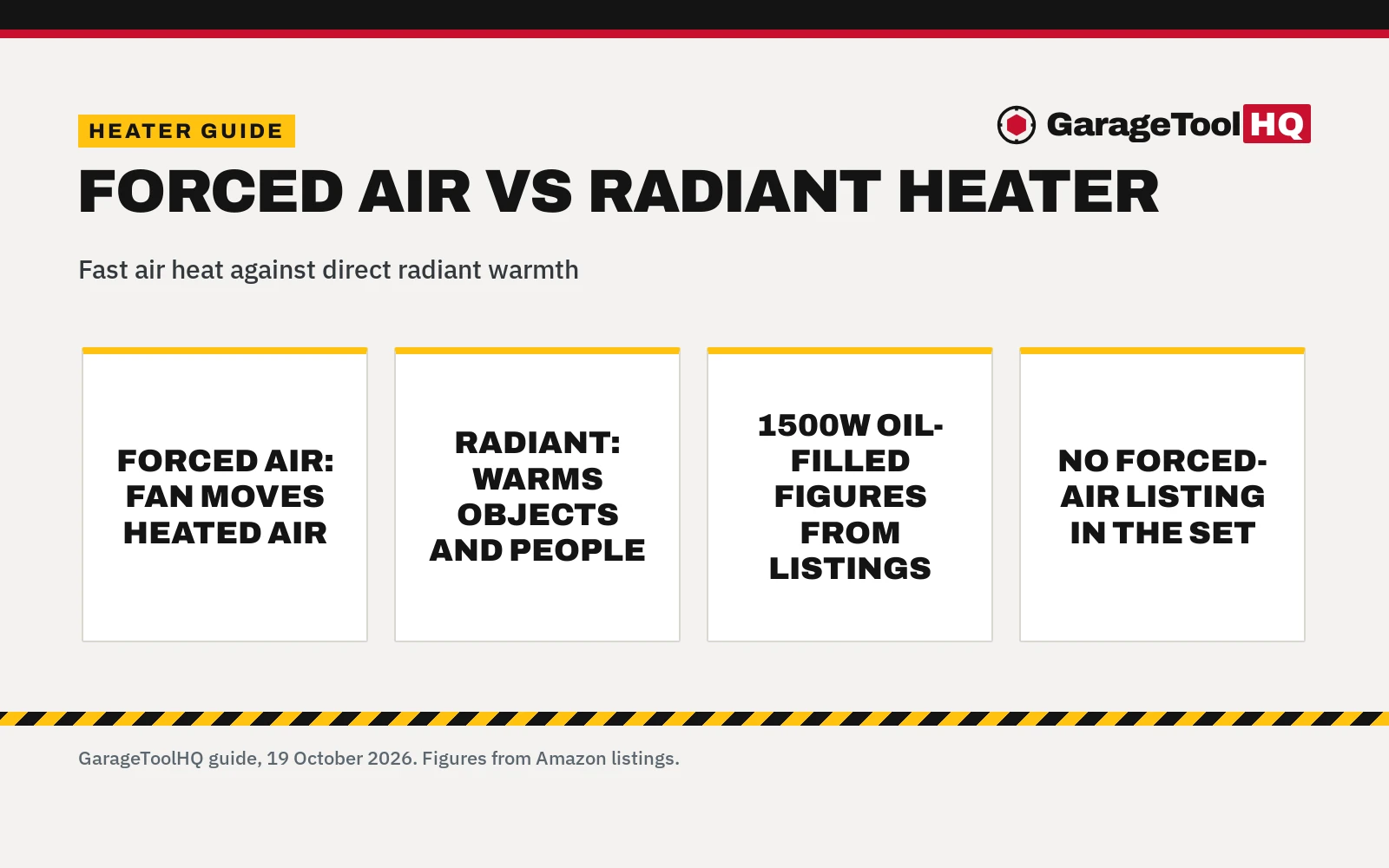
Forced air vs radiant heater for a garage: fan-driven heat warms the air fast while oil-filled radiators warm you directly, with 1500W radiant figures from the listings.

On this page
Top picks at a glance
As an Amazon Associate we earn from qualifying purchases.
- 1
 Mr. Heater 809.7/10View on Amazon
- 2
 Mr. Heater 99.7/10View on Amazon
- 3
 BILT HARD 859.7/10View on Amazon
- 4
 Mr. Heater 50View on Amazon
- 5
 Dura Heat EUH1465 Electric Forced Air Heater with PivotingView on Amazon
- 6
 Remington LP Forced Air HeaterView on Amazon
- 7
 Dura Heat Electric Forced Air HeaterView on Amazon
- 8
 BILT HARD 125View on Amazon
- 9
 Flame King 60View on Amazon
Forced air vs radiant heater comes down to what gets warm first. A forced-air heater blows air across a heating element, so it warms the garage air fast but stores little heat itself once the fan stops. A radiant heater warms objects and people directly, so it feels warm where you stand even before the room air catches up. Work in one spot and radiant is the comfortable pick; want the whole air volume warm quickly and forced air gets there first. The listings here cover the radiant side only, four oil-filled electric radiators, so the forced-air side below is explained from how those heaters work, without listing figures.
More options to compare
 Mr. Heater 50Check price on Amazon
 Dura Heat EUH1465 Electric Forced Air Heater with PivotingCheck price on Amazon
 Remington LP Forced Air HeaterCheck price on Amazon
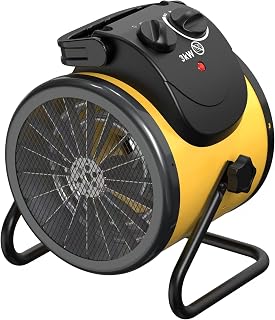 Dura Heat Electric Forced Air HeaterCheck price on Amazon
 BILT HARD 125Check price on Amazon
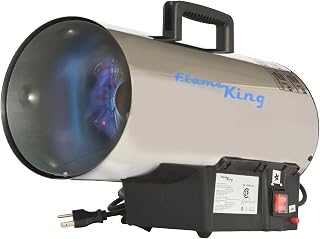 Flame King 60Check price on Amazon
GarageToolHQ earns a commission when you buy through links on this page, at no extra cost to you. Read our affiliate disclosure.
Forced air vs radiant heater: how they heat differently
An electric forced-air heater is a heating element plus a fan. The fan pushes room air across the element and throws warm air into the space, which raises the air temperature quickly while the fan runs. Turn it off and the heat stops with the fan. The fan makes noise and stirs dust, and on fuel-burning types the combustion needs a steady supply of fresh air.
A radiant oil-filled heater is a sealed column of oil warmed by an electric element. The hot surface radiates heat to whatever faces it: you, the workbench, the floor. There is no fan, so it runs silent and stirs nothing. The trade is speed: the oil takes time to heat and the room air warms slowly, but the surface stays warm after the element cycles off, which the Amazon Basics listing notes as heat retained after shutoff.
| Type | How it heats | Feel and noise | From the listings |
|---|---|---|---|
| Forced air, electric | Fan blows air across an element | Fast air warm-up; fan noise; air cools when off | No forced-air listings in this set |
| Forced air, fuel (torpedo) | Burns fuel, blows the hot air out | Very fast heat; loud; needs ventilation | No fuel listings in this set |
| Radiant oil-filled, electric | Heated oil radiates to objects and people | Silent; slow air warm-up; warmth lingers | 1500W; ETL-listed on the DREO and Amazon Basics |
What the listings show on the radiant side
All four radiant listings are 1500W electric oil-filled radiators on 120-volt or 110-volt power. The two De’Longhi models state 12.5 amps, 3-year warranties, thermal cut-off and an anti-freeze setting that switches the heater on at 41 degrees F; the Dragon adds a 24-hour timer, child lock and a 23-foot cable. The DREO states 1500W with 600 and 900W modes, ETL listing, tip-over and overheat protection, a 24-hour timer, remote control and 250 sq. ft. of coverage at 17.6 pounds. The Amazon Basics states the same three power modes, ETL listing with tip-over and overheat protection, 7 fins and 150 sq. ft. of coverage at 15.4 pounds.
Two things stand out for garage use. First, silence: every one of these runs without a fan, which matters if the garage doubles as a workshop where you want to hear yourself think. Second, the safety list is long on the two ETL-listed models: tip-over and overheat protection on both, with fully enclosed elements on the Amazon Basics. None of the four states a forced-air mode, so treat them as radiant-only.
Choosing for a garage
Match the heater to how you use the space. If you wrench in one bay for hours, a radiant heater pointed at the work area keeps you warm without heating the whole building, and the silent running suits a workshop. If you open the big door often or need the whole air volume comfortable quickly before a job, forced air gets the air temperature up faster, at the cost of fan noise and moving air.
Fuel changes the answer. Electric forced-air and all four radiant listings here make no combustion gases. Fuel-burning forced-air heaters, the torpedo type common on job sites, burn fuel to make that fast heat, so they need the ventilation their manual specifies and a carbon monoxide alarm in the garage. Never run a fuel engine or an unvented fuel heater in a closed garage, whatever the type.
Size the heater to the space before buying: our guide to what size garage heater you need walks through it, and the best garage heater for a 2-car garage picks compare real models side by side.
Any heater that burns fuel needs fresh air and a carbon monoxide alarm. Electric heaters, forced-air or radiant, make no carbon monoxide. If you go with fuel, follow the manual’s ventilation rules and never run it in a closed garage.
Never run a fuel-burning heater, generator or engine in a closed garage: carbon monoxide builds up fast and has no smell. Fit a CO alarm, keep clearances to cars and storage, use vented gas heaters installed to code, and put 240V electric heaters on a dedicated circuit. See CPSC carbon monoxide guidance. Read our Safety Disclaimer.
Whatever heater you choose: keep the maker’s clearances from walls, cars and combustibles, keep flammables like gas cans and solvents away from the heat, use a CO alarm with any fuel-burning heater, and check that tip-over and overheat protection are stated on the listing before you buy.
Frequently Asked Questions
Which heats a garage faster, forced air or radiant?
Forced air warms the room air faster because the fan moves heated air through the space. Radiant warms you and nearby objects first while the air catches up more slowly. For a quick warm-up before a job, forced air gets the air temperature up first.
Is a radiant oil-filled heater safe to leave running?
The listings state tip-over and overheat protection on the ETL-listed models and thermal cut-off on the De’Longhi models, which are the features to look for. Even so, follow the manual’s clearances and never leave any heater running unattended.
Do radiant heaters need ventilation?
Electric oil-filled radiators make no combustion gases, so they need no venting. Fuel-burning forced-air heaters do: follow the manual’s ventilation rules and fit a carbon monoxide alarm.
Can I use one of these oil-filled radiators in a garage?
The DREO listing names the garage as a recommended use. All four are indoor electric heaters, so the garage should be enclosed enough for the heat to stay, and the heater needs its stated clearances from cars and combustibles.
Why does my garage feel cold even with a radiant heater running?
Radiant heat warms what it faces, not the air. If you stand outside its line of sight or the garage is drafty, the air stays cold while the heater works. Point it at the work area and cut the drafts you can.
Related: garage heater sizing, the best garage heaters for a 2-car garage, our garage upgrades hub and the cost to heat a garage.