How to Choose a Car Lift for Home Garage: What to Know
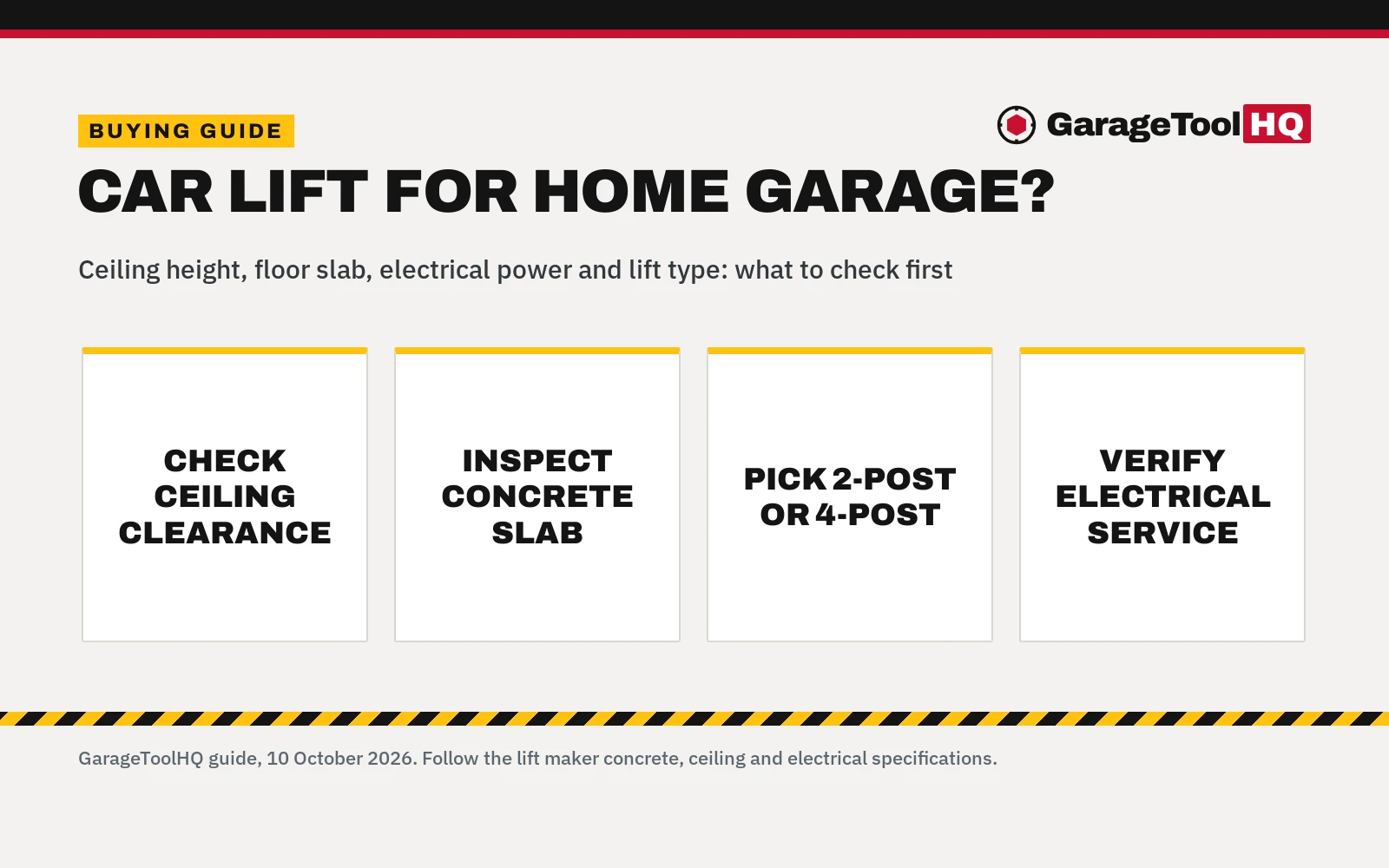
How to choose a car lift for home garage safely: evaluating ceiling height, concrete slab requirements, electrical supply and 2-post vs 4-post lift designs.

On this page
Top picks at a glance
As an Amazon Associate we earn from qualifying purchases.
- 1
 KATOOL 12000 lbs Extra Height 167inch 2 Post Lift Two Post9.6/10View on Amazon
- 2
 6600 lbs Portable Car Lift9.5/10View on Amazon
- 3
 WEIZE 11000lbs Two Post Car Lift9.5/10View on Amazon
- 4
 XK 2 Post Auto Car Lift 10000 lb Capacity Truck Clear FloorView on Amazon
- 5
 2 Pcs 18'' Heavy Duty Parking Aid for GarageView on Amazon
- 6
 SYLSTAR Work Light for MechanicView on Amazon
How to choose a car lift for home garage use comes down to matching your ceiling height, concrete slab, electrical service, and maintenance needs to the right lift design. For full underbody and wheel service, a two-post lift provides open chassis access. For vehicle storage and drive-on maintenance, a four-post lift offers drive-on runways. Where ceiling height is restricted, a portable scissor hoist provides mid-rise lifting without permanent floor anchors.
More options to compare
 XK 2 Post Auto Car Lift 10000 lb Capacity Truck Clear FloorCheck price on Amazon
 2 Pcs 18'' Heavy Duty Parking Aid for GarageCheck price on Amazon
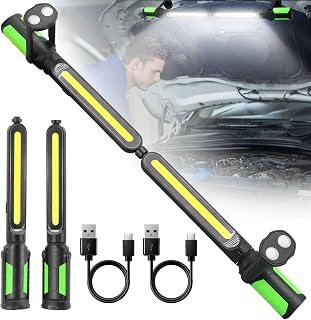 SYLSTAR Work Light for MechanicCheck price on Amazon
GarageToolHQ earns a commission when you buy through links on our product pages, at no extra cost to you. Read our affiliate disclosure.
Below: space checks, how lift styles compare, a buyer checklist, and essential installation requirements.
How to choose a car lift for home garage: what to measure first
Residential garages have fixed physical limits that dictate which lift styles can operate safely:
- Ceiling height: Clearance must accommodate column height and vehicle roof height at full rise. For example, the SDLANCH two-post lift lists an overall height of 106.30 inches with a 70.87-inch maximum lifting height, while the KATOOL two-post lift lists an overall height of 111 inches with a 70.75-inch lift height. Taller clear-floor units, like the KATOOL extra-height model, measure 166.75 inches (167 inches) tall. Account for garage door tracks, openers, and lights.
- Concrete floor slab: Two-post lifts exert heavy tension on concrete anchors, while four-post lifts spread load over four posts. Always follow the lift maker concrete thickness and strength specifications before installation.
- Bay dimensions: Ensure adequate perimeter clearance. SDLANCH lists an overall width of 129.92 inches with a 107.87-inch column distance, while KATOOL lists an overall width of 140 inches, and its extra-height model measures 165.5 inches wide with a 117.75-inch drive-thru clearance.
- Electrical service: Many automotive lifts require a dedicated 220V circuit. XK lists a 220V power unit with a 30A minimum breaker, SDLANCH lists a 220V 2.2KW (2.95HP) motor, and KATOOL uses 4.0HP 220V motors. In contrast, KATOOL 8,500-pound and 9,500-pound four-post lifts run on standard 110V power. Always use a licensed electrician to wire dedicated circuits.
Lift types for home garages: 2-post, 4-post and scissor hoists
| Lift Style | Mounting & Footprint | Best For |
|---|---|---|
| Two-post lift | Anchored to concrete slab; swing arms | Wheel, suspension, brake, and underbody repairs |
| Four-post lift | Freestanding or anchored; drive-on runways | Vehicle storage, fluid services, and heavy pickups |
| Scissor lift | Low profile, freestanding; hydraulic scissor | Tire and brake service, detailing, low ceilings |
Two-post lifts: Anchored columns swing arms under chassis lift points, leaving wheels and suspension hanging free for brake and drivetrain repairs. See our guide to the best car lift for home garage setups.
Four-post lifts: Drive-on runways support vehicles by the tires, making them ideal for storage. Moving kits included with KATOOL 8,500-pound and 9,500-pound models permit rolling an unloaded lift. For wheel service on runways, units like the MutsMover 15,000-pound lift include a 6,000-pound rolling jack.
Scissor lifts: Compact scissor frames raise vehicles to waist height for brake jobs and detailing where ceilings are low. Learn more in our guide on how to use a scissor lift and our review of the QuickJack 6000TLX.
How to select the right car lift: the buyer checklist
- Measure overhead rise: Add vehicle height to lift stroke. SDLANCH lists 70.87 inches, KATOOL lists 70.75 inches (11,000-pound) and 70.86 inches (12,000-pound), MutsMover lists 77 inches, and KATOOL lists 79 inches (84 inches max) on its 9,500-pound model. For low spaces, see the best car lift for low ceiling garages.
- Inspect the concrete slab: Two-post hoists require structural concrete to resist pullout forces. Follow the lift maker concrete specifications, inspect for cracks, and never drill post-tension slabs.
- Match vehicle weight and pad height: Capacities range from 8,500 pounds (KATOOL four-post) up to 13,000 pounds (AUTOKATO two-post) and 15,000 pounds (MutsMover four-post). For low cars, KATOOL lists a 4.25-inch minimum height (3.9 inches on its 11,000-pound unit), while SDLANCH lists a 3.94-inch minimum height with arms extending from 29.25 inches to 46.06 inches.
- Plan electrical supply: Verify voltage and breaker size. XK specifies 220V with a 30A breaker, SDLANCH uses 220V (2.95HP), KATOOL uses 4.0HP 220V, and KATOOL 8,500-pound units run on 110V. Always use a licensed electrician.
- Verify safety locks: Confirm mechanical locks engage at working heights. SDLANCH and KATOOL use manual releases, and KATOOL equips its 8,500-pound lift with primary and secondary locks on each column.
- Plan freight unloading: Crated lifts weigh from 1068 pounds (XK) and 1200 pounds (KATOOL 11,000) to 2117 pounds (KATOOL 9,500) and 4850 pounds (MutsMover). Listings specify the buyer must unload with a forklift or arrange terminal pickup.
Never get under a vehicle supported by a hydraulic jack alone. When servicing wheels or brakes off a lift or when working on the ground, always use rated jack stands positioned on solid, level ground at the vehicle maker lift points specified in your owner manual.
Check the lift's rated capacity against your heaviest vehicle, and its ceiling and concrete requirements (thickness and strength) before you buy. Install it exactly as the manufacturer specifies, use the mechanical locks before you go under, and look for ALI certification on the model. See the Automotive Lift Institute (ALI). Read our Safety Disclaimer.
2-post vs 4-post lifts for home garages
- Underbody access: Two-post lifts leave wheels and suspension completely free for component swaps. Four-post runways restrict wheel access unless paired with a rolling jack. See how to use a 2-post lift safely.
- Parking and storage: Four-post lifts provide an elevated platform for tandem parking without setting swing arms. Two-post lifts are less convenient for parking because they lack drip trays and restrict door clearance.
- Footprint: Two-post lifts require bay width for columns like the SDLANCH (129.92 inches) or KATOOL 11,000-pound unit (140 inches). Four-post runways require length, such as 186 inches (KATOOL 9,500) or 245 inches (MutsMover 15,000).
Read our full comparison of 2-post vs 4-post lift designs.
Concrete requirements and overhead clearances
Concrete foundation: Two-post columns exert intense tension on anchors. Always follow the lift maker concrete thickness and strength specifications, maintain required edge distances, and avoid slab seams.
Overhead clearance: Account for door tracks and openers hanging below joists. Compact hoists like the SDLANCH (106.30 inches) clear low ceilings where tall clear-floor units cannot.
Certifications and steel: KATOOL, AUTOKATO, and SDLANCH list CE certification. AUTOKATO specifies 150% static and 115% dynamic load ratings. North American buyers should check for ANSI/ALI ALCTV certification by the Automotive Lift Institute (ALI). MutsMover specifies Q345 structural alloy steel.
Frequently Asked Questions
Can I install a car lift in a standard garage?
Yes, if ceiling height, concrete slab strength, and power meet the lift maker specifications. Compact units like the SDLANCH (106.30 inches tall) fit under standard ceilings.
How much ceiling height do I need for a car lift?
Clearance must accommodate column height and raised vehicle height. Clear-floor lifts like KATOOL extra-height require 166.75 inches (167 inches), while compact two-post models like SDLANCH (106.30 inches) or four-post units like KATOOL 8,500-pound (70.87-inch rise) suit lower spaces.
What concrete thickness is required for a 2-post lift?
Anchor requirements depend on capacity and column leverage. Always follow the lift maker concrete specifications exactly, and never anchor near cracks or expansion joints.
Do I need 220V power for a home garage car lift?
Many two-post lifts require 220V power (XK lists 30A, KATOOL uses 4.0HP 220V). However, four-post storage lifts like the KATOOL 8,500-pound and 9,500-pound models run on 110V. Always use a licensed electrician.
What is the difference between ALI certified and CE certified lifts?
ALI (ANSI/ALI ALCTV) provides North American third-party safety validation. CE indicates European standard compliance. Verify any hoist has heavy steel and reliable mechanical locks.
Can I park one car under another on a 2-post lift?
While possible with adequate ceiling clearance, two-post lifts lack drip trays to catch fluids and require setting arms each time. A four-post lift like the KATOOL 8,500-pound or MutsMover 15,000-pound unit is better suited for vehicle storage.
Related: 2-post vs 4-post lift comparison, our guide to the best car lift for home garage, our roundup of the best car lift for low ceiling spaces, our overview of home car lifts, and instructions on how to use a 2-post lift safely. For floor work, see our picks for jack stands and floor jacks.