Battery Tender Junior vs Battery Tender Plus (2026)
Two Battery Tender Juniors for 6V and 8V batteries against two Pluses for 12V, compared by voltage, charge current, banks and warranty.

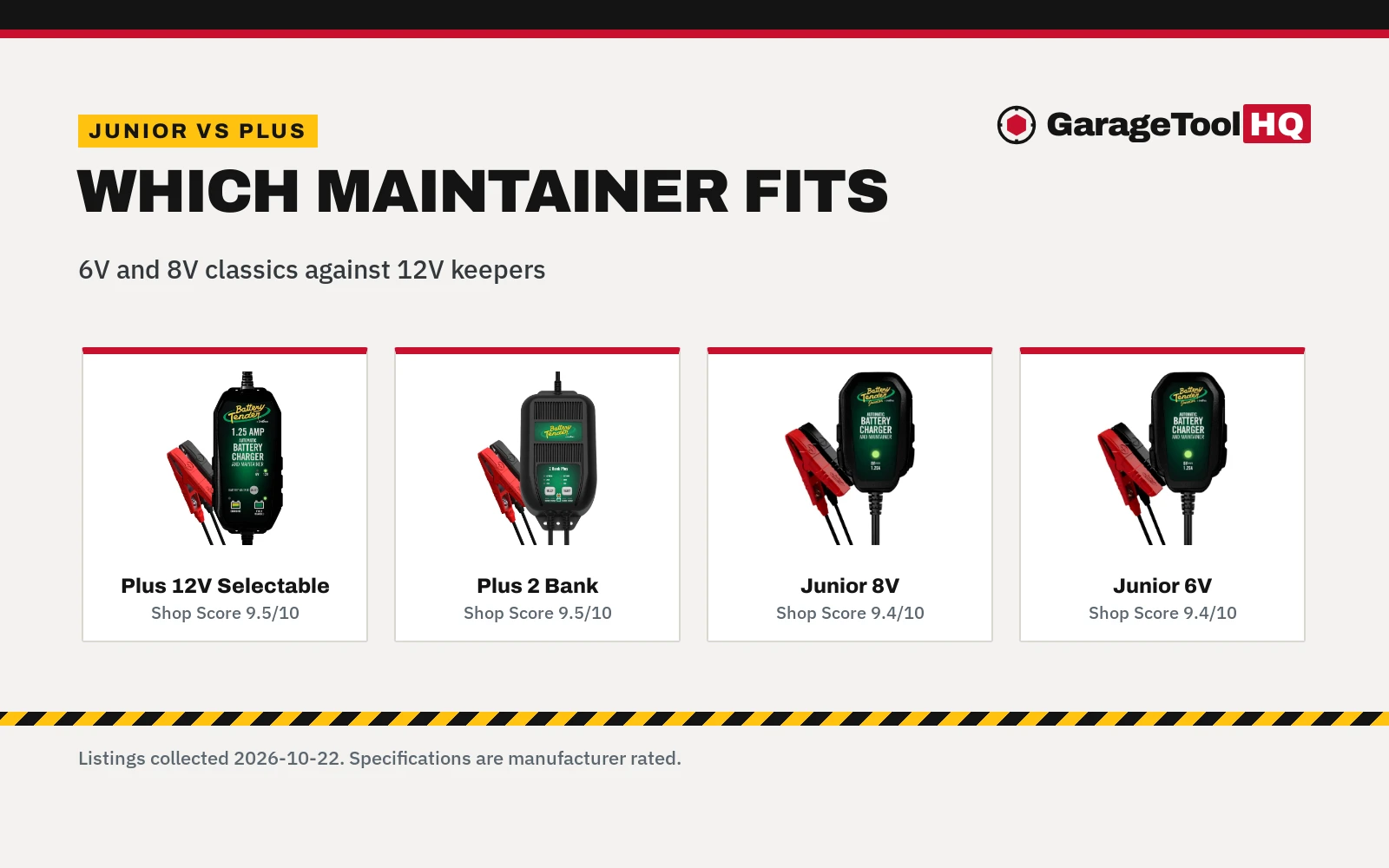
On this page
Top picks at a glance
As an Amazon Associate we earn from qualifying purchases.
- 1
 Battery Tender Junior 8V9.4/10View on Amazon
- 2
 Battery Tender Plus 12V 1.25 AMP Battery Charger and9.5/10View on Amazon
- 3
 Battery Tender Junior 6V9.4/10View on Amazon
Verdict: Pick a Battery Tender Junior if your battery is 6V or 8V; the Junior examples here carry a 5-year warranty and do one job well. Pick a Battery Tender Plus for 12V batteries, especially the selectable 12V example that also handles 6V, or the 2-bank example if you keep two batteries at once.
A battery tender keeps a parked battery at full charge without overcharging it, switching to float mode once the battery is full. This battery tender junior vs battery tender plus comparison covers four real listings: two Juniors for 6V and 8V batteries, and two Pluses for 12V, one of them a two-bank unit. The difference between the lines is voltage and capacity, not quality.
GarageToolHQ earns a commission when you buy through links on this page, at no extra cost to you. Read our affiliate disclosure.
The picks
| # | Product | Shop Score | Buy |
|---|---|---|---|
| 1 | Battery Tender Plus 12V 1.25 AMP Battery Charger | 9.5/10 | Buy on Amazon |
| 2 |  Battery Tender Plus 2 Bank Multibank Charger | 9.5/10 | Buy on Amazon |
| 3 | Battery Tender Junior 8V | 9.4/10 | Buy on Amazon |
| 4 | Battery Tender Junior 6V | 9.4/10 | Buy on Amazon |

Battery Tender Plus 12V 1.25 AMP Battery Charger
A 12V 1.25A Battery Tender Plus that is fully selectable between 6V and 12V, with a 5-year warranty.
Pros
- Selectable 6V or 12V
- 5-year warranty
- Spark-proof, reverse polarity detection
- Float mode for long storage
Cons
- One battery at a time
- Powersports-focused listing
- Claims 50% more power than the Junior while both list 1.25A
- No temperature compensation stated
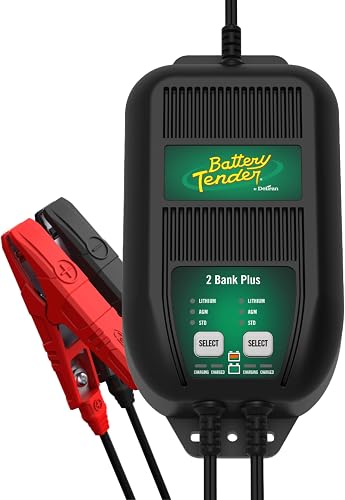
Battery Tender Plus 2 Bank Multibank Charger
A 2-bank Battery Tender Plus with two independent 12V 1.25A stations and temperature compensation.
Pros
- Two independent 12V banks
- Temperature compensation
- Spark proof, reverse polarity protected
- LED stage indicator
Cons
- 2-year warranty vs 5-year on the Juniors
- 12V batteries only
- Two units to place
- No 6V or 8V support
Battery Tender Junior 8V
An 8V 1.25A Battery Tender Junior for 8V lead-acid batteries, with float mode and a 5-year warranty.
Pros
- 5-year warranty
- Float mode, no overcharging
- Spark-proof circuitry
- 0.7 lb, compact
Cons
- 8V batteries only
- One battery at a time
- Listing says 4-step but names 3 steps
- No temperature compensation stated
Battery Tender Junior 6V
A 6V 1.25A Battery Tender Junior for 6V lead-acid batteries, with float mode and a 5-year warranty.
Pros
- 5-year warranty
- Float mode for storage
- Spark-proof circuitry
- 0.65 lb, compact
Cons
- 6V batteries only
- One battery at a time
- 4-step program names only 3 steps
- No temperature compensation stated
battery tender junior vs battery tender plus: side by side
| Battery Tender Junior | Battery Tender Plus | Notes | |
|---|---|---|---|
| Voltage | 6V or 8V, 1.25A | 12V 1.25A; one example selectable 6V or 12V | Match the tender to the battery |
| Batteries | One at a time | One at a time, or two on the 2-bank | 2-bank keeps two 12V batteries |
| Warranty | 5-year warranty on both examples | 5-year on the 12V; 2-year limited on the 2-bank | Longest term on three examples |
| Float mode | Yes, after full charge | Yes, after full charge | All four are maintainers |
Figures are manufacturer rated, collected 21 October 2026. A figure from one listing describes that listing only.
The Junior: the 6V and 8V keeper
The Junior line is the small-voltage keeper. The 8V example charges and maintains 8V lead-acid, flooded, AGM and gel cell batteries at 1.25A; the 6V example does the same at 6V. Both are fully automatic, both switch to float mode after a full charge for safe long-term storage without overcharging, and both are spark-proof with a ring terminal and alligator clip combo cable in the box. Both carry a 5-year warranty, the longest stated here.
The listings share one oddity: both call their program a 4-step charging program while naming three steps (Initialization, Bulk Charge, Float Mode). Neither listing states temperature compensation. The Junior is one battery at a time, one voltage each, which is all most 6V and 8V owners need.
The Plus: the 12V keeper
The Plus line is the 12V keeper with more capacity. The 12V example is fully selectable between 6V and 12V, making it the only example here that spans both Junior voltages and 12V. It charges at 1.25A, suits lead-acid, flooded and sealed maintenance-free batteries (AGM and gel cell), switches to float mode automatically, is spark-proof with reverse polarity detection, and carries a 5 Year Industry Leading Warranty. Its listing aims it at powersports: motorcycles, ATVs, UTVs, personal watercraft and scooters.
The 2-bank Plus doubles down: two independent 12V 1.25A stations, each with temperature compensation that adjusts charge voltage to ambient temperature, a two-color LED stage indicator, spark proofing and reverse polarity protection. The trade is the warranty: 2-year limited against the 5 years on the other three examples.
Reading the listings carefully
Two claims in these listings deserve a careful read. Both Junior listings call their program a 4-step charging program and then name three steps: Initialization, Bulk Charge and Float Mode. The fourth step is never named. It changes nothing about how the charger works, but it is a reminder to read the step list, not the step count.
The Plus 12V listing claims it contains 50% more charging power than the Battery Tender Junior while both examples list 1.25 amps. The numbers on the two listings do not support the claim, so treat it as marketing and compare the stated specs: 1.25A on both sides, selectable voltage on the Plus 12V, and the warranty terms, 5 years on three examples and 2-year limited on the 2-bank.
What the listings agree on is the core job: every example provides a full charge and then switches to float mode to maintain proper voltage for long-term storage without overcharging. Spark-proof connections appear on all four listings, and reverse polarity protection or detection on the two Plus listings. Those are the figures that decide, and they are stated clearly.
Which side for which garage
Match the tender to the battery voltage first; nothing else matters until that is right. A 6V classic gets the Junior 6V, an 8V battery gets the Junior 8V, and both come with the longest warranty stated here. A single 12V battery gets the Plus 12V, which also covers 6V if the garage has both. Two 12V batteries get the 2-bank Plus, accepting its shorter warranty for the second station. All four are maintainers: each listing says it provides a full charge and then holds the battery at float mode. They are sized for maintenance charging, not for fast recovery of a deeply discharged battery.
How we scored them
Each example is scored on performance, build, value, safety and warranty, using only what the listing publishes. None of the listings states a safety certification, so safety is zero for all; warranty scores follow the stated term.
| Product | Shop Score | Perf. /35 | Build /25 | Value /25 | Safety /10 | Warranty /5 |
|---|---|---|---|---|---|---|
| Plus 12V Selectable | 9.5 | 30 | 21 | 20 | 0 | 1 |
| Plus 2 Bank | 9.5 | 29 | 20 | 20 | 0 | 1 |
| Junior 8V | 9.4 | 28 | 19 | 19 | 0 | 1 |
| Junior 6V | 9.4 | 27 | 19 | 19 | 0 | 1 |
Scores run from 9.2 to 9.8: each product’s point total is placed on that range, so more points always means a higher score.
Lead-acid batteries can release hydrogen while charging, so charge in a ventilated space away from sparks and flames, connect positive first and negative last, set the charger to the battery type (flooded, AGM, gel, lithium), and wear eye protection. Read our Safety Disclaimer.
Frequently Asked Questions
Can a Battery Tender Junior charge a 12V battery?
No. The Junior examples here are 8V and 6V at 1.25A. Use the Plus 12V, which is selectable between 6V and 12V, for 12V batteries.
What is the difference between a battery tender and a trickle charger?
All four listings describe maintainers that switch to float mode after a full charge, and the Junior listings say they are smarter than a trickle charger. See our battery charger vs battery maintainer comparison.
Can I leave a battery tender connected all winter?
That is what float mode is for: the listings say the charger maintains proper voltage for long-term storage without overcharging. Keep the battery in a ventilated area and follow the manual.
Do I need the 2-bank Plus for two batteries?
Not necessarily, but it is convenient: two independent 12V 1.25A stations with temperature compensation. Two single tenders would also work.
What batteries do these tenders fit?
The Juniors fit their stated voltage in lead-acid, flooded, AGM and gel cell. The Plus 12V fits 6V or 12V lead-acid, flooded and sealed maintenance-free (AGM and gel cell). The 2-bank fits AGM, sealed maintenance-free and flooded 12V batteries.
Related: the best battery charger maintainer, the best battery charger for motorcycles, the best battery maintainer for classic cars and AGM vs flooded battery charger.