Best Air DA Sander (2026): 5 Pneumatic Sanders Compared
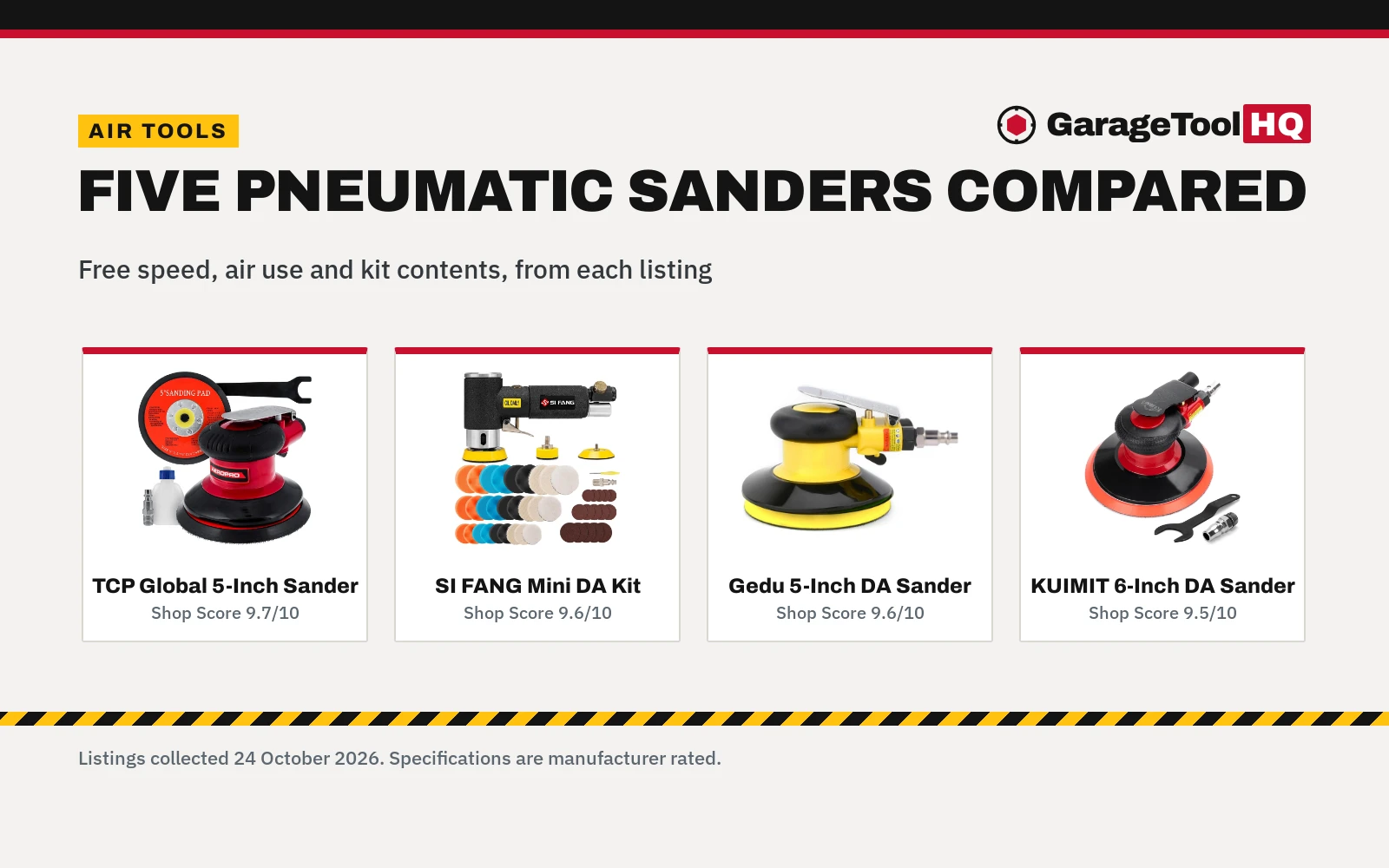
Five pneumatic dual action sanders compared by pad size, orbit diameter, free speed, air requirements, kit accessories and manufacturer warranty coverage.

On this page
Top picks at a glance
As an Amazon Associate we earn from qualifying purchases.
- 1
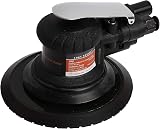 Best OverallIngersoll Rand 300G9.6/10View on Amazon
- 2
 Best for Heavy RemovalIngersoll Rand 328B9.6/10View on Amazon
- 3
 Best Complete KitUPWOOD UW-313-59.5/10View on Amazon
- 4
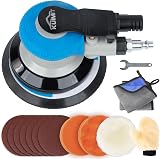 Best Detailing PackageKUIMIT 5″ Air Sander9.4/10View on Amazon
- 5
 Low noise 6 Inch DA Sander for Auto BodyView on Amazon
- 6
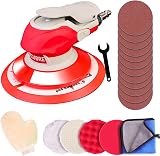 5/6 Inch Pneumatic Orbital Air Sander High-Speed DA SanderView on Amazon
- 7
 PROSHI 6“ Random Orbit Air SandersView on Amazon
- 8
 Professional Air Random Orbital Palm SanderView on Amazon
- 9
 Autolock 6 Inches Air Random Orbital SanderView on Amazon
Prepping a rusted fender or feathering body filler before laying primer demands smooth, swirl-free rotation that will not gouge sheet metal. Finding the best air da sander comes down to matching pad diameter, orbit throw, free speed and air demand to your garage compressor. A pneumatic dual-action palm sander uses compressed air to spin and orbit simultaneously, preventing localized heat buildup and leaving clean surfaces ready for paint. This guide compares 5 pneumatic sanders across motor power, orbit size, speed, included accessories and warranty terms.
GarageToolHQ earns a commission when you buy through links on this page, at no extra cost to you. Read our affiliate disclosure.
Quick picks
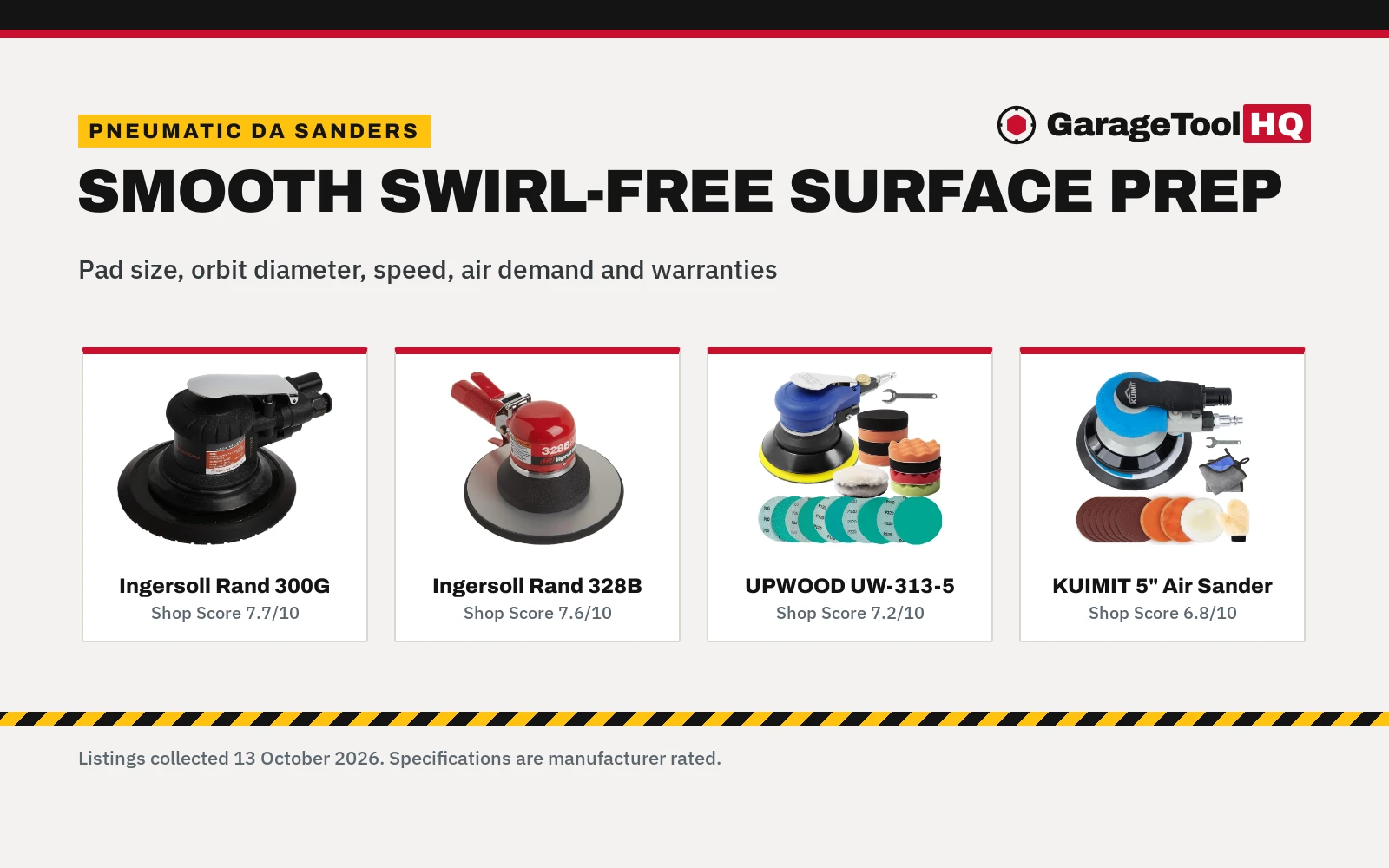
- Best Overall Ingersoll Rand 300G: 6 in pad with a 3/16 in orbit, 0.20 hp motor, 360° swivel vacuum adapter, and 1.9 lb composite body. Check price on Amazon
- Best for Heavy Removal Ingersoll Rand 328B: 8 in pad, 0.25 hp motor, 5/32 in orbit and 825 rpm geared speed for stripping large flat panels. Check price on Amazon
- Best Complete Kit UPWOOD UW-313-5: 5 in sander with a 3/16 in orbit, 10000 rpm speed, 10 sandpapers, and 10 polishing sponge and wool pads. Check price on Amazon
- Best Detailing Package KUIMIT 5″ Air Sander: 5 in palm sander with a 2,500 to 12,000 rpm speed regulator, 3.1 lb weight, and 10 included accessories. Check price on Amazon
The picks

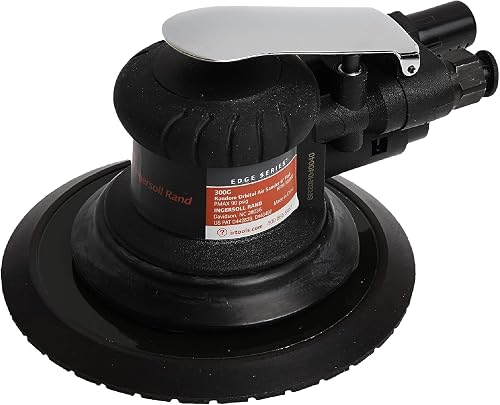
Ingersoll Rand 300G 6" Random Orbital Air Sander
A 6 in random orbital air sander with a 0.20 hp motor, 3/16 in orbit, 10,000 rpm free speed, 360° swivel vacuum adapter and a 1.9 lb composite body.
Pros
- 3/16 in orbit diameter with 10,000 rpm free speed for fine finishing
- 360° swivel vacuum adapter helps clear sanding dust
- Lightweight 1.9 lb composite body with contoured grip
- Stated 1 Year Limited Warranty
Cons
- Compressor not included (sold as bare tool)
- No sanding discs or pads included in the box
- Listing contains contradictory 4.5 A rating for an air tool
- Spec table lists 1.2 kg shipping weight alongside 1.9 lb tool weight

Ingersoll Rand 328B 8" Dual-Action Orbital Air
An 8 in dual-action pneumatic sander with a 0.25 hp motor, 825 rpm geared speed, 5/32 in orbit and ball-bearing construction for heavy panel prep.
Pros
- Large 8 in pad covers big, flat panels quickly
- 0.25 hp motor with 825 rpm geared speed for heavy stock removal
- Ball-bearing construction with durable composite housing
- Stated 1 year warranty from purchase date with receipt
Cons
- 825 rpm speed is slow for fine feather edging
- Heavy material removal focus makes it less suited for curved body lines
- Compressor and sanding discs are not included
- Listing includes contradictory 8 A rating for a pneumatic tool

5 inch Air Random Orbital Sander for Auto Body
A 5 in pneumatic palm sander with a 3/16 in orbit, 10000 rpm speed, 12 CFM air flow rating and a 20-piece abrasive and polishing pad set.
Pros
- Includes 10 sandpapers and 10 polishing sponge and wool pads
- 3/16 in orbit diameter with 10000 rpm free speed
- Standard 5/16"-24 pad thread accepts 5 in or 6 in pads
- Listing publishes air demand of 12 CFM
Cons
- No concrete warranty term stated (listed only as limited warranty)
- Requires a compressor of no less than 3-1/2 KW or 100 L for continuous use
- 1020 g weight is heavier than bare composite palm sanders
- Listing includes contradictory 3 A spec table entry
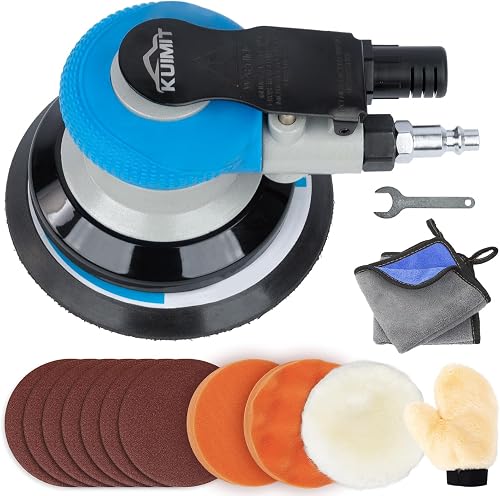
5" Air Sander Kit - Garage-Ready Dual Action Tool
A 5 in palm air sander kit with a 2,500 to 12,000 rpm regulator, cushioned grip, 3.1 lb weight and a 10-piece detailing and buffing package.
Pros
- Built-in speed regulator adjusts from 2,500 to 12,000 rpm
- 10-item kit with 5 in pad, contour sponges, mitt, cloths and fitting
- Palm-style body with cushioned grip for single-handed control
- Hook and loop pad allows fast abrasive changes
Cons
- Orbit diameter is not stated in the listing
- No warranty term is stated
- Contradictory part number DMJ-Black-6in on a 5-inch kit listing
- Spec table lists contradictory 1 A electrical rating

Professional Air Random Orbital Palm Sander
A 6 in dual-action pneumatic palm sander featuring a heat-treated cast steel cylinder, 12000 rpm speed, 1 kg weight and low center of gravity design.
Pros
- 12000 rpm maximum rotational speed for rapid material prep
- Heat-treated cast steel cylinder for internal durability
- Low center of gravity palm design aids vertical work
- Lightweight 1 kg assembly reduces fatigue during overhead use
Cons
- Orbit diameter is not stated in the listing
- No warranty term is stated
- Air consumption (CFM) is not stated on the listing
- Spec table contains contradictory 10 A electrical rating
More options to compare
 Low noise 6 Inch DA Sander for Auto BodyCheck price on Amazon
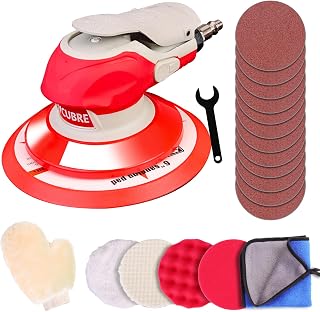 5/6 Inch Pneumatic Orbital Air Sander High-Speed DA SanderCheck price on Amazon
 PROSHI 6“ Random Orbit Air SandersCheck price on Amazon
 Professional Air Random Orbital Palm SanderCheck price on Amazon
 Autolock 6 Inches Air Random Orbital SanderCheck price on Amazon
Compare the picks
| Model | Shop Score | Pad size | Orbit diameter | Speed | Weight | Power / Air demand | Warranty |
|---|---|---|---|---|---|---|---|
| Ingersoll Rand 300G | 9.6/10 | 6 in | 3/16 in | 10,000 rpm | 1.9 lb | 0.20 hp | 1 Year Limited Warranty |
| Ingersoll Rand 328B | 9.6/10 | 8 in | 5/32 in | 825 rpm | 2.5 lb | 0.25 hp | 1 year |
| UPWOOD UW-313-5 | 9.5/10 | 5 in | 3/16 in | 10000 rpm | 1020 g | 12 CFM | Not stated (listed as limited warranty) |
| KUIMIT 5″ Air Sander | 9.4/10 | 5 in | Not stated | 12,000 rpm | 3.1 lb | Not stated | Not stated |
| Gedu GAOA124-3 | 9.4/10 | 6 in | Not stated | 12000 rpm | 1 kg | Not stated | Not stated |
Specifications are manufacturer rated, as published on each listing and collected 12 October 2026. Where a listing contradicts itself, both figures are shown.
How we scored them
Each sander is scored on performance, build, value, safety and warranty, with the criteria published on our How We Pick page. None states an independent safety certification, and three give no concrete warranty term.
| Product | Shop Score | Perf. /35 | Build /25 | Value /25 | Safety /10 | Warranty /5 |
|---|---|---|---|---|---|---|
| Ingersoll Rand 300G | 9.6 | 32 | 22 | 20 | 0 | 3 |
| Ingersoll Rand 328B | 9.6 | 30 | 22 | 20 | 0 | 3 |
| UPWOOD UW-313-5 | 9.5 | 29 | 20 | 22 | 0 | 0 |
| KUIMIT 5″ Air Sander | 9.4 | 28 | 19 | 21 | 0 | 0 |
| Gedu GAOA124-3 | 9.4 | 27 | 19 | 20 | 0 | 0 |
Scores run from 9.2 to 9.8: each product’s point total is placed on that range, so more points always means a higher score.
What the listings tell you
We compared the 5 pneumatic sander listings in detail. Only 3 stated the orbit diameter, a key factor that shapes sanding aggression and swirl patterns. 2 stated a concrete warranty term of 1 year, while others omitted warranty terms or listed limited coverage without a duration. All 5 listings contained spec table errors showing electrical amperage ratings for pneumatic air tools.
Buying guide: finding the best air da sander
Orbit diameter and sanding motion
Dual-action (DA) sanders combine spindle rotation with an offset orbital motion. This dual action prevents the abrasive grain from tracing the exact same circle twice, which eliminates rotary swirl marks on car panels. The orbit diameter (also called throw) dictates material removal rate. A 3/16 in orbit provides an all-around balance for smoothing feather edges, scuffing old paint and final body work. A smaller 5/32 in orbit delivers tighter, more controlled motion suited for aggressive leveling without jumping across flat sheet metal. Listings that omit orbit diameter leave buyers guessing whether the tool behaves as an aggressive sander or a fine finisher.
Pad size and disc mounting
Pad diameter determines working surface area and accessibility on vehicle contours. A 5 in pad offers nimble control over curved fenders, door pillars and bumper covers. A 6 in pad is the standard shop size for quarter panels and hoods, providing broader leveling action. For massive flat expanses like truck beds, van sides and long hoods, an 8 in pad covers area rapidly with minimal dish out. Check the mounting style as well: hook and loop backing pads allow rapid abrasive swaps between grits, whereas pressure-sensitive adhesive (PSA) pads require peeling discs. Spindles with a standard 5/16″-24 thread allow you to switch pad diameters or replace worn hook-and-loop faces easily.
Air supply and compressor demand
Unlike an impact wrench that runs in short bursts, an air sander runs continuously for minutes at a stretch. A sander listing an air flow requirement of 12 CFM requires a substantial air compressor to maintain continuous operating pressure without stalling. If your compressor cannot keep pace with the tool’s CFM rating, line pressure drops, pad rotation slows, and sanding efficiency falls off. For continuous auto body work, pair your air sander with adequate tank volume and clean air delivery. Check what CFM do air tools need and what size air compressor do I need for air tools before setting up your garage air lines.
Speed regulation and motor power
Free speed ratings on air palm sanders typically reach 10,000 to 12,000 rpm. High rotational speed accelerates paint stripping and body filler shaping, but fine surface prep often requires throttling back to avoid overheating delicate finishes. A built-in speed regulator allows you to dial down rotational speed between 2,500 and 12,000 rpm for delicate feather edging or buffing without leaving the workpiece. Geared sanders operating at lower speeds, such as 825 rpm with a 0.25 hp motor, focus motor torque on aggressive flat-panel stripping where high speed would generate unwanted panel heat.
Dust collection and exhaust design
Sanding auto body primer and paint generates fine airborne particulate that fouls abrasives and clogs garage air. Sanders equipped with a swivel vacuum adapter, such as a 360° vacuum port, connect directly to shop dust extractors to clear dust channels immediately. For shops without vacuum systems, rear exhaust ports diffuse cold exhaust air backward along the supply hose, directing air away from the fresh sanding surface.
Wear eye protection with every air tool, use impact-rated sockets on impact wrenches, disconnect the air line before changing accessories, and finish lug nuts with a torque wrench to the vehicle's spec. See OSHA eye and face protection. Read our Safety Disclaimer.
Garage Fit Check
- Air compressor sizing: Continuous sanding demands substantial CFM; listings like the UPWOOD specify 12 CFM air flow and note that continuous use requires a compressor of no less than 3-1/2 KW or 100 L.
- Pad mounting and spindle threads: Check pad attachment before buying abrasives; listings include 5 in, 6 in and 8 in diameters, with standard 5/16″-24 spindle threads supporting replacement hook-and-loop or PSA pads.
- Dust extraction hookup: If dust containment matters in your garage, verify vacuum compatibility; the Ingersoll Rand 300G provides a built-in 360° swivel vacuum adapter to mate with shop collection hoses.
- Tool weight and profile: Palm sanders here weigh between 1.9 lb and 3.1 lb (1020 g to 1.33 kg in metric listings), with low-profile heights down to 2.95 in for tight clearances.
Frequently Asked Questions
What is the best da sander for automotive body work?
For automotive surface prep and fine feather edging, a lightweight random orbital sander with a 6 in pad, 3/16 in orbit diameter and a vacuum connection delivers the cleanest swirl-free finish. For heavy material removal and stripping large flat panels, a geared sander with an 8 in pad and lower rotational speed provides greater leveling power.
What air compressor size is needed for a pneumatic DA sander?
Because air sanders run continuously rather than in short bursts, they require high air volume. A sander rated at 12 CFM requires a large shop compressor (such as 3-1/2 KW or 100 L capacity as specified on semi-industrial listings) to prevent pressure drop during extended sanding sessions. Check your compressor output rating before setting up your pneumatic air line.
What is the difference between a 3/16 in and 5/32 in orbit?
A 3/16 in orbit provides a wider pattern that removes material efficiently while remaining smooth enough for primer prep and feather edging. A 5/32 in orbit produces a tighter motion often paired with geared lower-speed sanders to level large flat panels without aggressive swirl marks.
How does a pneumatic DA sander differ from an electric palm sander?
A pneumatic DA sander is noticeably lighter because it houses an air motor rather than an electric motor with copper windings. It runs cooler in continuous operation and eliminates motor burnout risks, provided your garage air line supplies dry air and regular pneumatic tool oil. Learn more in our guide on DA sander vs orbital sander mechanics and how to oil air tools.
Why do pneumatic sander listings show amperage numbers?
Several pneumatic sander listings erroneously display amperage numbers (such as 1 A, 3 A, 4.5 A, 8 A or 10 A) in their Amazon technical specification tables. These errors occur when listing templates designed for corded electric tools are applied to air-powered tools. True pneumatic sanders operate solely on compressed air and require no electrical amperage.
Related: our air tools hub, the best DA sander for auto body, the DA sander with vacuum guide, and our DA sander vs orbital sander comparison. Also see our guide on what CFM do air tools need. Also see our advice on what size air compressor do I need for air tools. Also see our guide on how to oil air tools. Also see our review of the best air tool lubricant. Also see our comparison of the best air hose for garage. Also see our guide on best air compressor for home garage. Also see our guide on best air compressor dryer for garage. Also see our explanation of how does an air compressor dryer work. Also see our guide on best air impact wrench for home garage. Also see our guide on how to use air impact wrench. Also see our review of the best air die grinder. Also see our review of the best air hammer. Also see our review of the best air ratchet. Also see our guide to the best blow gun for garage. Also see our guide to the best air compressor hose reel. Also see our tutorial on how to plumb compressed air lines in a garage.