Best Rotary Polisher for Paint Correction (2026): 5 Picks Compared
Five rotary polishers for automotive paint correction, compared by motor wattage, speed range, pad accessories, ergonomics, safety features and warranty terms.

On this page
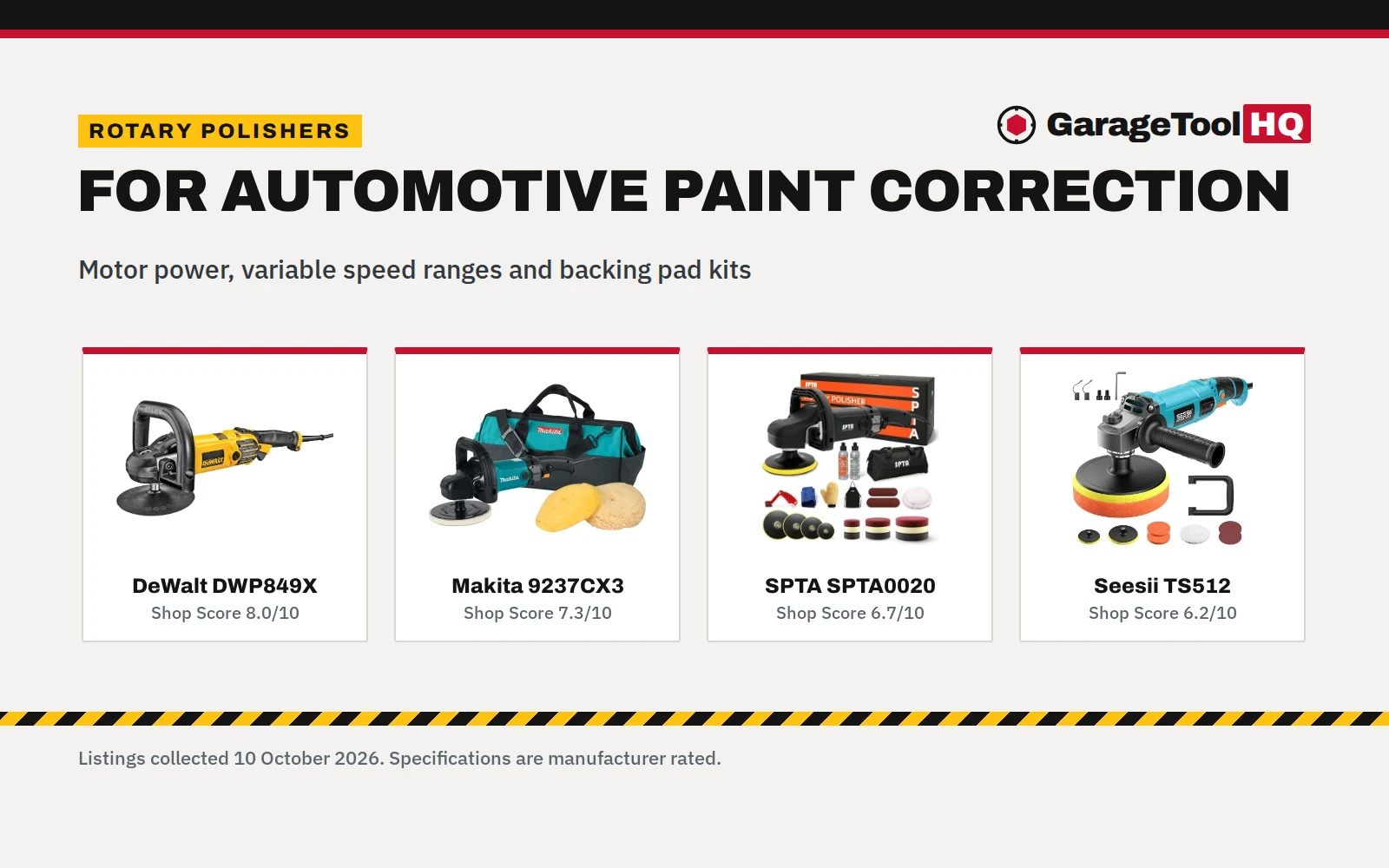
Top picks at a glance
As an Amazon Associate we earn from qualifying purchases.
- 1
 Best OverallDeWalt DWP849X9.6/10View on Amazon
- 2
 Best Speed ControlMakita 9237CX39.5/10View on Amazon
- 3
 Best Accessory KitSPTA SPTA00209.4/10View on Amazon
- 4
 High Power Budget PickSeesii TS5129.3/10View on Amazon
- 5
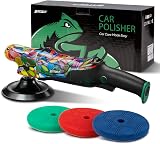 BATOCA P2 Car Buffer PolisherView on Amazon
- 6
 Adam's Polishes SK Pro 12mm Car PolisherView on Amazon
- 7
 ENEACRO 1700W Rotary Car Buffer Polisher Waxer 7-inch/6-inchView on Amazon
- 8
 GEVEELIFE Buffer PolisherView on Amazon
- 9
 USB Polishing MachineView on Amazon
Selecting the best rotary polisher for paint correction requires understanding direct-drive mechanics. Unlike dual-action orbiters that oscillate, a rotary buffer spins its pad on a fixed central axis, generating concentrated friction and heat to level heavy scratches, severe swirl marks, and etched clear coat. Speed control, motor amperage, backing plate versatility, and physical balance determine how efficiently a machine cuts without damaging delicate clear coat. This guide compares five listings by motor wattage, RPM ranges, included pad sets, safety mechanisms, and warranty coverage.
GarageToolHQ earns a commission when you buy through links on this page, at no extra cost to you. Read our affiliate disclosure.
Quick picks
- Best Overall DeWalt DWP849X: 12 amp motor, 0-3,500 RPM variable trigger and dial, no-volt release switch and a 3-year limited warranty. Check price on Amazon
- Best Speed Control Makita 9237CX3: 10 amp motor with constant speed control under load, soft start and wire mesh intake covers. Check price on Amazon
- Best Accessory Kit SPTA SPTA0020: 500-3000 RPM rotary with digital speed display, four backing plates and twelve polishing pads. Check price on Amazon
- High Power Budget Pick Seesii TS512: 1600W copper motor with 7 speed settings from 1000-3600 RPM, dual handles and speed lock button. Check price on Amazon
The picks
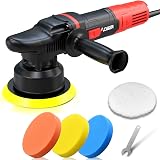

DEWALT Buffer Polisher, 7-in-9-in, 12 amp
A 12 amp corded rotary polisher rated up to 3,500 RPM with a no-volt release switch, wool ingestion shields and a 3-year limited warranty.
Pros
- 12 amp motor with 1440 watts maximum power
- Variable speed dial and trigger spanning 0 to 3,500 RPM
- No-volt release switch prevents unintended restart if power cuts
- 3-year limited warranty with pop-off brushes and wool ingestion shields
Cons
- Weighs 6.7 pounds without pads attached
- Hook-and-loop backing pad included, but pads sold separately
- Higher RPM ceiling requires careful heat management on thin clear coat
- Length of 22 inches makes tight curves more demanding to navigate
Makita 9237CX3 7" Polisher
A 10 amp 7-inch rotary polisher featuring constant speed control under load, soft start and wire mesh intake covers.
Pros
- Constant speed control maintains RPM under working pressure
- 10 amp motor with soft start to reduce polish fling-off
- Wire mesh intake covers prevent wool fibers from entering motor
- Rubberized loop handle and gear housing protect vehicle surfaces
Cons
- Spec table lists power source as Hand Powered despite 10A corded motor
- No warranty duration is stated on the listing
- No electrical certification listing is stated
- Single 7-inch configuration without smaller spot pads included
Buffer Polisher, SPTA 7 Inch 180mm Rotary Polisher
A 7-inch rotary polisher featuring a digital speed display from 500 to 3000 RPM and a kit with four backing plates and twelve pads.
Pros
- Digital screen display indicates 6 variable speed settings
- Speed range starts at 500 RPM for controlled compound spreading
- Extensive kit includes four backing plates in 3, 5, 6 and 7 inches
- Supplied with twelve polishing and wool pads, sandpaper and apron
Cons
- Listing bullet states 1200W while spec table states 1580W max
- Listing mentions a warranty period without specifying months or years
- No electrical safety certification is stated
- Digital screen requires care in dusty polishing environments

SEESII Car Buffer Polisher 1600W 7 Inch/6 Inch
A 1600W copper-motor rotary polisher offering 7 variable speeds up to 3600 RPM with dual handles and speed lock button.
Pros
- High-output 1600W pure copper motor for cutting defect removal
- 7 variable speed selections ranging from 1000 to 3600 RPM
- Speed lock button allows continuous operation without holding trigger
- Includes both 6-inch and 7-inch backing pads with sponge and wool pads
Cons
- Listing advises a 10-minute cool-down every 30 minutes of operation
- Weight is not stated in bullets or spec table
- Bullet refers to random buffer polisher despite rotary configuration
- No warranty term or safety listing is stated

AOBEN Car Buffer Polisher,6 inch Dual Action
A 700W 6-inch dual action random orbital polisher with 6 speeds from 1000 to 4500 RPM and a 12-month warranty.
Pros
- Dual action random orbital motion reduces clear coat burn risk
- 6 variable speed settings from 1000 to 4500 rpm
- Equipped with 6.5-inch foam pads to cushion 6-inch backing plate edges
- Stated 12-month manufacturer warranty coverage
Cons
- Orbital action lacks the aggressive correction power of true rotaries
- Listing states the machine stops under excessive pressure at speeds 1-3
- Weight contradiction: bullet states 5.29 lb while table states 6.8 lb
- Lower 700W motor output compared to dedicated rotary polishers
More options to compare
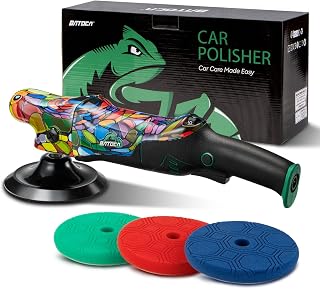 BATOCA P2 Car Buffer PolisherCheck price on Amazon
 Adam's Polishes SK Pro 12mm Car PolisherCheck price on Amazon
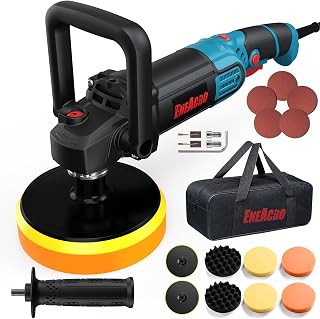 ENEACRO 1700W Rotary Car Buffer Polisher Waxer 7-inch/6-inchCheck price on Amazon
 GEVEELIFE Buffer PolisherCheck price on Amazon
 USB Polishing MachineCheck price on Amazon
Compare the picks
| Model | Shop Score | Power | Speed range | Pad size | Weight | Safety feature | Warranty |
|---|---|---|---|---|---|---|---|
| DeWalt DWP849X | 9.6/10 | 12 A (1440 W) | 0-3,500 RPM | 7 in or 9 in | 6.7 lb | No-volt release switch | 3-year limited |
| Makita 9237CX3 | 9.5/10 | 10 A | 3000 rpm | 7 in | 7 lb | Not stated | Not stated |
| SPTA SPTA0020 | 9.4/10 | 1200W (1580W max) | 500-3000 Rpm | 3, 5, 6, 7 in | 6.6 lb | Not stated | Not stated |
| Seesii TS512 | 9.3/10 | 1600W | 1000-3600 RPM | 6 in and 7 in | Not stated | Not stated | Not stated |
| AOBEN AT3501 | 9.2/10 | 700W | 1000-4500 rpm | 6 in (6.5 in pads) | 5.29 lb (or 6.8 lb) | Not stated | 12 months |
*Specifications are manufacturer rated, as published on each listing and collected 10 October 2026.
How we scored them
Each polisher is scored out of 10 across performance, build quality, value, safety, and warranty terms, using the scoring criteria detailed on our How We Pick page. A stated safety mechanism such as an accidental restart prevention switch earns safety points; listings without stated safety features receive zero. Concrete manufacturer warranty terms receive points calibrated to coverage duration.
| Product | Shop Score | Perf. /35 | Build /25 | Value /25 | Safety /10 | Warranty /5 |
|---|---|---|---|---|---|---|
| DeWalt DWP849X | 9.6 | 30 | 22 | 20 | 4 | 3 |
| Makita 9237CX3 | 9.5 | 30 | 22 | 20 | 0 | 0 |
| SPTA SPTA0020 | 9.4 | 27 | 18 | 22 | 0 | 0 |
| Seesii TS512 | 9.3 | 26 | 16 | 20 | 0 | 0 |
| AOBEN AT3501 | 9.2 | 21 | 16 | 18 | 0 | 2 |
Scores run from 9.2 to 9.8: each product’s point total is placed on that range, so more points always means a higher score.
What the listings tell you
Examining rotary buffer listings highlights important differences in motor specifications and listing accuracy. Motor power across these five models spans from 700W up to 1600W, or 10 A to 12 A on amperage-rated units. Speed ranges generally begin between 0 RPM or 500 RPM and reach ceilings between 3000 RPM and 4500 RPM. However, listing discrepancies are common: one model lists its corded electric machine as Hand Powered in its specification table, another shows contradictory wattage ratings of 1200W in bullet points and 1580W in its spec table, and one listing represents a random orbital polisher rather than a true direct-drive rotary buffer. Only two of the five listings publish a concrete warranty term.
Buying guide: best rotary polisher for paint correction
Direct rotary drive vs dual action
A rotary buffer drives its backing plate directly from the motor spindle without oscillation. This direct rotation generates continuous friction, allowing cutting compounds to level severe clear coat defects rapidly. In contrast, an orbital tool oscillates while turning, which disperses friction and stalls under heavy pressure. Understanding the distinction between direct drive and orbital motion is essential when reviewing dual action vs rotary polisher characteristics. While a dual-action machine offers greater margin for error, a dedicated rotary polisher delivers the aggressive cutting speed needed for severe oxidation and sanding marks.
Motor power and speed ranges
Rotary polishers in this comparison feature motors rated from 10 A to 12 A, or 700W to 1600W. Variable speed control is critical for paint correction. Lower speeds, such as 500 RPM or 1000 RPM, allow compounds to spread evenly across panels without excessive sling. Medium speeds between 1000 RPM and 3000 RPM generate the required heat and friction to break down abrasive compounds and level defects. Dial controls and variable-speed triggers provide dual-stage control, while electronic speed stabilization maintains constant rotational velocity under pad pressure.
Backing plates and pad sizes
Pad diameter significantly affects maneuverability and surface heat generation. Standard large plates measure 7 inches or 6 inches, which cover broad sections such as hoods, roofs, and flat door panels efficiently. Smaller backing plates, including 5 inches and 3 inches, concentrate motor torque and allow precise correction around bumper contours, mirror caps, and narrow pillars. Choosing a polisher compatible with standard hook-and-loop backing plates allows operators to swap between aggressive wool cutting pads and finishing foam discs as outlined in our guide on how to choose a car polisher.
Heat management and operator safety
Direct pad rotation produces friction that warms both the automotive panel and the polisher gear housing. Tools engineered with rubber overmolding and copper motor windings manage operating temperatures across extended sessions. Some high-wattage units advise specific cool-down cycles, such as a 10-minute rest every 30 minutes of operation. For operator protection, restart prevention switches safeguard against accidental spindle activation when reconnecting power cords. Wire mesh intake shields prevent airborne wool fibers from being drawn into internal motor armatures.
Handling weight and ergonomics
Rotary polishers evaluated here weigh between 5.29 pounds and 7 pounds. Because paint correction requires sustained machine control across vertical and horizontal body panels, handle configurations directly affect operator fatigue. Interchangeable bale handles, D-handles, and straight side handles allow detailers to adapt their grip angle for balanced downward pressure without tilting the backing plate edge into the clear coat.
Keep electric pressure washers on a GFCI outlet, never point the wand at people or pets, wear eye protection with polishers and chemicals, and read the label before mixing any cleaning products. Read our Safety Disclaimer.
Frequently Asked Questions
Why use a rotary polisher instead of a dual action polisher?
A rotary polisher utilizes direct-drive rotation to generate concentrated heat and friction, enabling faster leveling of deep scratches, heavy oxidation, and sanding marks compared to orbital machines. For lighter correction or finishing without swirl risk, review the best dual action polisher for beginners.
What speed should be used for rotary paint correction?
Spreading compound is typically managed at lower dial speeds from 500 RPM to 1000 RPM to prevent sling. Active defect correction is performed at moderate rotational speeds between 1000 RPM and 3000 RPM, depending on clear coat hardness and pad composition.
Can a rotary buffer burn through automotive clear coat?
Yes. Because direct rotation produces continuous friction in a fixed circular pattern, holding the pad in one spot or applying excessive edge pressure can quickly heat and burn through clear coat. Moving the pad continuously across the surface and avoiding sharp panel edges prevents heat buildup.
What backing plate and pad sizes work best on a rotary polisher?
A 7-inch or 6-inch backing plate works best for leveling broad, flat panels such as vehicle hoods and roofs. For tight bumper contours, door jambs, and pillars, stepping down to 5-inch or 3-inch backing plates provides precise control.
Why is a no-volt release switch important on a corded polisher?
A no-volt release switch prevents the polisher from spinning unexpectedly when plugged into a live electrical receptacle if the power trigger was left in the locked-on position. The switch requires intentional resetting before motor current is delivered.
Related: our car detailing hub, our comparison of dual action vs rotary polisher tools, and our guide on how to choose a car polisher. Also see our how to use a dual action polisher. Also see our best dual action polisher for beginners. Also see our best cordless polisher. Also see our best mini polisher cordless. Also see our best cordless polisher buffer. Also see our best car detailing kit. Also see our best detailing cart. Also see our how to start a mobile detailing business equipment list. Also see our best gifts for car detailing enthusiasts. Also see our best car vacuum for detailing. Also see our best steam cleaner for car detailing. Also see our best car dryer blower. Also see our best foam cannon.