Best Cordless Polisher: 5 Battery Buffers and Polishers Compared
Five polishers for car paint care and waxing, compared by motor type, speed range, battery voltage, pad size, included accessories and warranty terms.

On this page
Top picks at a glance
As an Amazon Associate we earn from qualifying purchases.
- 1
 Best Professional RotaryDEWALT DCM849B9.5/10View on Amazon
- 2
 Best Mini DetailerBATOCA S59.5/10View on Amazon
- 3
 Best Value KitProtmex Cordless DA9.4/10View on Amazon
- 4
 Best for WaxingTHINKWORK W61329.3/10View on Amazon
A cordless polisher provides complete freedom of movement around vehicles without dragging a power cord over clean clear coat. The best cordless polisher balances motor power, battery runtime and controllable speed to remove swirls or spread wax efficiently. This guide compares five polishers by motor type, speed range, battery voltage, pad size, kit accessories and warranty terms.
GarageToolHQ earns a commission when you buy through links on this page, at no extra cost to you. Read our affiliate disclosure.
Quick picks
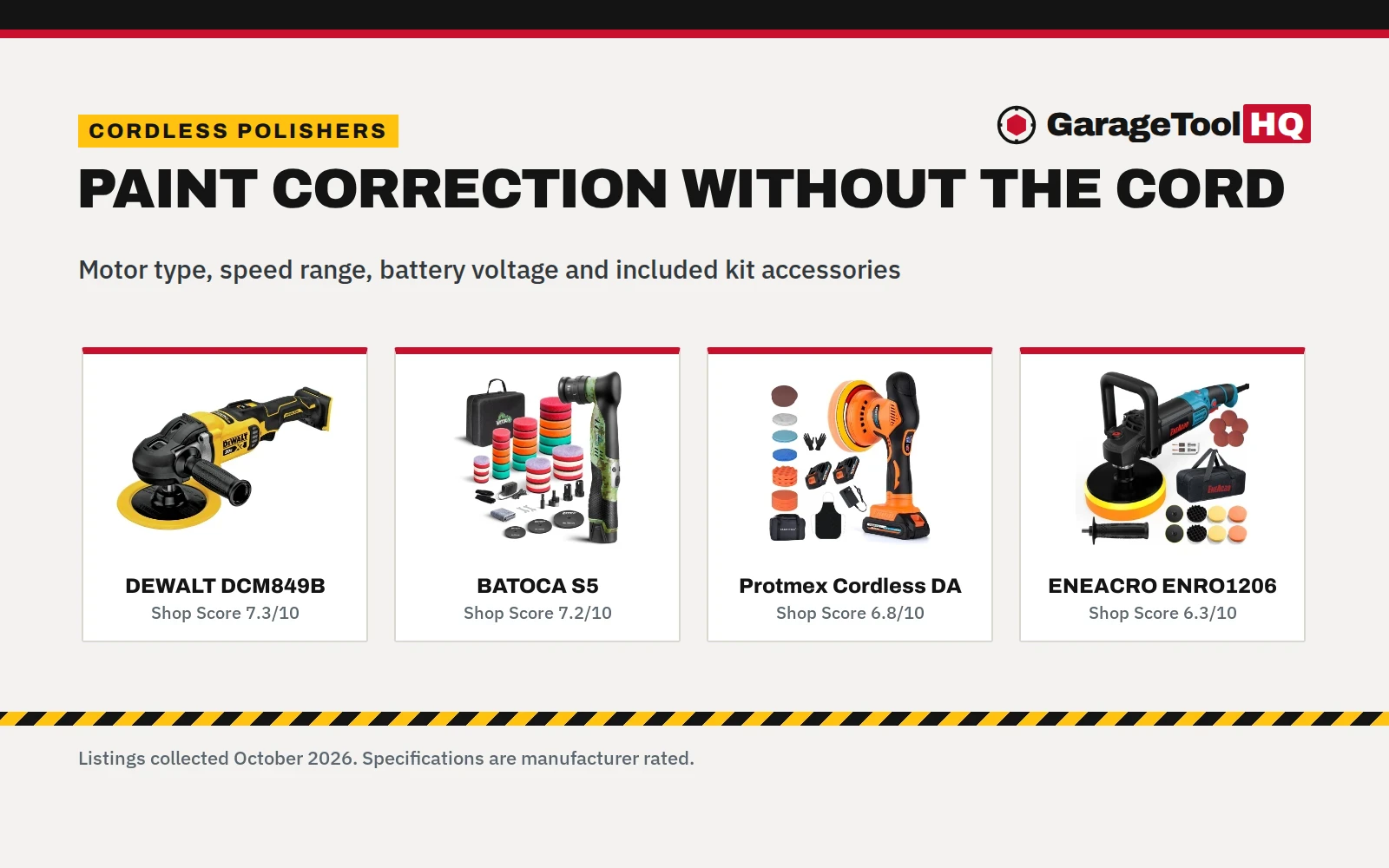
- Best Professional Rotary DEWALT DCM849B: Brushless motor, 20V battery platform, 800 to 2,200 RPM trigger and dial, and a 7-inch backing plate at 4.8 lb. Check price on Amazon
- Best Mini Detailer BATOCA S5: Two 12V 2.0Ah batteries, interchangeable rotary and 12 mm dual-action shafts, and 1, 2, and 3-inch backing plates. Check price on Amazon
- Best Value Kit Protmex Cordless DA: Two 21V 2,000mAh batteries, 6 speeds from 2,800 to 5,500 RPM, 18 accessories, and a 2-year manufacturer warranty at 3.3 lb. Check price on Amazon
- Best for Waxing THINKWORK W6132: 10-inch double-handle buffer with two 20V 2,000mAh batteries, 6 speeds from 1,500 to 3,600 RPM, and multiple bonnets. Check price on Amazon
The picks
DEWALT 20V MAX* XR Cordless Polisher, Rotary
A 20V cordless rotary polisher with a brushless motor, 7-inch backing plate, variable speed dial and trigger from 800 to 2,200 RPM.
Pros
- Brushless motor for efficient runtime and performance
- Speed control on both dial and trigger from 800 to 2,200 RPM
- 7-inch backing plate handles large panels quickly
- Rubber gear case overmold with bail and side handles
Cons
- Bare tool: battery and charger sold separately
- Rotary action requires skill to prevent clear coat burns
- 4.8 lb tool weight before attaching a battery
- No safety listing stated on the listing

BATOCA S5 Cordless Mini Car Polisher Buffer Sander
A cordless mini polisher kit featuring interchangeable rotary and 12 mm dual-action shafts, 1, 2, and 3-inch backing plates, and two 12V 2.0Ah batteries.
Pros
- Interchangeable shafts for both rotary and 12 mm dual-action motion
- Includes 1-inch, 2-inch, and 3-inch backing plates
- Two 12V 2.0Ah batteries and fast charger included
- 6-speed adjustment from 2,000 to 5,500 RPM
Cons
- 20 to 30 minute runtime without load per battery
- Small backing plates not suited for large body panels
- 3-inch backing plate cannot be fitted on the straight rotary shaft
- No safety listing stated on the listing

Protmex Cordless Car Buffer Polisher w/ 2x2000mAh
A 6-inch cordless eccentric polisher with two 21V 2,000mAh batteries, six variable speeds from 2,800 to 5,500 RPM, and 18 accessories at 3.3 lb.
Pros
- Two 21V 2,000mAh batteries included in the kit
- Variable 6-speed dial from 2,800 to 5,500 RPM
- Lightweight 3.3 lb operating weight with battery
- 18 polishing pads, covers, and sanding sheets included
Cons
- Orbit throw measurement in millimeters is not stated
- Spec table lists Number of Packs as 10 for a single tool
- Included components field in spec table omits the 18 accessories
- No safety listing stated on the listing

ENEACRO 1700W Rotary Car Buffer Polisher Waxer
A corded electric 1,700W rotary polisher with 6-inch and 7-inch backing plates, 7 speeds from 1,300 to 3,500 RPM, and dual handles at 5.5 lb.
Pros
- High-power 1,700W, 10 A motor for heavy paint correction
- Includes both 6-inch and 7-inch loop backing plates
- 7-speed dial from 1,300 to 3,500 RPM with trigger lock
- Comes with D-handle, side handle, bag, and carbon brushes
Cons
- Corded electric: requires an electrical outlet and extension cord
- Rotary drive creates heavy heat and friction on paint
- 5.5 lb tool weight is heavier than cordless options
- Brushed motor requires periodic carbon brush replacement

20V Cordless Buffer Polisher,10 Inch Portable
A 10-inch cordless orbital buffer and waxer with two 20V 2,000mAh batteries, six speeds from 1,500 to 3,600 RPM, and double steering handles.
Pros
- Wide 10-inch pad covers flat hoods and roofs quickly
- Two 20V 2,000mAh lithium batteries with power indicators
- Double-handle grip reduces arm fatigue when spreading wax
- Includes wool pads, velvet pads, bonnets, and sponges
Cons
- No warranty term is stated anywhere on the listing
- 7.09 lb weight makes it the heaviest tool here
- Orbit throw measurement is not stated
- 10-inch fixed pad size cannot detail mirrors or pillars
Compare the picks
| Model | Shop Score | Type | Speed range | Power | Backing plate | Corded | Warranty |
|---|---|---|---|---|---|---|---|
| DEWALT DCM849B | 9.5/10 | Rotary | 800 to 2,200 RPM | 20V battery (bare tool) | 7 in (180 mm) | No | 1 year |
| BATOCA S5 | 9.5/10 | Rotary and DA (12 mm) | 2,000 to 5,500 RPM | 2 x 12V 2.0Ah batteries | 1 in, 2 in, 3 in | No | 1 year |
| Protmex Cordless DA | 9.4/10 | Eccentric (DA) | 2,800 to 5,500 RPM | 2 x 21V 2,000mAh batteries | 6 in | No | 2 years |
| ENEACRO ENRO1206 | 9.3/10 | Rotary | 1,300 to 3,500 RPM | 1,700 W, 10 A | 6 in and 7 in | Yes | 12 months |
| THINKWORK W6132 | 9.3/10 | Orbital buffer | 1,500 to 3,600 RPM | 2 x 20V 2,000mAh batteries | 10 in | No | Not stated |
Specifications are manufacturer rated, as published on each listing and collected 9 October 2026. Where a listing contradicts itself, both figures are shown.
How we scored them
Each polisher is scored out of 10 on performance, build, value, safety and warranty, with the weights published on our How We Pick page. None states a UL, ETL or CSA listing, so all score zero on safety, and one gives no stated warranty term.
| Product | Shop Score | Perf. /35 | Build /25 | Value /25 | Safety /10 | Warranty /5 |
|---|---|---|---|---|---|---|
| DEWALT DCM849B | 9.5 | 30 | 22 | 18 | 0 | 2 |
| BATOCA S5 | 9.5 | 29 | 20 | 20 | 0 | 2 |
| Protmex Cordless DA | 9.4 | 28 | 19 | 19 | 0 | 3 |
| ENEACRO ENRO1206 | 9.3 | 27 | 18 | 16 | 0 | 2 |
| THINKWORK W6132 | 9.3 | 23 | 16 | 19 | 0 | 0 |
Scores run from 9.2 to 9.8: each product’s point total is placed on that range, so more points always means a higher score.
What the listings tell you
We analyzed five polisher listings across multiple brands. Only one stated a specific orbit throw in millimeters, while three included two battery packs in the box. Four stated a concrete manufacturer warranty term, but none provided a UL, ETL or CSA electrical safety certification. Notably, one listing in the comparison group specified corded electric power rather than battery operation.
Buying guide: choosing the best cordless polisher
Rotary versus dual action
A rotary polisher turns directly on an axis, delivering rapid cutting power for deep scratches and oxidized gelcoat, but requires careful technique to prevent holograms and burning clear coat. Dual-action and eccentric polishers orbit while rotating, which dissipates friction and significantly reduces the risk of cutting through automotive clear coat.
Motor design: brushless versus brushed
Motor construction directly affects performance and long-term maintenance in cordless buffers. A brushless motor, like the design on the DEWALT rotary polisher, eliminates friction from wearable contact points, providing higher efficiency and extended battery runtime per charge. In contrast, brushed motors utilize carbon brushes that wear down over time. Tools like the corded ENEACRO provide replacement carbon brushes in the box because the brushes eventually require servicing after extended polishing sessions. For cordless tools where battery conservation is paramount, brushless architecture extracts maximum rotational energy from each battery charge.
Battery voltage and runtime
Cordless detailing tools in this group operate on 12V, 20V or 21V battery packs. Listings that state runtime claims indicate 20 to 30 minutes of continuous operation per 2,000mAh pack, meaning polishing an entire vehicle requires multiple charged packs or a fast charger.
Managing battery runtime and charge cycles
Because cordless polishers draw continuous current under pad pressure, managing your charging routine prevents unwanted work interruptions. With typical battery runtimes spanning 20 to 30 minutes per 2,000mAh pack, a single battery is rarely enough to complete compounding and polishing on an entire car. Selecting kits that include two batteries allows you to keep one pack on the charger while using the other on vehicle panels. Fast chargers capable of replenishing a pack in 1 hour help maintain a continuous workflow, provided you pace your work panel by panel and avoid running lithium packs until they are completely drained.
Backing plates and pad sizing
Backing plate size determines where each machine excels. Small 1-inch, 2-inch and 3-inch backing plates fit tight bumper recesses, mirrors and emblems. Standard 6-inch and 7-inch plates cover broad exterior panels like doors and fenders. Large 10-inch buffers cover broad horizontal panels quickly for applying wax, but cannot navigate narrow curves.
Pad materials: foam, wool, and bonnets
Matching the pad material to your compounding stage ensures clean correction without hazing. The listings in this comparison bundle diverse pad styles for different detailing steps. Dense wool polishing discs provide aggressive defect cutting to level deeper clear coat scratches and heavy oxidation. Wave sponge pads and waffle foam pads help distribute polishing compound across vehicle panels while promoting airflow to dissipate surface heat. Soft cloth covers, coral velvet bonnets, and fine waxing bonnets, such as those supplied with wide-format waxers, are designed specifically for applying liquid carnauba or buffing off paste wax residue without marring freshly corrected clear coat.
Ergonomics, weight, and handle configurations
Polishing requires steady, even pressure across vertical doors and horizontal hoods, making tool balance and handle ergonomics essential. Operating weight varies significantly among cordless models, from ultra-lightweight detailers at 926 g and mid-sized orbital units at 3.3 lb up to heavier machines reaching 4.8 lb and 7.09 lb. For vertical panels, lightweight polishers reduce shoulder strain. Interchangeable handles, including loop bail handles and perpendicular side handles, allow you to reposition your grip when navigating curved bumpers, lower rocker panels, and rooflines.
Cordless shop equipment
If you already use battery tools for wheel maintenance, knowing how much torque you need to remove lug nuts helps you evaluate your tool collection. Explore our cordless tools hub to see how battery platforms compare across garage projects.
Wash and prep before polishing
Never polish dirty vehicle panels, as loose grit becomes trapped beneath the buffing pad and scratches clear coat. Check what PSI pressure washer is safe for cars to wash and rinse surfaces before buffing.
Use rated jack stands on solid ground, wear eye protection with power and air tools, keep fuel-burning equipment out of a closed garage, and follow the manual for every tool. Read our Safety Disclaimer.
Frequently Asked Questions
Is a cordless polisher powerful enough for paint correction?
Yes. Cordless polishers equipped with pure copper or brushless motors provide variable speeds up to 5,500 RPM, which is sufficient for compounding clear coat and lifting oxidation. Because battery packs run down, having backup batteries on hand keeps workflow continuous.
How long does a battery buffer run on one charge?
Listings that specify run duration state between 20 and 30 minutes of continuous operation from a 2,000mAh pack. Using dual batteries allows one pack to replenish while the second powers the tool.
What is the difference between rotary and dual-action polishers?
A rotary polisher turns directly on a fixed spindle, which concentrates friction and requires practiced control to prevent burning paint. A dual-action or eccentric machine combines rotation with an orbital throw, spreading heat across the surface for safer correction.
Can I use a cordless polisher for waxing?
Yes. Low speed settings from 1,300 to 2,800 RPM allow smooth, even application of liquid or paste wax without flinging compound off the pad.
Should beginners choose a rotary or an orbital polisher?
Beginners are generally safer using an orbital or dual-action machine. Rotary polishers generate friction quickly and can scorch clear coat along body lines or thin edges if held stationary.
Related: the best cordless polisher buffer, our car detailing hub and the best mini polisher cordless. Also see our best dual action polisher for beginners. Also see our how to choose a car polisher. Also see our how to use a dual action polisher. Also see our best cordless ratchet. Also see our best cordless impact wrench for lug nuts. Also see our best car detailing kit. Also see our best foam cannon. Also see our best steam cleaner for vehicles. Also see our what psi pressure washer is safe for cars. Also see our how to start a mobile detailing business equipment list.