Do Battery Desulfators Work?
Do battery desulfators work? The pulse and desulfation modes on four smart chargers, what the makers state they reverse, and the limits to know.

On this page
Top picks at a glance
As an Amazon Associate I earn from qualifying purchases.
- 1
 NOCO GENIUS2D 2A 12V Onboard Battery Charger9.8/10View on Amazon
- 2
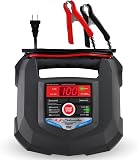 Schumacher Electric 15A Car Battery Charger9.8/10View on Amazon
- 3
 YHCHKJ 20A Car Battery Charger9.7/10View on Amazon
- 4
 WAVLINK 280W Smart Battery Charger9.7/10View on Amazon
A car sits through the winter, and when spring comes the battery turns the engine over slowly or not at all. Do battery desulfators work? Yes, as the makers state it, for a sulfated lead-acid battery: the NOCO and YHCHKJ state that pulse charging reverses sulfation and restores capacity, and the WAVLINK and Schumacher list a desulfation mode. Here, desulfation is a mode inside a smart charger, not a separate device, and the YHCHKJ states plainly that it is not a jump starter.
GarageToolHQ earns a commission when you buy through links on our product pages, at no extra cost to you. Read our affiliate disclosure.
Below: what sulfation is, how the desulfation mode works, how to match a charger to your battery, and the chargers in the gear section.

NOCO GENIUS2D 2A 12V Onboard Battery Charger
A 2 A, 12V direct-mount onboard charger and maintainer with temperature compensation and a desulfator, for under-the-hood installation.
Pros
- Mounts permanently under the hood
- Thermal sensor adjusts charge to temperature
- Desulfator and overcharge protection
- UL, CEC and FCC stated; 3 year warranty
Cons
- 2 A is slow on a fully flat battery
- Needs mounting and wiring
- Lead-acid only, no lithium
- 12V only

Schumacher Electric 15A Car Battery Charger
A 15 A, 6V and 12V microprocessor charger and maintainer with a 3 A trickle mode, battery tester and desulfation, UL 1236 listed.
Pros
- 15 A charging recharges a flat car battery quickly
- 3 A smart trickle for maintenance
- Charges 6V and 12V, tests and desulfates
- States UL 1236, FCC and DOE compliance
Cons
- No lithium mode stated
- No engine start function
- 1 year warranty
- 2.7 lb, bigger than a maintainer
YHCHKJ 20A Car Battery Charger
A 20 amp smart charger for 12 and 24 volt batteries with Pulse Repair desulfation, adjustable currents and a 5-year after-sales service guarantee, handling the desulfation and charging part of the job.
Pros
- Pulse Repair restores lead-acid battery capacity
- 20 amp max current with adjustable 12V and 24V modes
- Temperature compensation and multiple protections
- 5-year after-sales service guarantee
Cons
- Not a jump starter; cannot start a dead battery
- Needs at least 2 volts to start charging
- No 6 volt support
- 24 volt charging tops out at 10 amps, not 20 amps
WAVLINK 280W Smart Battery Charger
A 280 watt smart charger for 6, 12 and 24 volt batteries with four modes including Desulfation, an LCD display and reverse polarity protection, handling the desulfation and charging part of the job.
Pros
- Four modes including Desulfation and Maintain
- 20 amp charging for 6, 12 and 24 volt batteries
- Reverse polarity, sparkproof and short-circuit protection
- LCD display shows charging status
Cons
- 3 month warranty is short
- Operating range tops out at 104 F
- No temperature compensation stated
- 2.5 lb, heavier than the 1.23 lb YHCHKJ
Do battery desulfators work? What sulfation is
Sulfation is the buildup of lead sulfate crystals on the plates of a lead-acid battery, and it cuts the capacity the battery can hold. The NOCO states that precision pulse charging reverses sulfation and acid stratification, and the YHCHKJ states that Pulse Repair restores lead-acid battery capacity. Both makers describe the same job: breaking the crystals down.
Sulfation is a lead-acid problem. The WAVLINK and YHCHKJ also charge lithium and LiFePO4 batteries. The YHCHKJ states that Pulse Repair restores lead-acid battery capacity, and the NOCO is built for 12 volt lead-acid batteries only. The WAVLINK lists Desulfation as a mode and charges lithium batteries, but it states no desulfation claim for lithium.
How the desulfation mode works
Pulse charging works in short bursts of current that break down sulfate crystals. The NOCO states that precision pulse charging automatically detects and reverses sulfation and acid stratification. The YHCHKJ states that Pulse Repair restores lead-acid battery capacity and activates a battery in poor condition. The WAVLINK lists Desulfation as one of four charging modes, and the Schumacher lists an advanced desulfation mode.
The WAVLINK and YHCHKJ show charging status on an LCD display, and the YHCHKJ adds temperature compensation for hot or cold weather. The NOCO adds a thermal sensor that adjusts the charge by ambient temperature, and its Force Mode charges a battery from as low as 1 volt, or down to zero volts for a completely dead battery. The Schumacher adds auto voltage detection and a 3 amp trickle charge.
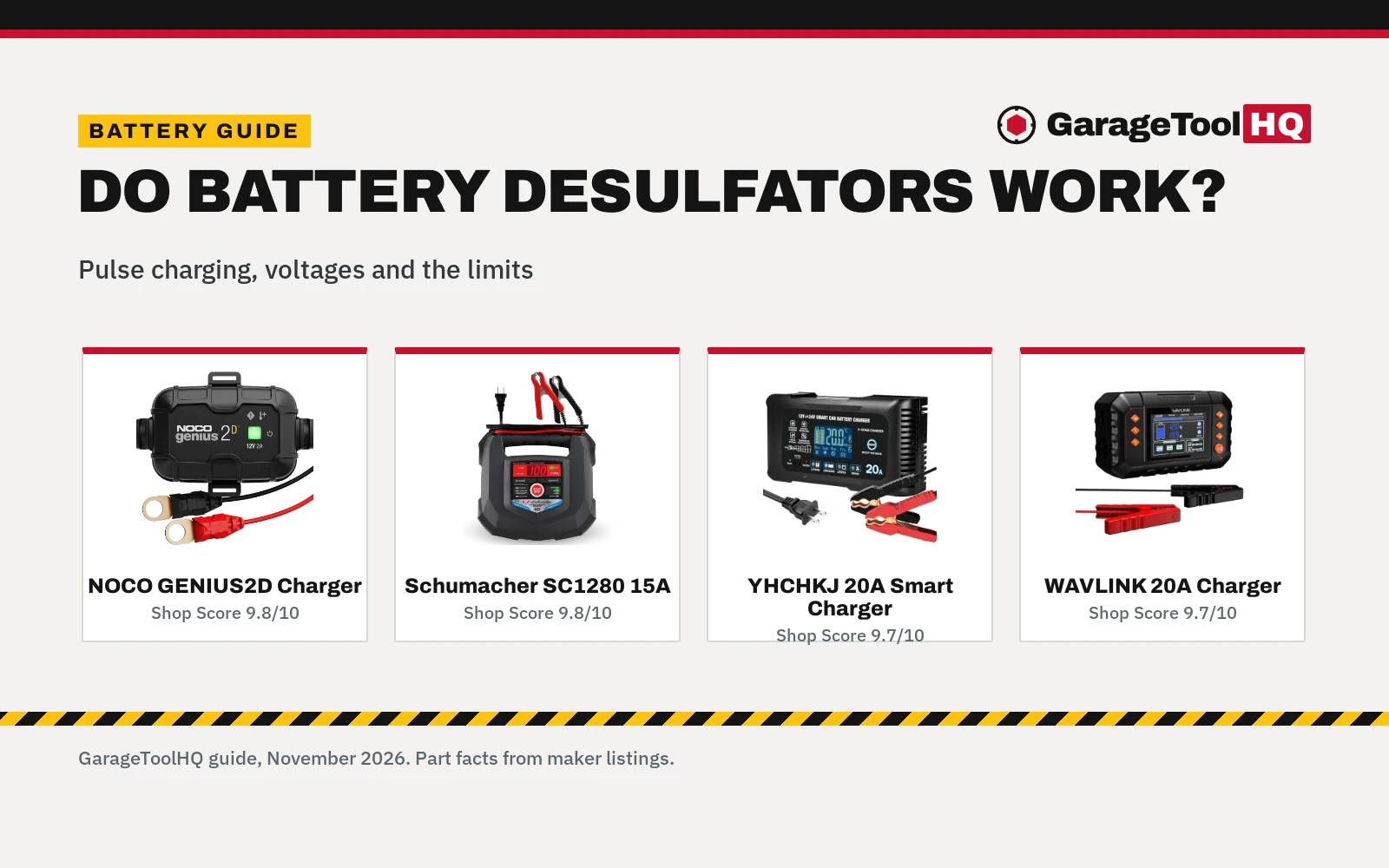
| Charger | Desulfation mode | Battery types | Max current |
|---|---|---|---|
| WAVLINK 20A Charger | Desulfation mode | Lead-acid 6, 12 and 24V; lithium, LiFePO4 12 and 24V | 20A |
| YHCHKJ 20A Smart Charger | Pulse Repair | 12 and 24 volt lithium, LiFePO4, lead-acid | 20A |
| NOCO GENIUS2D Charger | Pulse charging, desulfator | 12 volt lead-acid | 2A |
| Schumacher SC1280 15A | Desulfation mode | 6 and 12 volt standard, AGM, gel, deep-cycle | 15A |
How to match a charger to your battery
Match the voltage first. The WAVLINK charges 6, 12 and 24 volt batteries, the YHCHKJ charges 12 and 24 volt batteries, the NOCO charges 12 volt lead-acid batteries, and the Schumacher charges 6 and 12 volt batteries. Then match the battery type: lead-acid covers wet, gel, AGM, SLA and deep-cycle here. The YHCHKJ needs at least 2 volts to start, while the NOCO charges from as low as 1 volt.
Then match the current. A 20 amp charger fills a battery faster than a 2 amp maintainer: the WAVLINK and YHCHKJ charge at 20 amps, the Schumacher at 15 amps, and the NOCO at 2 amps. The YHCHKJ lets you pick the current, with 5, 10 and 20 amp modes at 12 volts and 3, 5 and 10 amp modes at 24 volts.
Lead-acid batteries can release hydrogen while charging, so charge in a ventilated space away from sparks and flames, connect positive first and negative last, set the charger to the battery type (flooded, AGM, gel, lithium), and wear eye protection. Read our Safety Disclaimer.
What a desulfator cannot do
The YHCHKJ states it plainly: it is not a jump starter and cannot start a dead battery. The NOCO charges a battery from as low as 1 volt, and its Force Mode charges a completely dead battery down to zero volts. The YHCHKJ needs at least 2 volts to start, so a battery below that will not charge on it.
Do battery desulfators work? The gear
The four chargers below cover the job above: a pair of 20 amp smart chargers with a desulfation mode, a 2 amp onboard maintainer with Force Mode, and a 15 amp charger with a desulfation mode.
FAQ: garage tools
Do battery desulfators work on lithium batteries?
Not on the claims stated here. Sulfation is a lead-acid problem, and the desulfation claims stated here are for lead-acid batteries: the YHCHKJ states Pulse Repair restores lead-acid capacity. The WAVLINK lists a Desulfation mode and charges lithium batteries, but it states no desulfation claim for lithium.
Can a desulfator revive a dead battery?
It depends on the charger. The NOCO charges a battery from as low as 1 volt, and its Force Mode charges a completely dead battery down to zero volts. The YHCHKJ needs at least 2 volts to start.
What voltage charger do I need?
Match the battery. The WAVLINK charges 6, 12 and 24 volt batteries, the YHCHKJ charges 12 and 24 volt batteries, the NOCO charges 12 volt batteries, and the Schumacher charges 6 and 12 volt batteries.
Does a desulfator need a special mode?
Yes, and every charger names its own. The WAVLINK lists Desulfation as one of four charging modes, the YHCHKJ uses Pulse Repair, the NOCO detects sulfation with precision pulse charging, and the Schumacher lists an advanced desulfation mode.
What protections should a battery charger have?
Look for reverse polarity, overcharge, overcurrent and short-circuit protection, and temperature compensation. The WAVLINK lists reverse polarity protection, and the NOCO lists overcharge protection with temperature compensation.
Can I leave a desulfator charger connected?
It depends on the charger. The NOCO is made to stay connected indefinitely without overcharging, and the YHCHKJ trickle-charges (on Amazon) for maintenance over months.
Related: diagnostics and electrical hub, the what is a battery desulfator guide, battery desulfator vs battery charger, best car battery desulfators and the best battery charger maintainers. Also see how to choose a car battery and car battery charger problems.