How to Use Wheel Chocks: Setup, Placement and Safety Guide
How to position wheel chocks correctly on level ground and slopes, pair them with the parking brake and jack stands, and select the right chock material.

On this page
Top picks at a glance
As an Amazon Associate we earn from qualifying purchases.
- 1
 MaxxHaul Rubber Wheel Chock 2 Pack9.7/10View on Amazon
- 2
 MaxxHaul Solid Rubber Wheel Chock 2-Pack9.6/10View on Amazon
- 3
 PAULINN Camper RV Wheel Chock Stabilizer 2 Sets for Travel9.6/10View on Amazon
- 4
 Amazon Basics Automotive Wheel ChocksView on Amazon
- 5
 Vestil LWC-15 Laminated Rubber Wheel Chock 8 In. x 10-5/16View on Amazon
How to use wheel chocks begins with parking on a solid, level surface, setting the vehicle parking brake, and placing wedge-shaped blocks tight against the center of the tire tread on the downhill side. When raising an axle with a floor jack for maintenance, place chocks on both sides of the tires that remain on the ground before lifting. For trailers and recreational vehicles, position chocks against the tires before disconnecting the hitch to block rolling movement.
More options to compare
 Amazon Basics Automotive Wheel ChocksCheck price on Amazon
 Vestil LWC-15 Laminated Rubber Wheel Chock 8 In. x 10-5/16Check price on Amazon
GarageToolHQ earns a commission when you buy through links on our product pages, at no extra cost to you. Read our affiliate disclosure.
Below: how wheel chocks prevent rolling accidents, how solid rubber, plastic, and scissor designs compare, a step-by-step placement checklist, and essential rules for pairing chocks with jack stands during garage maintenance.
How to use wheel chocks: where the rolling risk comes from
A parked vehicle feels stable until gravitational force, mechanical slack, or lifting leverage overcomes tire friction. Understanding how and why vehicles roll highlights why wheel chocks are indispensable shop safety equipment:
- Incline gravity. Even a slight driveway slope creates continuous downward pull. Gravity works against the tire contact patch, and if tire traction slips on smooth concrete, oil, moisture, or gravel, the vehicle rolls downhill uncontrolled.
- Transmission park pawl limitations. In an automatic transmission, placing the selector in park engages a small metal component called a parking pawl into a notched gear. The pawl allows several inches of vehicle rocking before locking, and high stress on steep grades can jam or shear the pawl. A manual transmission left in gear relies solely on engine compression, which can slip over time.
- Open differential rotation. When a vehicle has an open differential, raising one drive wheel allows that lifted wheel to spin freely in the opposite direction while the grounded wheel rotates, even with the transmission in park. Without chocks against the grounded rubber, the car can roll off a jack.
- Lifting pivot dynamics. Raising a vehicle with a hydraulic jack lifts one end along an arc rather than straight vertical travel. This lateral leverage pushes or pulls the vehicle horizontally, creating roll force against the remaining grounded wheels.
Common wheel chock materials and designs: how they compare
| Chock Type | Primary Material | Best Application | Key Characteristics |
|---|---|---|---|
| Solid molded rubber | Dense synthetic or natural rubber | Passenger cars, trucks, shop maintenance | High surface friction, grips concrete and asphalt, weather-resistant |
| Structural poly foam or rigid plastic | High-density polypropylene or poly foam | Light vehicle storage, trunk travel kits | Lightweight to carry, easy to store, requires textured base for traction |
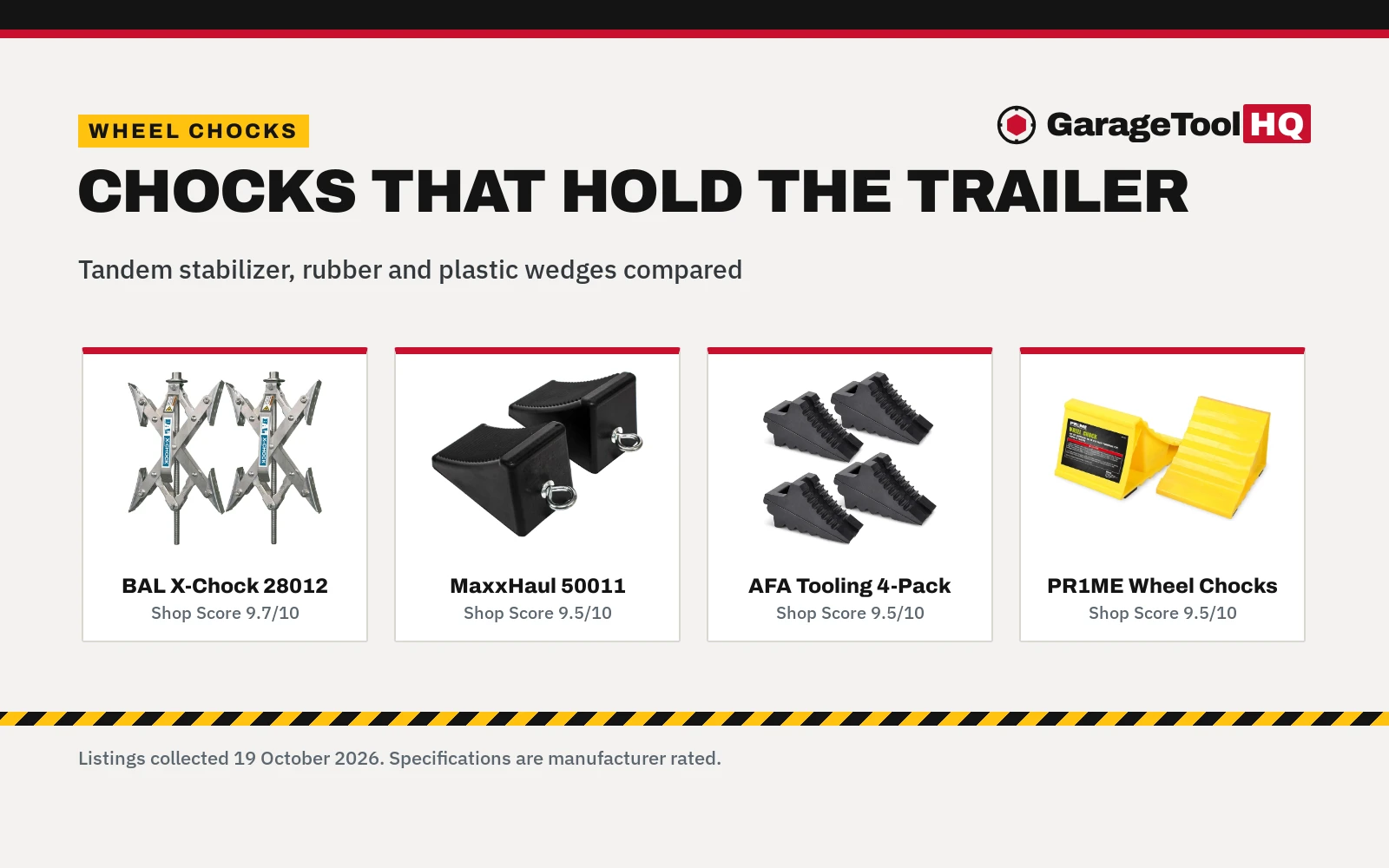
| Tandem-axle scissor stabilizer | Cast iron or heavy steel | Dual-axle travel trailers and RVs | Expands between adjacent tires to lock rotation on opposing faces |
The gross weight of the vehicle, the outer tire diameter, and the ground surface determine which chock construction provides adequate holding power. Heavy molded rubber blocks offer the highest friction coefficient on slick concrete shop floors, while mechanical scissor chocks apply opposing force between adjacent tandem trailer wheels.
Equipment listings show concrete differences in dimensions, materials, and weights across different designs. For example, MAXXHAUL lists an 8 by 4 by 4 inch structural poly foam chock weighing 1.8 pounds as a pair under model 50503. Reonite lists a hard plastic chock measuring 7.87 by 4.56 by 4.17 inches with a 5 mm non-slip base mat, rated for tire diameters up to 26 inches with an item weight of 2.79 pounds for a 4 pack. Amazon Basics lists automotive chocks measuring 8.27 by 6.06 by 4.53 inches. Among molded rubber blocks, ROBLOCK lists rubber chocks measuring 6.3 by 4.3 by 4 inches with 3 reflective strips, while OULEME lists rubber blocks measuring 8 by 5 by 4 inches at 2.45 lb each. OULEME also lists rubber pairs connected by a 52-inch braided nylon rope. Rhino USA lists heavy rubber chocks measuring 9 by 14 by 4 inches with a set weight of 14.96 pounds, and Vacallity lists solid rubber blocks measuring 5.31 by 5.31 by 7.87 inches with a 14.2-inch connecting rope. For tandem-axle camper applications, WELLUCK lists heavy cast iron X-shaped chocks weighing 10 pounds that expand between 3.5 and 12 inches to lock opposing tires.
How to use wheel chocks safely: the step-by-step checklist
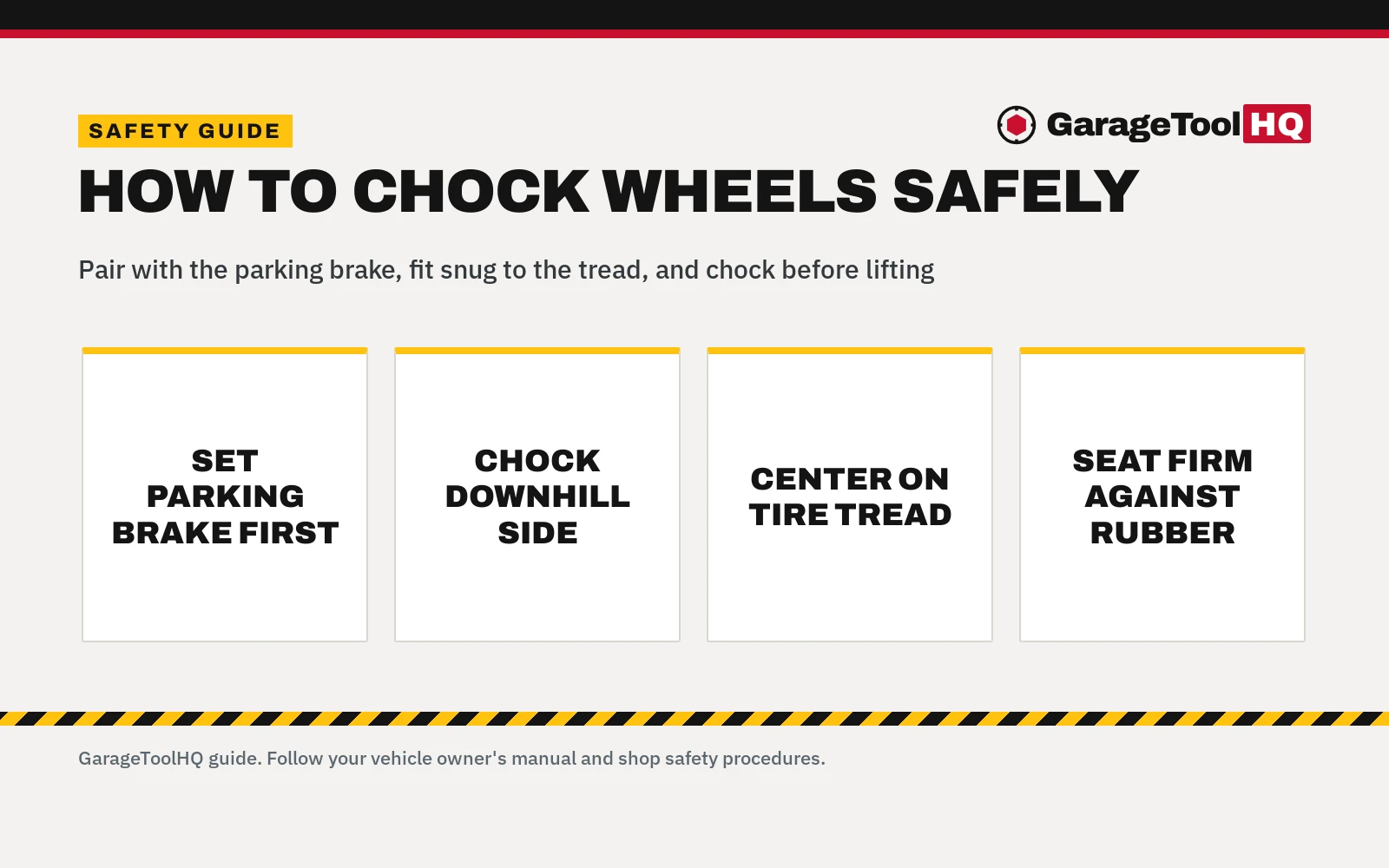
- Park on a solid, level surface. Whenever possible, position the vehicle on level concrete or asphalt. Shift automatic transmissions into park, or shift manual transmissions into low gear or reverse. Turn off the ignition.
- Engage the parking brake fully. Set the emergency brake firmly before stepping out of the vehicle. The parking brake provides internal mechanical hold, while chocks provide external physical resistance.
- Inspect the ground and tire contact points. Clear away loose debris, ice, or thick grease from the path directly in front of and behind the tires where the chocks will rest.
- Determine the direction of slope and rolling hazard. If the vehicle is parked on an incline, identify the downhill direction. If raising the vehicle with a jack, identify which axle remains on the ground.
- Position chocks against the correct tire faces. When parked facing downhill, place chocks against the front face of the downhill tires. When parked facing uphill, place chocks against the rear face of the downhill tires. When lifting an axle on level ground, place chocks against both the front and rear faces of the grounded tires.
- Center the chock squarely on the tire tread. Align the curved or angled face of the wedge with the center of the tire tread. Avoid setting chocks crooked, off to the sidewall edge, or angled away from the direction of travel.
- Press the chock snug against the tread rubber. Push the chock firmly under the tire curve by hand. The wedge face must touch the tire tread snugly with no gap between the block and the rubber.
- Chock both sides of the axle. Always chock both the driver side and passenger side tires across the axle. Chocking only a single tire creates a pivot point around which the vehicle can swing if force is applied.
- Verify placement before beginning work. Walk around the vehicle to confirm each chock sits flat on the floor and snug against the tire. Never remove a chock while the vehicle is raised or while someone is working nearby.
Wheel chocks keep tires from rolling, but they do not support vehicle weight. Never get under a vehicle on a jack alone. Always support the vehicle with rated stands on solid level ground placed at the vehicle owner’s manual lift points before beginning any underside inspection or repair work.
A jack is for lifting, not holding. Never work under a vehicle supported only by a jack: set it on rated jack stands, on solid, level ground, at the manufacturer's lift points, chock the wheels, and give the car a firm shake before you go under. Read our Safety Disclaimer.
When to use wheel chocks: parking slopes vs maintenance lifting
Wheel chocks serve distinct roles depending on whether you are securing a parked vehicle, lifting a car for maintenance, or unhitching a trailer:
- Lifting the front axle: When you raise the front wheels off the floor to change brake pads or drain engine oil, the rear tires remain on the ground. Place chocks tight against both the front and rear faces of both rear tires. This prevents the vehicle from rolling backward or forward as the floor jack swings upward.
- Lifting the rear axle: Raising the rear wheels creates an extreme rolling hazard on rear-wheel drive and all-wheel drive vehicles. The parking brake locks the rear wheels, so lifting the rear axle disables the vehicle’s primary mechanical hold. The front wheels have no parking pawl and can rotate freely through the open front differential and steering linkages. You must chock both the front and rear faces of both front tires before raising the rear axle. Review our guide to how to use a floor jack safely before operating hydraulic jacks.
- Working with jack stands: Jack stands provide rigid vertical support once the car is elevated. Place the jack at designated reinforced pinch welds or frame locations identified in the vehicle owner’s manual. Lower the car onto rated stands positioned on flat concrete, keeping the chocks firmly wedged against the grounded tires throughout the entire procedure. For sizing recommendations, see our guide on what size jack stands do I need and compare models in our roundup of the best jack stands.
- Driving onto service ramps: When driving a vehicle onto elevated service ramps for oil changes, the elevated wheels rest on the ramp platforms while the opposing axle stays on the garage floor. Immediately engage the parking brake and place chocks behind the grounded wheels to prevent the car from rolling backward down the ramp incline. Compare heavy ramp options in our guide to the best car ramps.
Chocking travel trailers, RVs, and tandem axles
Trailers present unique rolling risks because towed equipment lacks a transmission parking pawl. When uncoupling a travel trailer, utility hauler, or boat trailer from a tow vehicle hitch, gravity and tongue weight can cause the trailer to roll or tongue jacks to collapse:
- Chock before unhitching: Always place wheel chocks against the trailer tires before unlatching the hitch coupler, removing safety chains, or cranking the trailer tongue jack. Never disconnect the tow vehicle while trailer wheels remain unblocked.
- Tandem-axle trailers: For trailers equipped with dual axles, standard wedge chocks should be placed on the downhill side of both wheels on the lowest axle. In addition, scissor-style chocks fit between the tires on tandem axles. Turning the drive bolt expands the metal arms outward against both tires simultaneously, locking tire rotation from opposing directions and stabilizing camper bounce.
- Soft ground and unpaved campsites: When parking on dirt, gravel, or wet grass, standard plastic chocks can slide or sink under tire load. Use dense rubber chocks with deep bottom tread lugs, or place a wide wooden or composite traction pad beneath the chock to prevent slipping.
For a detailed breakdown of top-rated rubber and metal tire stops, browse our complete guide to the best wheel chocks.
Frequently Asked Questions
Which side of the tire do you put wheel chocks on?
On a downhill slope, place wheel chocks against the downhill side (in front of the tires when facing downward). On an uphill slope, place chocks against the downhill side (behind the rear face of the tires when facing upward). When lifting a vehicle on level ground, place chocks on both the front and rear faces of the tires that stay on the ground.
Do you put wheel chocks in front or behind tires?
Put wheel chocks in the direction the vehicle would naturally roll if the parking brake failed. If the car is parked facing downhill, put chocks in front of the tires. If the car is parked facing uphill, put chocks behind the tires. When using a jack on a flat garage floor, put chocks both in front and behind the grounded wheels.
Do you need wheel chocks on both sides of a vehicle?
Yes. Always chock both tires across the grounded axle. Chocking only one side leaves the opposite wheel free to move, which can cause the vehicle to pivot around the single blocked wheel and push the car off a jack or jack stands.
When should you chock trailer wheels when unhitching?
Chock trailer wheels before loosening the hitch ball coupler, disconnecting safety chains, or raising the tongue jack. Keeping trailer wheels locked before disconnecting ensures the trailer cannot roll forward, backward, or sideways when separated from the tow vehicle.
Where to buy wheel chocks and what features to check?
Wheel chocks are available at automotive parts stores, farm supply retailers, trailer dealerships, and online marketplaces. When selecting chocks, choose dense oil-resistant rubber over thin plastic for garage work, ensure the chock height matches your tire diameter, and look for integrated carry handles or pull ropes for safe placement and removal.
Related: our guide to how to use a floor jack safely, our comparison of the best wheel chocks, choosing the best jack stands, our overview of what size jack stands do I need, and our jacks and stands hub.