Mini Split vs Garage Heater: Which One Should You Buy?
A mini split heats and cools a garage from a fixed install, while a kerosene torpedo heater brings portable high-output heat for open spaces; which one fits depends on how the garage is used.

On this page
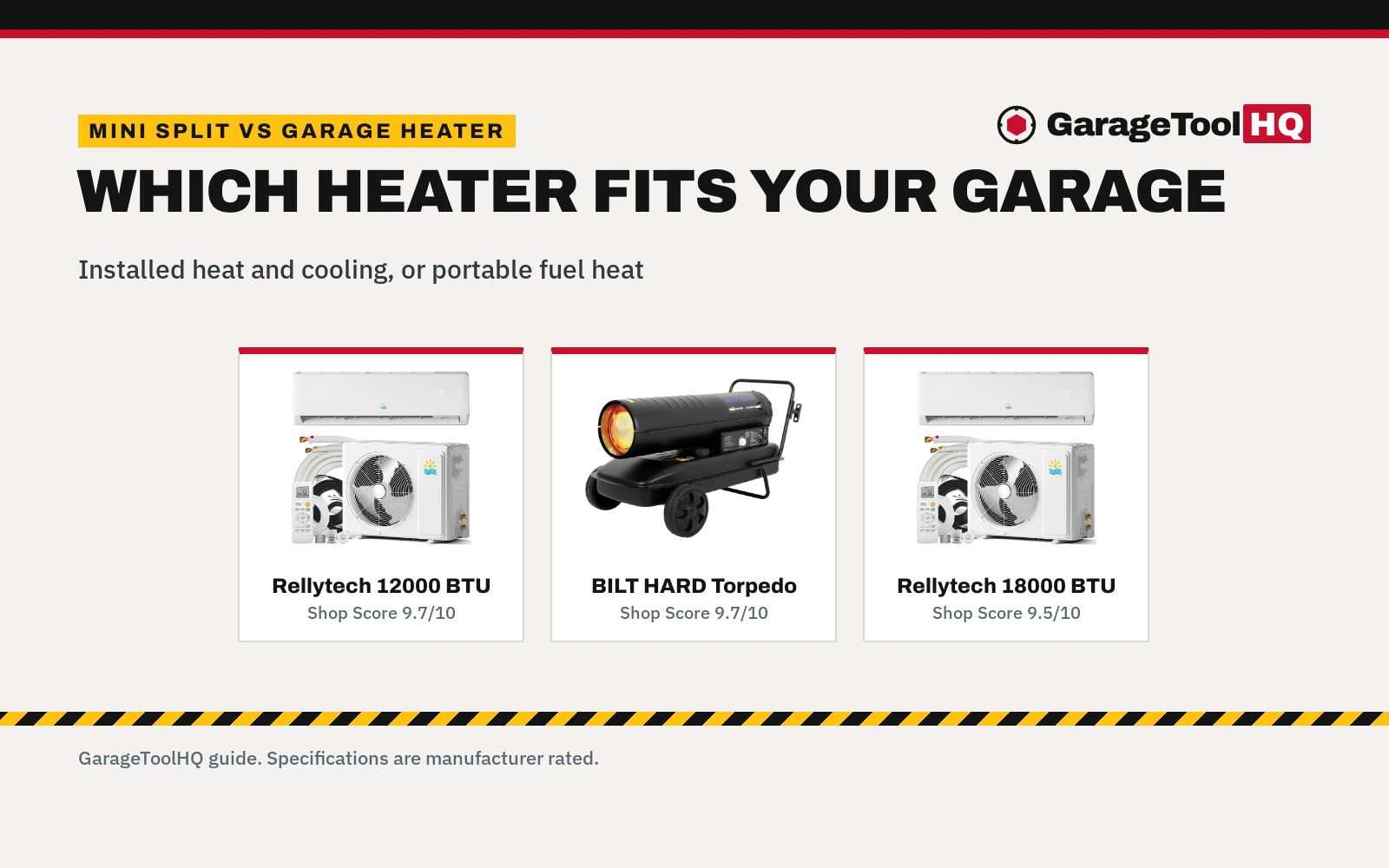
Top picks at a glance
As an Amazon Associate I earn from qualifying purchases.
- 1
 Rellytech Mini Split AC/Heating System, 12000 BTU9.7/10View on Amazon
- 2
 BILT HARD 215,000 BTU Forced Air Kerosene Diesel9.7/10View on Amazon
- 3Rellytech Mini Split AC/Heating System, 18000 BTU9.5/10View on Amazon
Verdict: In this mini split vs garage heater comparison, choose a mini split if the garage is a year-round workspace that needs heat and cooling with the door closed. Choose a kerosene torpedo heater if the heat is for open-air and jobsite work and portability matters more than cooling.
Both options make heat, but they suit different garages: a mini split is a fixed install that heats and cools, while a torpedo heater is a portable fuel heater for open spaces. This comparison covers how each one heats, what each asks of the garage, and the examples below.
GarageToolHQ earns a commission when you buy through links on this page, at no extra cost to you. Read our affiliate disclosure.
Example heaters

Rellytech Mini Split AC/Heating System, 12000 BTU
A 12,000 BTU ductless mini split with 12,500 BTU of heating, 19 SEER2, 115V power and a stated 42 dB sound level, covering up to 750 sq. ft.
Pros
- 12,000 BTU cooling and 12,500 BTU heating from one unit
- 19 SEER2 with HSPF2 8.5 for efficient running
- 42 dB sound level with a sleep mode and a 24-hour timer
- ETL and AHRI certified, with an 8-year warranty
Cons
- Needs professional HVAC installation
- Covers up to 750 sq. ft., less than the 18,000 BTU model
- A single indoor unit, so a second room needs another unit
- Needs an outdoor unit placed outside the garage

BILT HARD 215,000 BTU Forced Air Kerosene Diesel
A 215,000 BTU forced-air kerosene torpedo heater with a 13.2-gallon tank, CSA certified, covering up to 10,750 sq. ft. on wheels.
Pros
- 215,000 BTU of heat, the highest output here
- 13.2-gallon tank for long runs
- Runs on 2-K kerosene or filtered diesel #1 and #2
- CSA certified, with overheat protection and a thermostat
Cons
- Kerosene fuel, so it needs fresh air and a carbon monoxide alarm
- Listed for outdoor use, not for a closed garage
- No cooling, so it only heats
- Large body at 21.3 x 41.7 x 22.6 inches, so it needs floor space
Rellytech Mini Split AC/Heating System, 18000 BTU
A 18,000 BTU ductless mini split with 18,400 BTU of heating, 19 SEER2, 208-230V power, covering up to 1,250 sq. ft.
Pros
- 18,000 BTU cooling and 18,400 BTU heating
- 19 SEER2 with HSPF2 8.5
- Covers up to 1,250 sq. ft., the widest coverage of the mini splits here
- 4 modes and 4 fan speeds with a 90 degree vertical swing
Cons
- 208-230V power needs a licensed electrician
- No certification is stated
- 112 pounds with a mounting plate to fix in place
- Larger indoor unit at 12.4 x 39.6 x 9.5 inches, so it needs more wall space
Side by side
| Rellytech 12000 BTU Mini Split | Rellytech 18000 BTU Mini Split | BILT HARD Torpedo Heater | |
|---|---|---|---|
| Type | Ductless mini split | Ductless mini split | Forced-air kerosene torpedo heater |
| Heating | 12,500 BTU | 18,400 BTU | 215,000 BTU |
| Cooling | 12,000 BTU | 18,000 BTU | Not stated |
| Coverage | Up to 750 sq. ft. | Up to 1,250 sq. ft. | Up to 10,750 sq. ft. |
| Efficiency | 19 SEER2, HSPF2 8.5 | 19 SEER2, HSPF2 8.5 | Not stated |
| Power | 115V, 1100 watts | 208-230V, 1700 watts | 120V, kerosene fuel |
| Noise | 42 dB | 26 dB | Not stated |
| Warranty | 8-year | 1 year | 1 year |
Example figures are manufacturer rated, as published by the maker and collected 20 October 2026.
Mini split vs garage heater: how each one heats
A mini split is a heat pump: it moves heat rather than making it from fuel, so the same unit heats and cools. The Rellytech 12000 BTU example heats at 12,500 BTU and cools at 12,000 BTU, while the Rellytech 18000 BTU example heats at 18,400 BTU and cools at 18,000 BTU. Both have 4 modes for cooling, heating, fan and dry use, and both are rated 19 SEER2 with HSPF2 8.5.
A torpedo heater burns fuel and blows the hot air out. The BILT HARD Torpedo example is rated at 215,000 BTU of forced-air heat, far above the mini split examples, but it heats only and cools nothing, so that output suits open spaces and jobsite work, not a closed room.
Power and installation
The 12,000 BTU mini split example runs on 115V at 1100 watts and needs professional HVAC installation. The 18,000 BTU example runs on 208-230V at 1700 watts, which means a licensed electrician for the circuit. The torpedo heater is listed at 120V and burns kerosene, so it needs fuel and fresh air rather than a new circuit, and it assembles in minutes with wheels and a pull handle.
Coverage
The 12,000 BTU mini split example covers up to 750 sq. ft. and the 18,000 BTU example covers up to 1,250 sq. ft., both for enclosed rooms. The torpedo heater example covers up to 10,750 sq. ft., but that figure is for open spaces and jobsite heat, not for a closed garage.
Noise and everyday use
The mini split examples are quiet: the 12,000 BTU example is listed at 42 dB with a sleep mode, a 24-hour timer and an LED-off function, while the 18,000 BTU example is listed at 26 dB. Both have 4 fan speeds and a 90 degree vertical swing, with remote control. The torpedo heater lists no sound level, and its thermostat, digital display and drain plug suit jobsite use.
Choose a mini split if
- You want heat and cooling in one fixed unit
- The garage is used year-round with the door closed
- You have power and a place for the outdoor unit
- You want a quiet unit with a sleep mode and timer
Choose a garage heater if
- You need portable heat for open-air or jobsite work
- You need strong heat fast and cooling does not matter
- You can give it fresh air and keep it out of a closed garage
- You want wheels and a pull handle for moving it
For more choices, see the best garage heater for a 2-car garage, and for fuel heat, the diesel vs propane garage heater comparison.
Never run a fuel-burning heater, generator or engine in a closed garage: carbon monoxide builds up fast and has no smell. Fit a CO alarm, keep clearances to cars and storage, use vented gas heaters installed to code, and put 240V electric heaters on a dedicated circuit. See CPSC carbon monoxide guidance. Read our Safety Disclaimer.
Garage Fit Check
- Measure wall space for the indoor unit and floor space for the torpedo heater, which is listed at 21.3 x 41.7 x 22.6 inches.
- Check power: the 12,000 BTU example runs on 115V, the 18,000 BTU example on 208-230V, and the torpedo heater on 120V with kerosene fuel.
- Plan where the outdoor unit goes for the mini split, and wheel space for the torpedo heater.
- Check ventilation and fit a carbon monoxide alarm before running the fuel heater, and keep it out of a closed garage.
FAQ: garage tools
Can a mini split heat a garage in winter?
Yes. The examples heat at 12,500 BTU and 18,400 BTU, with 4 modes for cooling, heating, fan and dry use, so one unit covers heat and cooling through the year. Both need a fixed install, and the 12,000 BTU example needs professional HVAC installation.
Can I use a kerosene torpedo heater in a closed garage?
No. The torpedo heater example is listed for outdoor use, and a fuel heater needs fresh air and a working carbon monoxide alarm. Never run an unvented fuel heater in a closed garage.
Does a mini split also cool a garage?
Yes. The examples cool at 12,000 BTU and 18,000 BTU, and both have a fan mode and a dry mode as well as heating.
What power does a mini split need?
It depends on the size. The 12,000 BTU example runs on 115V at 1100 watts, while the 18,000 BTU example runs on 208-230V at 1700 watts, which needs a licensed electrician.
How much space will a mini split cover?
The examples state coverage up to 750 sq. ft. for the 12,000 BTU unit and up to 1,250 sq. ft. for the 18,000 BTU unit.
Related: the best garage heater for a 2-car garage, garage heater vs dehumidifier, the best extension cord for a garage heater and the how we pick page.