Tie Rod Separator vs Ball Joint Separator: Which One Should You Buy?
Tie rod and ball joint separators compared for a home garage: how each separates a tapered stud, the jaw and size figures each listing states, and which side suits tie rod ends or ball joints.

On this page
Top picks at a glance
As an Amazon Associate I earn from qualifying purchases.
- 1
 OMT Ball Joint Separator9.7/10View on Amazon
- 2
 OMT 26pc Ball Joint Tool Kit9.7/10View on Amazon
- 3
 DAYUAN 5Pcs Ball Joint Separator9.6/10View on Amazon
- 4
 ARES 12016-15/16-inch Pickle Fork Ball Joint SeparatorView on Amazon
- 5
 GEARWRENCH 12" Tie Rod SeparatorView on Amazon
- 6
 Lisle 18520 Tie Rod SeparatorView on Amazon
This guide covers tie rod separator vs ball joint separator. Verdict: Choose a tie rod separator if you separate tie rod ends on larger vehicles. Choose a ball joint separator if you separate ball joints on cars and light trucks, and pick the adjustable example if you want a tool that also covers tie-rod ends.
Both tools separate a tapered stud from its seat. They differ in the joint they are built for and the vehicles each listing names, and that decides which side suits your job.
GarageToolHQ earns a commission when you buy through links on this page, at no extra cost to you. Read our affiliate disclosure.
| # | Product | Shop Score | Buy |
|---|---|---|---|
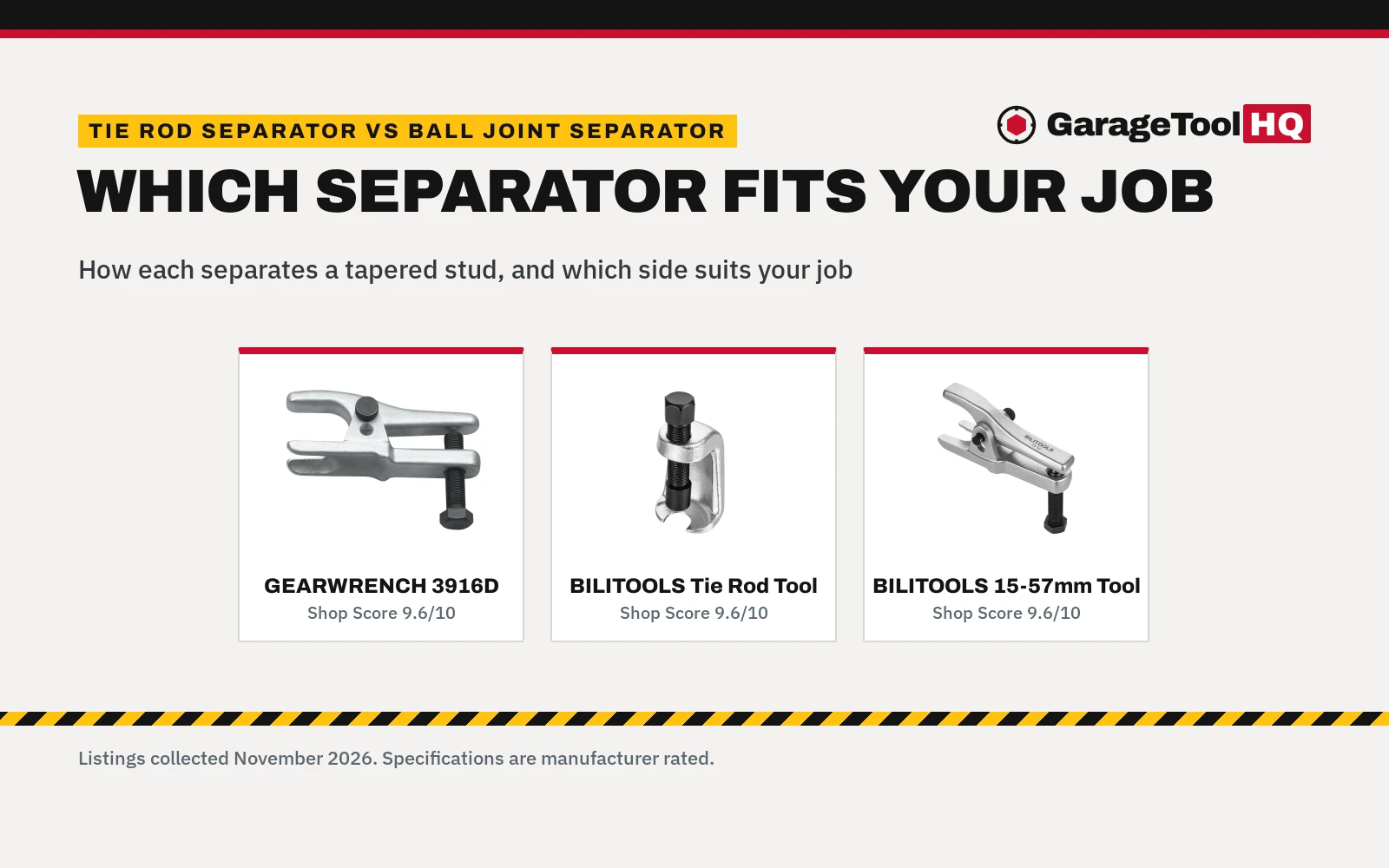
| 1 |  GEARWRENCH Ball Joint Separator | 3916D | 9.6/10 | Buy on Amazon |
| 2 |  BILITOOLS Heavy-Duty Tie Rod End Removal Tool | 9.6/10 | Buy on Amazon |
| 3 |  BILITOOLS Adjustable Ball Joint Separator | 9.6/10 | Buy on Amazon |
GEARWRENCH Ball Joint Separator | 3916D
A ball joint separator for ball joints from 1-1/8 in to 2-1/8 in and 30 to 56 mm.
Pros
- Ball joints from 1-1/8 in to 2-1/8 in and 30 to 56 mm
- Adjustable for different size ball joints
- Standard Limited Lifetime warranty
- Weighs 1.0 lb
Cons
- Not intended for use on 3/4 ton or 1 ton trucks
- Material not stated
- Forcing screw size not stated
- Ball joints only
BILITOOLS Heavy-Duty Tie Rod End Removal Tool
A heavy-duty tie rod end removal tool with a 19 mm jaw opening and an approx. 89 mm forcing screw, built from forged 45# steel.
Pros
- 19 mm jaw opening with a 15.7 mm U-slot depth
- Forged 45# carbon steel, heat-treated
- Approx. 89 mm screw for reach on thicker assemblies
- 1 Year Manufacturer warranty
Cons
- Fixed 19 mm jaw opening, not adjustable
- Weight not stated
- No ball joint size range stated
- 1 year warranty, shorter than the GEARWRENCH lifetime warranty
BILITOOLS Adjustable Ball Joint Separator
An adjustable ball joint separator for joints from 15 to 57 mm, built from drop-forged chrome-vanadium steel with a threaded spindle.
Pros
- Adjustable from 15 to 57 mm in stud diameter
- Drop-forged chrome-vanadium steel, heat-treated
- Threaded spindle, no hammering or prying
- Covers ball joints and tie-rod ends
Cons
- No warranty stated
- No weight stated
- No dimensions stated
- Slot width and depth not stated
Other tools worth a look
 ARES 12016-15/16-inch Pickle Fork Ball Joint SeparatorCheck price on Amazon
 GEARWRENCH 12" Tie Rod SeparatorCheck price on Amazon
 Lisle 18520 Tie Rod SeparatorCheck price on Amazon
Side by side
| Tie rod separator | Ball joint separator | Notes | |
|---|---|---|---|
| What it separates | Tie rod ends and ball joint studs from steering knuckles or steering arms | Ball joints from the spindle support arm; the adjustable example also covers tie-rod ends | The sides overlap on tie-rod ends |
| Jaw or size range | 19 mm jaw opening, 15.7 mm U-slot depth, 63 mm working height | 1-1/8 in to 2-1/8 in and 30 to 56 mm; 15 to 57 mm adjustable | Each figure belongs to its own listing |
| Vehicles | Full-size SUVs, heavy-duty pickups, cargo vans and box trucks | Most cars and light trucks; sedans, SUVs and light-duty trucks | GEARWRENCH example only: not intended for 3/4 ton or 1 ton trucks |
| How it applies force | Threaded forcing screw, approx. 15.6 mm thick and approx. 89 mm long | Threaded spindle, no hammering or prying (adjustable example only) | No forcing screw size stated for the GEARWRENCH example |
| Construction | 45# carbon steel, forged, heat-treated, bright chrome plating | Chrome-vanadium steel, drop-forged, heat-treated, chrome-plated (adjustable example) | GEARWRENCH states no material; both BILITOOLS examples state forged steel |
| Warranty | 1 Year Manufacturer | Standard Limited Lifetime; no warranty stated on the adjustable example | Warranty terms are per listing, not per side |
We copy each listing’s rated specs exactly as the manufacturer gives them; as of 12 November 2026.
Tie rod separator vs ball joint separator: how they differ
A tie rod separator is built to separate tie rod ends from steering knuckles or steering arms, and the BILITOOLS example also separates ball joint studs from the same seats. A ball joint separator is built to separate the ball joint from its seat: the GEARWRENCH example separates it from the spindle support arm, and the adjustable example separates joints from steering knuckles and spindle positions. The tie rod example suits full-size SUVs, heavy-duty pickups, cargo vans and box trucks, while the ball joint examples suit cars and light trucks, and the GEARWRENCH listing states it is not intended for 3/4 ton or 1 ton trucks.
Jaw openings and size ranges
The BILITOOLS tie rod example lists a 19 mm jaw opening, a 15.7 mm U-slot depth and a 63 mm working height, and it asks the buyer to compare the joint and the clearance with those figures before ordering. The GEARWRENCH ball joint example works on ball joints from 1-1/8 in to 2-1/8 in and 30 to 56 mm, with a slot 7/8 in wide by 1-1/4 in deep, and the adjustable BILITOOLS example covers studs from 15 to 57 mm through a threaded spindle.
What to check before you order
The GEARWRENCH example suits most cars and light trucks and is not intended for 3/4 ton or 1 ton trucks, while the BILITOOLS tie rod example is built for larger vehicles. The GEARWRENCH example carries a Standard Limited Lifetime warranty, and the BILITOOLS tie rod example carries a 1 Year Manufacturer warranty.
Choose a tie rod separator if
- You separate tie rod ends on larger vehicles
- You need a 19 mm jaw opening
- You want forged 45# steel and a 1 year warranty
- You work on larger vehicles
Choose a ball joint separator if
- You separate ball joints on cars and light trucks
- You want an adjustable opening from 15 to 57 mm
- You want a Standard Limited Lifetime warranty on the tool
- You need a tool that also covers tie-rod ends
Example separators
For more choices, see the best tie rod end separator and the best ball joint tool.
Use rated jack stands on solid ground, wear eye protection with power and air tools, keep fuel-burning equipment out of a closed garage, and follow the manual for every tool. Read our Safety Disclaimer.
Garage Fit Check
- Measure the joint and clearance first: the tie rod example lists a 19 mm jaw opening, 15.7 mm U-slot depth and 63 mm working height.
- The GEARWRENCH example suits most cars and light trucks, not 3/4 ton or 1 ton trucks.
- The adjustable example covers studs from 15 to 57 mm; check the stud diameter first.
- The GEARWRENCH example measures 11.0 by 5.25 by 2.75 in.
FAQ: garage tools
What size tie rod separator do I need?
Compare the joint and the clearance with the figures the BILITOOLS tie rod example lists: a 19 mm jaw opening, a 15.7 mm U-slot depth and a 63 mm working height.
How does a tie rod separator work?
The threaded forcing screw presses the tapered stud out of the steering knuckle or steering arm. The BILITOOLS example states to fully seat the jaws, center the forcing screw, apply force gradually, and stop if the puller shifts or slips.
What is a tie rod separator?
It is a tool that separates tie rod ends from steering knuckles or steering arms during steering, suspension and front-end repair of tapered stud joints. The BILITOOLS example has a 19 mm jaw opening and a forged 45# steel body.
Do you need a tie rod separator?
You need one for steering, suspension and front-end repair of tapered stud joints, when a tie rod end must come off its steering knuckle or steering arm. The adjustable example also covers tie-rod ends from 15 to 57 mm.
How to use tie rod separator tool?
Compare the joint and the clearance with the 19 mm jaw opening, 15.7 mm U-slot depth and 63 mm working height the BILITOOLS example lists. Then fully seat the jaws, center the forcing screw, apply force gradually, and stop if the puller shifts or slips.
Related: the best inner tie rod removal tool, the tie rod separator vs pickle fork comparison, the ball joint press vs separator comparison and the engine and shop equipment hub.