What Does Dual Action Polisher Mean? Mechanism and Guide
How a dual action polisher combines pad rotation with orbital oscillation to correct paint defects and eliminate swirls while protecting vehicle clear coat.

On this page
Top picks at a glance
As an Amazon Associate we earn from qualifying purchases.
- 1
 Griot's Garage G9 Random Orbital Polisher9.6/10View on Amazon
- 2
 Cordless Car Buffer Polisher for Dewalt 20V Max9.6/10View on Amazon
- 3
 BATOCA 2026 New Dual Action Polisher9.5/10View on Amazon
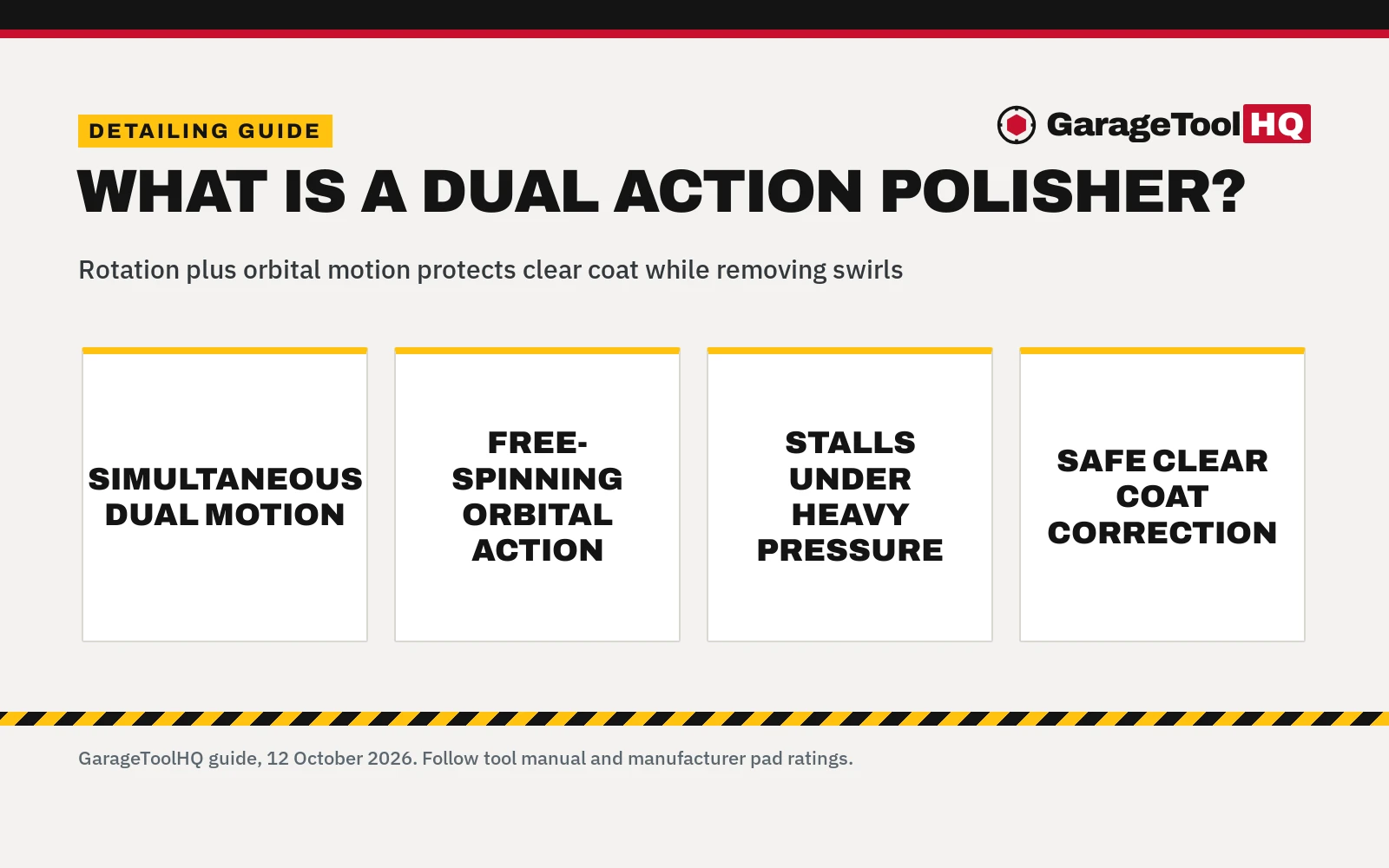
When you pull a car into the garage under bright lighting after a wash and spot swirl marks across the hood, reaching for a machine buffer is the standard fix. But before buffing paint, many car owners ask: what does dual action polisher mean? A dual action polisher means a paint buffing tool whose backing plate spins in a circle while simultaneously oscillating in an eccentric orbit. This dual motion distributes friction across the panel, and on common random orbital designs, it allows the pad to stop spinning under excessive downward pressure, minimizing the friction heat that causes clear coat burn-through.
GarageToolHQ earns a commission when you buy through links on our product pages, at no extra cost to you. Read our affiliate disclosure.
Below: how the dual motion operates, how random orbital polishers differ from rotary machines, and a step-by-step process for polishing safely in your home garage.
What does dual action polisher mean? How the mechanism works
On a direct rotary tool, the motor turns the pad around a fixed center point, concentrating friction along the same circular track. A dual action polisher uses an offset counterweight mechanism to deliver complementary movements at the exact same moment:
- Central spindle rotation. The backing plate rotates around its center, distributing polish across the surface.
- Eccentric orbital oscillation. The offset bearing moves the backing plate in an orbital path, vibrating the pad across the paint.
Because the pad combines spinning and orbital travel, abrasive particles follow an overlapping figure-eight pattern. This path breaks up scratch lines and leaves a finish free of the buffer trails and holograms common to rotary buffers.
On random orbital models, spindle rotation is free-spinning. The motor drives the eccentric counterweight, while centrifugal inertia rotates the pad on its bearing. If you press down too hard or tilt the pad against a sharp body crease, surface friction overcomes rotational inertia. The pad stalls its rotation while orbital oscillation continues, preventing concentrated friction heat from damaging clear coat.
Makers rate dual action polisher speeds in orbits per minute or revolutions per minute. For example, AVID POWER lists 2700 to 6500 OPM, while DEKOPRO lists 1800 to 5500 RPM, BATOCA lists 2500-5500RPM, Restick lists 1800 rpm to 5500 rpm, and AOBEN lists 1000 to 5500 rpm. RUPES lists 2000 – 4200 RPM on the LHR 15ES. Lower speeds spread wax, while higher speeds tackle paint defect removal.
Types of car polishers and how the mechanisms differ
Compare how buffer designs handle rotation and orbital movement:
| Polisher Type | Drive Mechanism | Clear Coat Safety and Garage Suitability |
|---|---|---|
| Random Orbital Dual Action Polisher | Free-spinning rotation driven by eccentric counterweight oscillation | Highest safety for DIY garages; pad rotation stalls under heavy pressure, reducing clear coat burn risk |
| Forced Rotation Dual Action Polisher | Positive gear drive forces both rotation and orbital oscillation simultaneously | Moderate safety; will not stall under pressure, cutting faster than random orbital while running cooler than rotary |
| Direct Rotary Polisher | Direct spindle drive spins pad on a single fixed axis without orbital oscillation | Demands professional technique; rapid friction heat can burn paint and leave holograms if tilted |
For DIY car care in a home garage, random orbital dual action polishers offer the safest balance of defect removal and paint protection.
How to set up and run a dual action polisher step by step
Follow this sequence when operating a dual action machine in your garage:
- Wash and decontaminate the paint. Wash and dry the vehicle completely, then remove bonded contaminants with a detailing clay bar.
- Select pad and compound. Match pad density to your goal. Pair backing plates correctly; for example, AVID POWER includes 5-inch and 6-inch backing plates, while BATOCA and DEKOPRO list 6-inch discs.
- Prime the pad surface. Work a thin film of polish across the foam face, then add a few pea-sized drops of compound.
- Spread before powering on. Dab the machine across your working section, then start on low speed to spread compound without sling.
- Keep the pad flat under light pressure. Guide the polisher with steady control; for example, AVID POWER includes a detachable D-handle with 5 positions. Let the tool work without leaning into it. On random orbital machines, excess pressure stalls rotation.
- Work overlapping passes. Move the machine slowly in straight lines, completing overlapping horizontal passes followed by vertical passes in a cross-hatch pattern.
- Wipe clean and inspect. Turn the tool off before lifting it from the panel. Buff away residue with a microfiber towel and inspect under garage lighting.
Factory clear coat is thin. Compounding removes a microscopic layer of clear coat to level scratches, so always use the least aggressive pad and polish combination that corrects the defect, and never linger over sharp body lines or panel edges.
Keep electric pressure washers on a GFCI outlet, never point the wand at people or pets, wear eye protection with polishers and chemicals, and read the label before mixing any cleaning products. Read our Safety Disclaimer.
Dual action polisher vs rotary buffer
A rotary buffer delivers rapid correction by spinning a pad on a direct spindle axis. In production body shops, technicians use rotary tools to level heavy sanding marks quickly. However, continuous single-axis rotation concentrates heat fast. Holding a rotary tool stationary or tilting it against a body crease can burn through clear coat or leave circular buffer trails.
A dual action polisher spreads friction across an oscillating orbit. Because the pad never follows a single friction track, surface temperatures remain low. On random orbital models, rotation stops if you tilt the tool or push too hard, protecting your paint. Read our breakdown of dual action vs rotary polisher mechanics for more detail.
For DIY car care, dual action polishers offer the most forgiving learning curve. Compare top starter tools in our guide to the best dual action polisher for beginners, or explore machine configurations in our guide on how to choose a car polisher.
Pad diameters, orbit throw, and motor specifications
Matching tool specifications to your garage space ensures comfortable handling across detailing jobs.
Orbit throw distance. Orbit throw refers to the diameter of the eccentric orbit. Short-throw polishers offer tight control around curved bumpers and mirrors. For example, Chemical Guys lists a 9mm orbit on the TORQX, DEKOPRO lists a 9mm orbit, and GlimHirVox lists a 9mm orbit. Long-throw polishers cover wider area per pass to correct flat hoods and roofs faster. For example, RUPES lists a 15mm orbit on the LHR 15ES, and AOBEN lists a 16mm orbit. RUPES also lists a 21 mm throw option. Compare larger-stroke options in our guide to the best long throw polisher.
Backing plate and pad diameter. Common dual action backing plates measure 5 inches or 6 inches. For instance, AOBEN lists a 5-inch polisher, while AVID POWER includes 5-inch and 6-inch backing plates. BATOCA, DEKOPRO, and Restick list 6-inch discs. GlimHirVox lists a 150mm base plate, and RUPES lists a 125mm backing plate with a 6.5″ pad size on the LHR 15ES. Larger polishers, such as the Milwaukee 2738-20, list a 7 inch pad size.
Motor power and power sources. Corded polishers run on standard household current. BATOCA, DEKOPRO, AOBEN, and WEN list 120 volts operation. Motor power varies by listing. For example, WEN lists a 0.5 amp motor with 60 watts power on the 6010 model, RUPES lists a 500 watt motor with 4.17 A on the LHR 15ES, Chemical Guys lists an 800W motor on the TORQX, GlimHirVox lists a 900W motor, BATOCA lists an 1100W motor, and AOBEN lists a 1600W motor. Cordless models rely on battery platforms. For example, Restick lists compatibility with 20V battery packs, and GlimHirVox lists 21V batteries with 18V compatibility. Review battery options in our guide to the best cordless polisher.
Machine weight. Tool weight affects fatigue on vertical body panels. For example, GlimHirVox lists 3.3lbs, WEN lists 3.4 pounds, Restick lists 4 pounds, RUPES lists 5.73 LBS on the LHR 15ES, Milwaukee lists 7.5 pounds, and BATOCA lists 8 pounds. Review our step-by-step guide on how to use a dual action polisher before your first session.
Frequently Asked Questions
Can a dual action polisher burn through clear coat?
While far safer than a rotary buffer, a dual action polisher can still wear through clear coat if you use overly aggressive pads and compounds on sharp panel edges or thin paint. Always use the least aggressive combination needed for the defect.
What is the difference between orbit throw and pad rotation?
Pad rotation is the circular spinning of the backing plate around its center. Orbit throw is the diameter of the eccentric path the backing plate travels as it oscillates. Together, they create the dual action motion.
Is a dual action polisher suitable for beginners?
Yes. A dual action polisher is the safest machine for DIY beginners because random orbital models stall under excess pressure, reducing the risk of paint damage while you learn proper technique.
Why do dual action polishers stall under heavy pressure?
On random orbital models, the backing plate spins on a free bearing rather than direct gears. When downward pressure creates friction that exceeds rotational momentum, rotation stops while oscillation continues, preventing friction heat.
What pad sizes work best on a dual action polisher?
Backing plate sizes of 5 inches and 6 inches are the most common detailing sizes. For example, AVID POWER includes 5-inch and 6-inch backing plates, while BATOCA and DEKOPRO list 6-inch discs.
Can a dual action polisher remove deep scratches?
A dual action polisher removes swirl marks, water spots, and light scratches. If a scratch catches your fingernail, it penetrates through the clear coat and requires touch-up paint rather than machine buffing.
Related: our step-by-step tutorial on how to use a dual action polisher, our mechanical breakdown of dual action vs rotary polisher performance, our recommendations for the best dual action polisher for beginners, and our selection guide on how to choose a car polisher. Browse our complete car detailing hub for more garage guides.