What Size Garage Heater Do I Need? BTU by Garage Size
Size a garage heater in BTU from volume, temperature rise and insulation, with charts for one-, two- and three-car garages across US climate zones.

On this page
Top picks at a glance
As an Amazon Associate we earn from qualifying purchases.
- 1
 Comfort Zone Hard-Wired Ceiling Mount Garage Electric Space9.7/10View on Amazon
- 2
 Comfort Zone Hard-Wired Ceiling Mount Garage Space Heater9.7/10View on Amazon
- 3
 DR. INFRARED HEATER DR-910F 109.7/10View on Amazon
- 4
 DR. INFRARED HEATER Portable Infrared Indoor and OutdoorView on Amazon
- 5
 DR. INFRARED HEATER NEW Upgraded DR-975 7500-Watt 240-VoltView on Amazon
- 6
 Dr. Infrared Heater DR-966 240-Volt Hardwired Shop GarageView on Amazon
- 7
 GiveBest Smart Wall HeaterView on Amazon
- 8
 DR. INFRARED HEATER DR218-1500W Greenhouse Garage WorkshopView on Amazon
- 9
 DR. INFRARED HEATER DR218-3000W Greenhouse Garage WorkshopView on Amazon
What size garage heater do I need? For a typical two-car garage (24 x 24 ft, 9 ft ceiling) in a cold Midwest or Northeast winter, plan on roughly 25,900 BTU if it is insulated, 34,500 BTU with some insulation and 51,800 BTU if it is not. That is the heat needed to hold 55 F when it is 5 F outside. Your number moves with three inputs: the garage’s volume, how many degrees you need to raise it, and how well it holds heat.
More options to compare
 DR. INFRARED HEATER Portable Infrared Indoor and OutdoorCheck price on Amazon
 DR. INFRARED HEATER NEW Upgraded DR-975 7500-Watt 240-VoltCheck price on Amazon
 Dr. Infrared Heater DR-966 240-Volt Hardwired Shop GarageCheck price on Amazon
 GiveBest Smart Wall HeaterCheck price on Amazon
 DR. INFRARED HEATER DR218-1500W Greenhouse Garage WorkshopCheck price on Amazon
 DR. INFRARED HEATER DR218-3000W Greenhouse Garage WorkshopCheck price on Amazon
GarageToolHQ earns a commission when you buy through links on our product pages, at no extra cost to you. Read our affiliate disclosure.
This guide shows the rule of thumb behind those numbers, the same one our garage heater BTU calculator uses, with charts by garage size and climate so you can find your row and move on to picking a heater.
What size garage heater do I need? The BTU formula
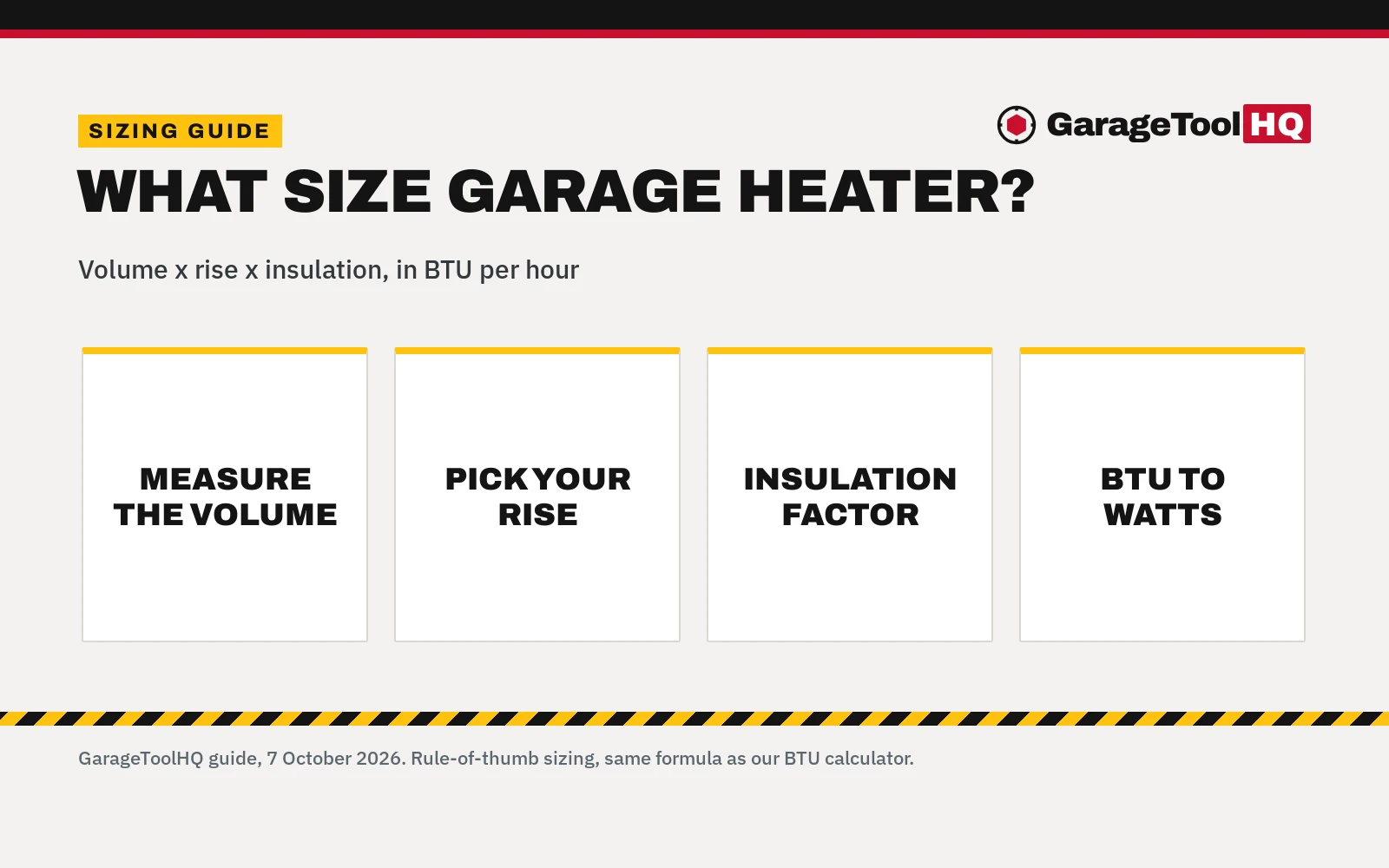
Heat output is rated in BTU per hour. The planning estimate is:
BTU per hour = garage volume (cu ft) x temperature rise (F) x insulation factor
- Volume: length x width x ceiling height in feet. A 24 x 24 ft garage with a 9 ft ceiling is 5,184 cu ft.
- Temperature rise: the indoor temperature you want minus the coldest temperature you expect outside. Most people heat a working garage to about 55 F, not living-room warm.
- Insulation factor: 0.10 for insulated walls, ceiling and door, 0.133 for partial insulation (walls or ceiling only), 0.20 for no insulation and an uninsulated door.
This is a sizing rule of thumb for shopping, not an engineered heat-loss calculation. A drafty door, block walls, a lot of windows or high wind push the real load up. If you are close to the line between two heater sizes, take the larger one, or fix the door seals first.
Worked example: a two-car garage in Zone 5
Take the 24 x 24 x 9 ft garage, some insulation, a 55 F target and a 5 F design low (common across the Midwest and Northeast):
- Volume: 24 x 24 x 9 = 5,184 cu ft.
- Rise: 55 minus 5 = 50 F.
- Heat: 5,184 x 50 x 0.133 = about 34,500 BTU per hour.
- Electric equivalent: 34,500 divided by 3,412 BTU per kW = about 10.1 kW, or about 42 A at 240V.
That puts this garage at the top of what a single 240V electric heater handles; a vented gas unit heater is the other way to get there. Insulate the walls and door and the same garage drops to about 25,900 BTU, which a 7,500 W electric heater (about 25,600 BTU) covers almost exactly.
Run your own numbers here:
Garage heater size chart by garage size
All rows use a 50 F rise (55 F inside, 5 F outside). For a milder climate, scale down in proportion: a 30 F rise needs 60 percent of these figures.
| Garage | Volume (cu ft) | Insulated (BTU/hr) | Some insulation | Uninsulated |
|---|---|---|---|---|
| One-car, 12 x 22 ft, 8 ft ceiling | 2,112 | 10,600 | 14,000 | 21,100 |
| Two-car, 24 x 24 ft, 9 ft ceiling | 5,184 | 25,900 | 34,500 | 51,800 |
| Two-car, 24 x 24 ft, 12 ft ceiling (lift height) | 6,912 | 34,600 | 46,000 | 69,100 |
| Three-car, 36 x 24 ft, 10 ft ceiling | 8,640 | 43,200 | 57,500 | 86,400 |
Note the two 24 x 24 ft rows. Raising the ceiling from 9 to 12 ft for a car lift adds a third more volume, and the heat load rises with it. If you plan a lift, size the heater for the tall ceiling.
Garage heater size chart by climate zone
Same two-car garage (24 x 24 ft, 9 ft ceiling), heated to 55 F. Design lows are typical planning temperatures for each zone; check your own area’s winter design temperature if you want a tighter number.
| Climate | Design low | Rise | Insulated | Some insulation | Uninsulated |
|---|---|---|---|---|---|
| Zones 1-2 (Gulf Coast, Florida, South Texas) | 35 F | 20 F | 10,400 | 13,800 | 20,700 |
| Zone 3 (Southeast, Southwest) | 25 F | 30 F | 15,600 | 20,700 | 31,100 |
| Zone 4 (Mid-Atlantic, Pacific Northwest) | 15 F | 40 F | 20,700 | 27,600 | 41,500 |
| Zone 5 (Midwest, Northeast, Colorado) | 5 F | 50 F | 25,900 | 34,500 | 51,800 |
| Zone 6 (Upper Midwest, northern New England) | -5 F | 60 F | 31,100 | 41,400 | 62,200 |
| Zone 7 (North Dakota, northern Minnesota, mountains) | -15 F | 70 F | 36,300 | 48,300 | 72,600 |
Converting BTU to watts for an electric heater
One kilowatt of electric heat delivers about 3,412 BTU per hour, and electric resistance heaters turn all of it into heat in the room. So divide your BTU figure by 3,412 to get kW, or check this table of common heater sizes:
| Heater rating | BTU per hour | Supply |
|---|---|---|
| 1,500 W | 5,118 | 120V or 240V |
| 4,000 W | 13,648 | 240V |
| 5,000 W | 17,060 | 240V |
| 7,500 W | 25,590 | 240V |
| 10,000 W | 34,120 | 240V |
A plug-in 1,500 W heater makes about 5,100 BTU. That is enough to take the chill off one corner of a small insulated garage, not to heat a two-car space in winter. Anything from about 4,000 W up runs on 240V and needs its own circuit sized by an electrician. Our guide to the best garage heater for a 2-car garage compares 5,000 W, 7,000 W and 7,500 W electric units and a 50,000 BTU gas unit heater against these sizes.
Which type of heater fits your number
- Under about 6,000 BTU: a 120V electric heater, for a small, well insulated space or spot heat at the bench.
- About 6,000 to 18,000 BTU: a 240V electric garage heater around 4 to 5 kW on a dedicated circuit.
- About 18,000 to 35,000 BTU: a 240V electric heater around 7.5 to 10 kW, or a vented natural gas or propane unit heater.
- Above about 35,000 BTU: a vented gas or propane unit heater, typically 45,000 BTU and up, installed per the manual and local code.
Gas and propane heaters produce carbon monoxide. For a garage you work in, use a vented unit heater installed to code, keep the clearances in the manual, and fit a carbon monoxide alarm. A heater that is not rated for indoor use does not belong in a garage at all.
Never run a fuel-burning heater, generator or engine in a closed garage: carbon monoxide builds up fast and has no smell. Fit a CO alarm, keep clearances to cars and storage, use vented gas heaters installed to code, and put 240V electric heaters on a dedicated circuit. See CPSC carbon monoxide guidance. Read our Safety Disclaimer.
Common sizing mistakes
- Sizing by floor area only. Square-foot rules ignore ceiling height. A 12 ft ceiling needs a third more heat than a 9 ft one over the same floor.
- Using the average winter temperature. Size for the cold nights you actually work through, or the heater runs flat out and still loses ground.
- Ignoring the door. A bare steel door is the biggest heat leak in most garages. An insulation kit and new bottom seal can move you from the uninsulated column to the partial one.
- Buying the biggest unit. An oversized heater short-cycles and blows hot air at the ceiling. Land close to your number with a little margin.
- Forgetting the circuit. A 7,500 W heater draws about 31 A at 240V. Check panel capacity before you pick electric; installation belongs to a licensed electrician.
If the real goal is keeping a car battery alive through winter rather than working in the garage, heat is the expensive answer. A battery charger maintainer does that job on a few watts.
Frequently Asked Questions
How many BTU do I need to heat a 2-car garage?
For a 24 x 24 ft garage with a 9 ft ceiling and a 50 F rise, about 25,900 BTU if insulated, 34,500 BTU with some insulation and 51,800 BTU uninsulated. In a mild climate with a 30 F rise, those drop to about 15,600, 20,700 and 31,100 BTU.
Is a 5,000 watt heater big enough for a 2-car garage?
A 5,000 W heater makes about 17,000 BTU. That covers an insulated two-car garage with roughly a 30 F rise, so it suits mild climates or a garage you keep cool. In a Zone 5 winter or with little insulation, look at 7,500 W or a gas unit heater.
What size heater do I need for a one-car garage?
A 12 x 22 ft garage with an 8 ft ceiling needs about 10,600 BTU insulated, 14,000 BTU with some insulation and 21,100 BTU uninsulated at a 50 F rise. A 5,000 W 240V heater (about 17,000 BTU) covers both of the first two cases; 4,000 W covers the insulated one.
Can a garage heater be too big?
Yes. An oversized heater reaches temperature fast, shuts off, and cycles, which wastes energy and leaves cold spots near the floor. Aim for your calculated number plus a small margin, not double.
Should I size for 55 F or 70 F?
Most garages are heated to about 50 to 60 F for working in a jacket. Heating to 70 F adds 15 F to the rise, which in Zone 5 means 30 percent more heat than a 55 F target. Size for how you actually use the space.
Related: the propane heater safety guide, the best garage heaters for a 2-car garage, the best LED garage lights for the rest of the ceiling plan, our garage upgrades hub and the garage heater BTU calculator. Also see our breaker size for a 240V heater. Also see our cost to heat a garage.