Short Throw vs Long Throw Polisher: Which One Should You Buy?
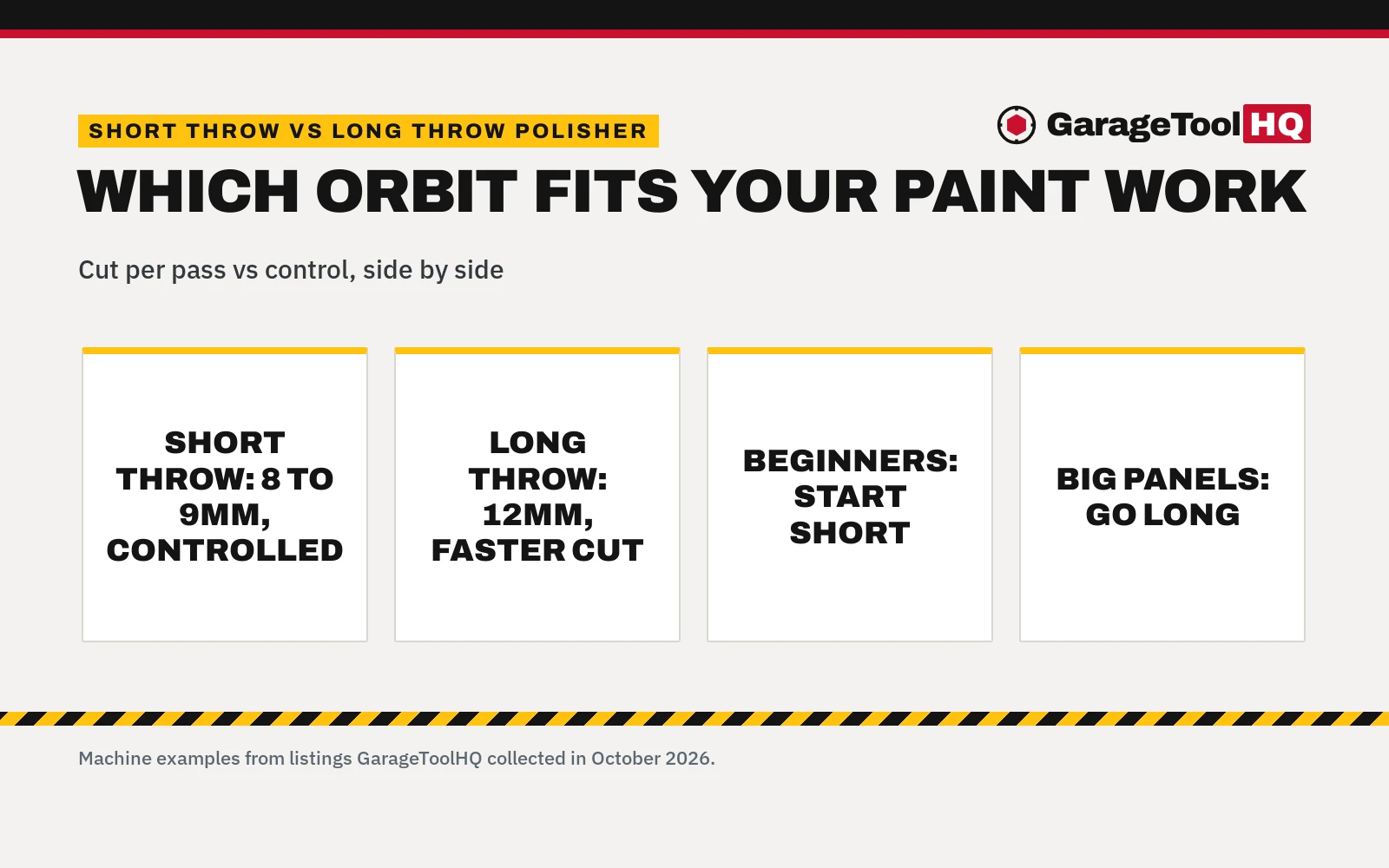
Short throw polishers cut slower and forgive more; long throw machines cover ground faster but ask for a steadier hand. What the throw changes and which fits your paint work.

On this page
Top picks at a glance
As an Amazon Associate we earn from qualifying purchases.
- 1
 Chemical Guys Car Polisher9.5/10View on Amazon
- 2
 Maxshine M312 Dual Action Polisher9.5/10View on Amazon
- 3
 AOBEN Buffer Polisher9.6/10View on Amazon
- 4
 Griot's Garage 10915 G15 Long Throw Orbital PolisherView on Amazon
- 5
 BATOCA P1 Car Buffer PolisherView on Amazon
- 6
 WEN Dual Action PolisherView on Amazon
The job is the swirl marks across the hood of the daily driver, and the question is short throw vs long throw polisher: which dual action machine fixes the paint without making new problems. A short throw polisher moves the pad in a tight orbit, so it cuts slower and forgives a shaky hand. A long throw polisher swings the pad wider, so it covers more paint per pass and corrects faster, but it needs a steadier grip on edges and curves. Beginners and spot workers start short. Big panels and heavy correction go long.
More options to compare
 Griot's Garage 10915 G15 Long Throw Orbital PolisherCheck price on Amazon
 BATOCA P1 Car Buffer PolisherCheck price on Amazon
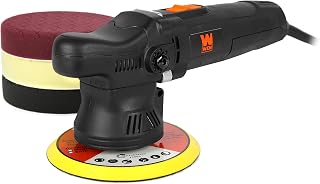 WEN Dual Action PolisherCheck price on Amazon
GarageToolHQ earns a commission when you buy through links on our product pages, at no extra cost to you. Read our affiliate disclosure.
Below: what the throw changes about cut and control, where each one wins on real paint, and what the listings say about throw size, power and speed.
Short throw vs long throw polisher: what the throw changes
Throw is the diameter of the pad’s orbit, measured in millimeters, and it is the one number that decides how a dual action polisher behaves. A wider orbit means the pad travels farther on every revolution, so each pass removes more clear coat and finishes the panel faster. A tighter orbit means less cut per pass, less heat, and a machine that is easier to keep flat on the paint. In this sample, the Chemical Guys TORQX lists a 9mm throw at 4550 OPM, the ZOTA mini lists an 8mm orbit, and the Griot’s G8 lists an 8mm orbit: those are the short throw machines. The Adam’s Swirl Killer lists a 12mm throw at up to 5500 OPM and the AUTIWOZ lists a 12mm orbital drive: those are the long throw machines.
| Short throw | Long throw | |
|---|---|---|
| Throw in the sample | 8mm (ZOTA, Griot’s G8), 9mm (Chemical Guys TORQX) | 12mm (Adam’s Swirl Killer, AUTIWOZ) |
| Cut per pass | Less; slower correction | More; faster correction |
| Control | Forgiving on curves and for new users | Needs a steady hand on edges and body lines |
| Pad sizes listed | 2 and 3 inch plates on the minis; full kit on the TORQX | 4 inch pads on the Adam’s; 1 and 3 inch on the AUTIWOZ mini |
| Best job | Spot correction, finishing, tight areas | Large flat panels, heavy swirls, faster jobs |
Two things do not change with the throw. Both are dual action, so the pad spins and orbits at once instead of spinning in place like a rotary, which is what keeps either one from burning paint the way a rotary can. And neither one replaces the pad and compound: the TORQX listing sells an 8-piece one-step kit with pad, compound and towels because the machine is only half the system.
When short throw is the better choice
- First polisher. Less cut per pass means mistakes show up as haze you can fix, not clear coat you cannot put back. The TORQX lists itself as forgiving enough for a first-time user at 4550 OPM.
- Tight areas. Headlights, A-pillars, bumpers and mirror caps: the ZOTA lists a 3.75 lb mini with 2 and 3 inch pads and the Griot’s G8 lists 2 and 3 inch backing plates. A short orbit plus a small pad is the combination for contours.
- Finishing work. Final polishing and waxing want control, not speed. Short throw machines run the low end of their speed dials well: the ZOTA lists 3000 to 7200 RPM and the AUTIWOZ lists 2000 to 5500 RPM across 6 gears.
When long throw is the better choice
- Big flat panels. Hoods, roofs and doors: the Adam’s lists a 12mm throw at up to 5500 OPM, which covers more paint per pass and shortens a full correction.
- Heavier defects. Oxidation and deeper swirls need cut, and a wider orbit delivers more of it without stepping up to a rotary.
- Second machine. Many garages run a full-size long throw for panels and keep a mini short throw for the details. The AUTIWOZ lists exactly that role: a 1.9 lb cordless mini with a 12mm orbital drive for headlights, scratches and tight areas.
What the listings say about power and speed
Throw gets the attention, but the motor decides whether the machine holds speed under pressure. The sample runs from a 380 watt motor on the ZOTA to an 800 watt motor on the TORQX, with the Griot’s G8 at 700 watts. Speeds run from 2000 RPM on the low end of the minis to 7200 RPM on the ZOTA, with the TORQX at 4550 OPM and the G8 at 6400 rpm. Weights run 1.9 lb for the AUTIWOZ mini to 9 lb for the 10-inch WEN waxer. Match the machine to the job: a heavy 10-inch orbital for waxing the truck, a light mini for the details, and a mid-size DA for correction.
Our best long throw polisher picks compare real models side by side.
One machine or two?
If the garage gets one polisher, buy for the job you do most. Mostly waxing and light swirl removal on one or two cars: a short throw DA does everything at a forgiving pace. Full paint corrections on big vehicles: the long throw earns its keep. If you already own a full-size machine, the second buy is almost always a mini, and the sample agrees: three of the listings are minis built for headlights, pillars and bumpers. Read what a dual action polisher means and how to use one before the first panel.
Keep electric pressure washers on a GFCI outlet, never point the wand at people or pets, wear eye protection with polishers and chemicals, and read the label before mixing any cleaning products. Read our Safety Disclaimer.
Frequently Asked Questions
What does throw mean on a polisher?
Throw is the diameter of the pad’s orbit in millimeters. A 9mm throw swings the pad in a 9mm-wide circle on top of its rotation. Bigger throw means more pad travel per revolution and more cut per pass.
Is a long throw polisher harder to use?
It asks for more care, not more skill. The wider orbit cuts faster, so keep the pad flat, slow down near edges and body lines, and let the machine’s weight do the work. On open panels it feels no harder than a short throw.
Can a short throw polisher remove swirls?
Yes, with the right pad and compound. It takes more passes than a long throw, but the Chemical Guys TORQX listing sells a one-step swirl correction kit built around a 9mm machine, which says plenty about what a short throw can do.
Do short and long throw machines use different pads?
Pad size follows the machine, not just the throw. The Adam’s 12mm machine lists 4 inch pads, the minis list 2 and 3 inch plates. Match the pad to the backing plate size the listing states.
Which throw is better for a beginner?
Short throw. Less cut per pass means a heavy hand costs you time, not clear coat. Start there, learn the technique on our beginner DA polisher guide, and step up to a long throw when corrections start feeling slow.
Can a dual action polisher burn through clear coat?
It is much harder than with a rotary, but not impossible. Keep the pad moving, start on a low speed, and check your work in good light. If the paint is thin or already failing, no polisher fixes it; see dual action vs rotary for when each is the wrong tool.
Related: forced rotation vs free spinning polisher, rotary polisher for paint correction, our mini polisher picks and the car detailing hub.