Stick Welder vs Wire Feed: Which One Should You Buy?
Stick welders burn a coated rod with no gas bottle while wire feed welders push filler wire from a spool; this guide compares both and ranks four stick welders for home garages.

On this page
Top picks at a glance
As an Amazon Associate we earn from qualifying purchases.
- 1
 HONE Stick Welder 110v9.7/10View on Amazon
- 2
 6" Bench Grinder Wheel 120 Grit & Wire Wheel Brush with 1/2"9.7/10View on Amazon
- 3
 YESWELDER 205Amp Stick Welder ARC Welding Machine with Lift9.7/10View on Amazon
- 4
 HONE Stick WelderView on Amazon
- 5
 Siasky Mini Welding MachineView on Amazon
- 6
 Stick WelderView on Amazon
- 7
 TOOLIOM 195A 110/220V Stick WelderView on Amazon
- 8
 ARCCAPTAIN 160A MIG Welder 110V 220V Gasless Gas MIG StickView on Amazon
- 9
 ARCCAPTAIN 200A Stick/Lift TIG Welder with TorchView on Amazon
A trailer bracket cracked at the weld, the mower deck has a split that wants a bead, and you are deciding how to join metal in your own garage. Stick welder vs wire feed is the question. A stick welder, also called ARC or MMA, burns a consumable electrode rod whose flux coating shields the weld, so there is no gas bottle to rent or refill. A wire feed welder pushes wire from a spool through the gun, with shielding gas or flux-core wire protecting the puddle. For a home garage that welds outdoors, on rusty or painted metal, or from a standard 110V outlet, the stick welder is the simpler and tougher pick. The wire feed earns its keep on clean sheet metal and long, tidy beads indoors. The four machines below are all stick welders from current listings, ranked from the most capable down to a light beginner unit.
More options to compare
 HONE Stick WelderCheck price on Amazon
 Siasky Mini Welding MachineCheck price on Amazon
 Stick WelderCheck price on Amazon
 TOOLIOM 195A 110/220V Stick WelderCheck price on Amazon
 ARCCAPTAIN 160A MIG Welder 110V 220V Gasless Gas MIG StickCheck price on Amazon
 ARCCAPTAIN 200A Stick/Lift TIG Welder with TorchCheck price on Amazon
GarageToolHQ earns a commission when you buy through links on our product pages, at no extra cost to you. Read our affiliate disclosure.
Stick Welder vs Wire Feed: How They Differ
The difference is what feeds the weld and what shields it, and that decides where each machine works best.
How a stick welder works
You clamp the ground lead to the work, touch a coated electrode rod to the metal to strike an arc, and the rod melts into the joint while its flux forms a shielding slag. The listings below all describe IGBT inverter machines with anti-stick, and three of the four also list hot start and arc force to help the arc start cleanly and keep the rod from freezing to the work. The Faiuot states anti-stick and current compensation, but no hot start or arc force. There is no gas, no spool and little to go wrong, which is why stick remains the farm and field favorite.
How a wire feed welder works
A motor drive pushes filler wire from a spool through the gun as you weld, and the arc melts wire and base metal together. With solid wire you need a bottle of shielding gas; with flux-core wire the shielding is in the wire itself. Wire feed is fast and easy to learn on clean steel, but wind blows gas shielding away outdoors, and the machine has more parts to maintain.
Which suits a home garage
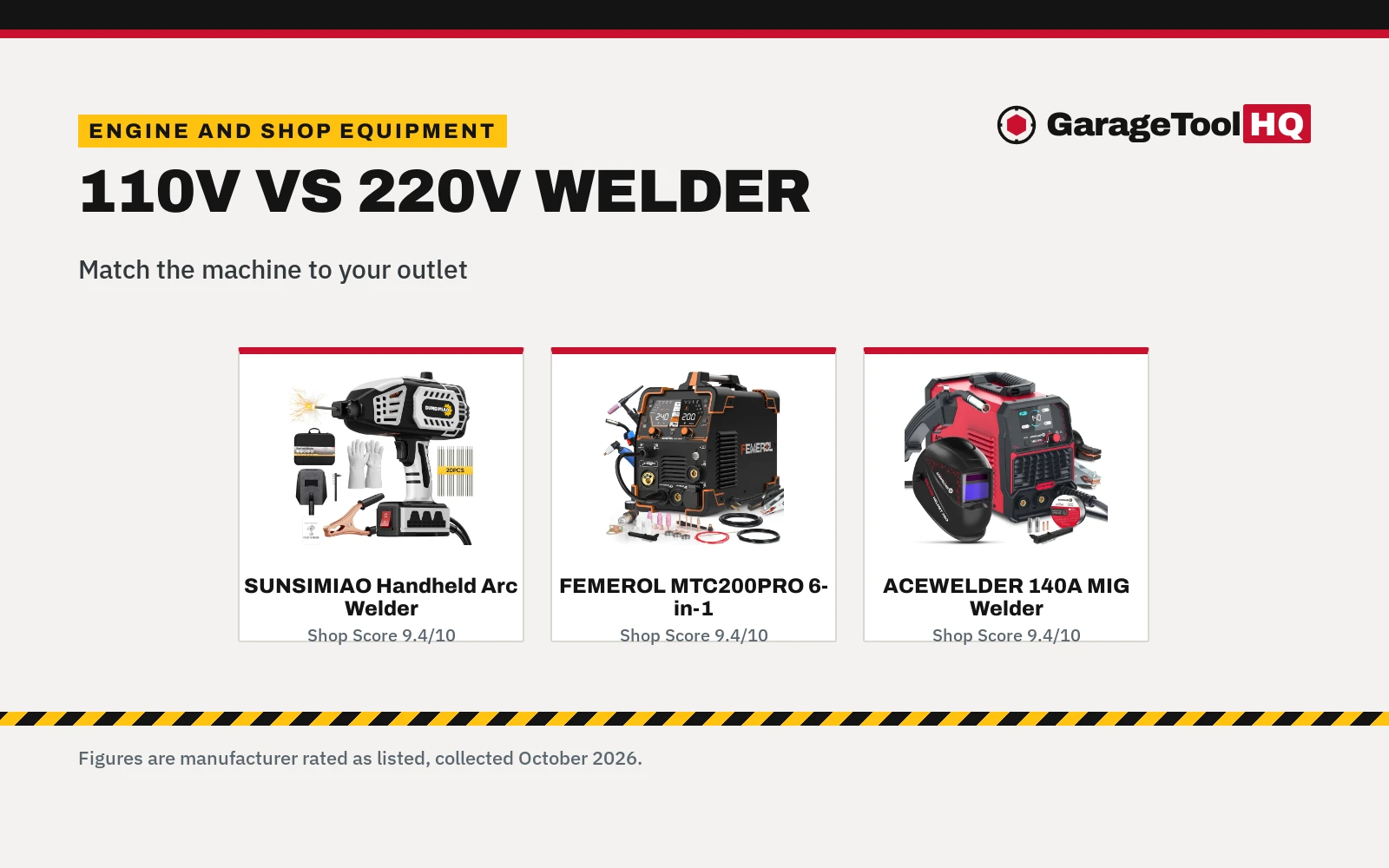
Welding outside, on a rusty trailer frame or a cracked implement, or running from a household 110V outlet points to stick: two of the four machines below run on 110V alone, and all four are described as portable. Working inside on clean sheet metal, auto body panels or long production-style beads points to wire feed. Many home shops end up with both, but if you buy one machine first, buy the one that matches where you weld.
The gear: four stick welders ranked
Every machine here is a stick welder from a current listing, ordered by our scoring: the most capable first.
Sefaspe ARC 200Pro
The Sefaspe leads the ranking as the only machine here that does more than stick. The listing states 200A on 110V/220V with stick from 40 to 200A and LIFT TIG from 10 to 200A, a synergic control that displays the matching electrode for the current you set, adjustable hot start and arc force, anti-stick and VRD safety protection, and compatibility with 2.5 to 4.0mm electrodes. Maximum stated weld thickness is 4mm, with multi-pass welding up to 12mm. It lists a large LED display, a stated 13.79 pounds, and a 2-year warranty with 24/7 technical support. For the garage that wants one machine to grow into, this is it.
Faiuot handheld welder kit
The Faiuot is the kit pick, and the only handheld gun-style machine here. The listing states a 110V IGBT inverter gun with 20 to 120A adjustable output on a 5-setting dial, for 3/32 to 1/8 inch (2.5 to 3.2mm) rods, at a stated 3.3 lbs and 9.8 x 9.45 inches. The kit is the story: auto-darkening goggles with #3 to #11 shading, 20 welding rods, ground clamp, brush, welding helmet, gloves and a carrying case are all listed as included, plus 360-degree cooling with overheat and overcurrent protection. The listing states a 3-year warranty, the longest stated term in this set. One wrinkle: the spec table lists 6.6 pounds against the bullets’ 3.3 lbs; we trust the bullets.
HONE 140A stick welder
The HONE is the dual-voltage workhorse. The listing states an actual 140A IGBT inverter machine on 110V/220V with a digital LCD display showing the real welding current, hot start, arc force and anti-stick, and a stated duty cycle of 40% at 120A on 110V and 40% at 140A on 220V. It runs AWS E6013, E7018 and E6011 rods from 1/16 to 1/8 inch (1.6 to 3.2mm), plus E6010 cellulose electrodes, and is stated for mild steel, carbon steel, stainless steel and cast iron. Stated protections cover overheat, overcurrent, over-voltage, under-voltage and short circuit. Weight is listed at 9.44 pounds. No warranty term is stated.
Siasky mini stick welder
The Siasky is the lightest machine here and the beginner pick. The listing states a 110V IGBT inverter welder at 3.3 pounds with an intelligent LED screen that automatically matches the current for beginners, anti-stick electrodes, and a fan for cooling and dust prevention. The kit lists electrode clips, work clips, face shields, brushes and 20 welding rods at 2.5mm. One wrinkle: the spec table lists 6.83 pounds against the bullets’ 3.3 pounds; we trust the bullets. No warranty term is stated.
How to choose
Check your outlet first
The Siasky and Faiuot are 110V machines that plug into a standard household outlet. The HONE and Sefaspe run on 110V or 220V. The HONE states 120A on 110V and its full 140A on 220V; the Sefaspe lists 200A on 110V/220V without stating which voltage unlocks the full range. If your garage has only 110V, the first two are the honest picks; if you have 220V, the HONE gives you its higher stated end, and the Sefaspe’s full range is stated for both voltages.
Match amps and rods to the metal
Thicker metal wants more amps and a bigger rod. The Sefaspe states 200A with 2.5 to 4.0mm electrodes and a 4mm maximum weld thickness, the HONE states 140A for 1/16 to 1/8 inch rods, and the Faiuot states 20 to 120A for 3/32 to 1/8 inch rods. Buy the machine whose stated range covers the thickest metal you weld now, not the thinnest.
Count what comes in the box
A welder without gear is a paperweight until you buy the rest. The Faiuot kit lists goggles, helmet, gloves, rods and a case; the Siasky lists rods, clips, face shields and brushes. The HONE and Sefaspe list welding accessories without the same detail, so budget for a helmet, gloves and rods if the listing does not name them.
Read the warranty
The Faiuot states a 3-year warranty and the Sefaspe a 2-year warranty with 24/7 support. The HONE and Siasky state no warranty term. For a machine with electronics inside, a stated warranty term is worth weighing alongside the amps.
Use rated jack stands on solid ground, wear eye protection with power and air tools, keep fuel-burning equipment out of a closed garage, and follow the manual for every tool. Read our Safety Disclaimer.
Frequently Asked Questions
What is a stick welder?
A stick welder, also called an ARC or MMA welder, joins metal with a consumable electrode rod. The arc melts the rod into the joint and the rod’s flux coating shields the weld, so no gas bottle is needed. All four machines in this guide are stick welders.
Is a stick welder or a wire feed easier for a beginner?
Wire feed is often considered easier to learn on clean steel, because the wire feeds itself. Stick takes practice to strike and hold the arc, which is why the machines here add beginner aids: the Siasky automatically matches current, the Sefaspe uses synergic control to suggest the electrode, and all four list anti-stick, with three of the four also listing hot start.
How do I set the amps on a stick welder?
Match the amps to the rod and the metal thickness, starting at the low end of the listing’s stated range. The Faiuot lists a 20 to 120A dial, the Sefaspe lists 40 to 200A for stick with a screen that suggests the electrode, and the Siasky lists automatic current matching for beginners. When in doubt, run a practice bead on scrap of the same thickness.
Can these stick welders weld aluminum?
The four listings state steel and iron as the metals the machines weld: mild steel, carbon steel, stainless steel and cast iron. None of them lists aluminum as a metal the machine welds; the Faiuot goggles bullet mentions aluminum only for the goggles’ clear vision. Aluminum is usually welded with TIG or MIG equipment, so treat these four as steel machines.
Do I need 220V for a stick welder?
Not necessarily. The Siasky and Faiuot are 110V machines. The HONE and Sefaspe run on 110V or 220V. The HONE states its full 140A on 220V and 120A on 110V; the Sefaspe lists 200A for both voltages without stating a difference. Check what your garage offers before you choose; see our engine and shop equipment hub.
Related guides
Also see our best stick welder, the best 110V portable stick welder and the best stick welder for farm use. For cutting, see the best portable plasma cutter and die grinder vs angle grinder.