Best Generator for Welding (2026): 5 Picks by Watts, Outlets and Fuel
Five portable generators compared by running watts, peak watts, outlets, fuel options, runtime and warranty, with a plain note on what their listings do and do not state about welding.

On this page
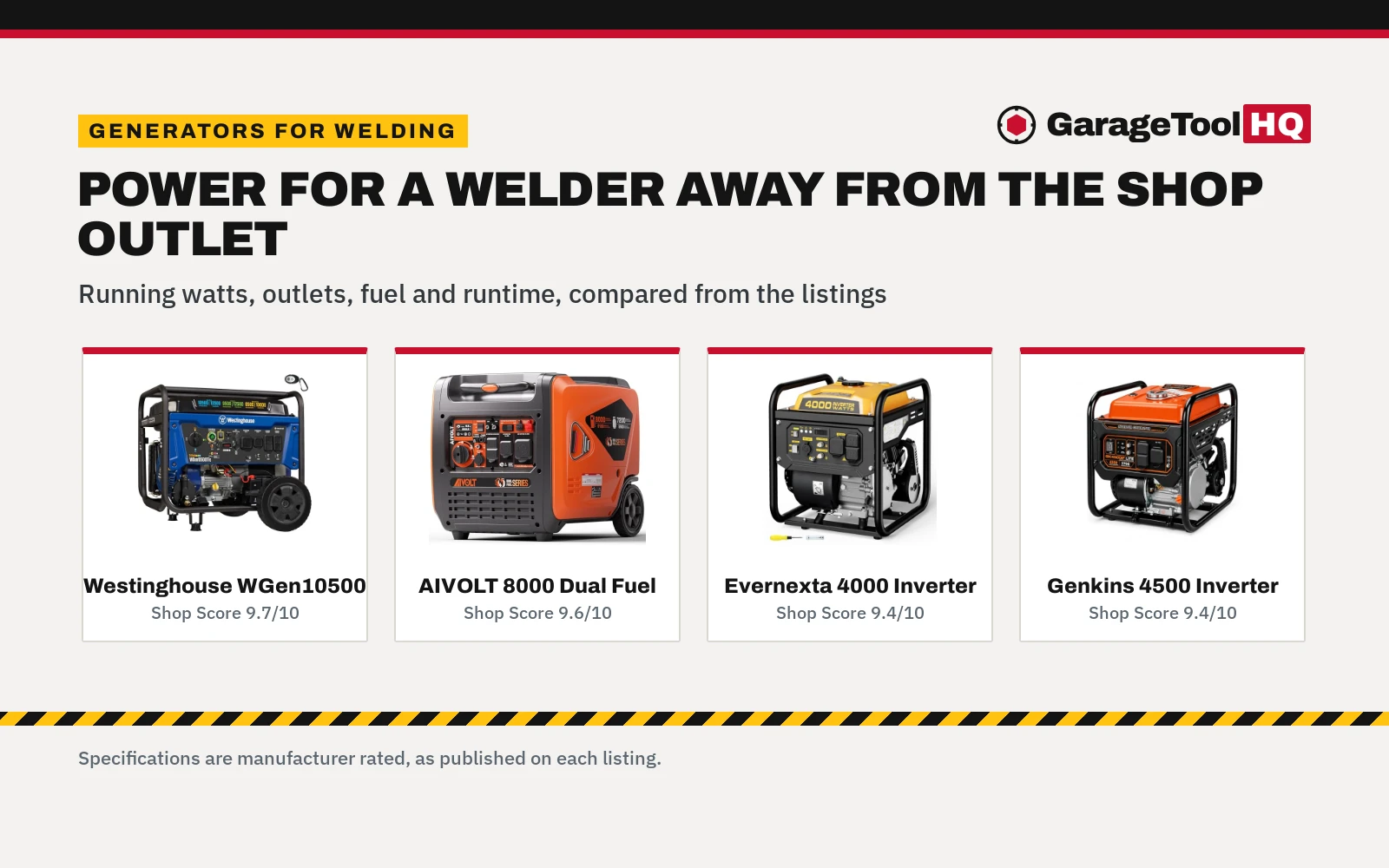
Top picks at a glance
As an Amazon Associate I earn from qualifying purchases.
- 1
 Best OverallWestinghouse WGen105009.7/10View on Amazon
- 2
 240V PickAIVOLT 8000 Dual Fuel9.6/10View on Amazon
- 3
 Lowest Weight PickEvernexta 4000 Inverter9.4/10View on Amazon
A gate hinge cracks on a trailer parked out in the yard, and the repair needs a bead laid down where the shop wall outlet cannot reach. The welder has to run off portable power, with enough capacity to hold an arc steady while the work goes on. That job is the reason to compare the best generator for welding on stated watts, outlets and fuel, rather than on guesswork about what a machine might power.
None of the five listings in this guide names a welder or a welding use, so this guide compares the machines on the figures their listings do state: running watts, peak watts, outlets, voltage, fuel and runtime. A welder manual states the power and plug type a given welder needs, and that stated requirement is the figure to match against a listing, with a licensed electrician for any 240V connection work.
GarageToolHQ earns a commission when you buy through links on this page, at no extra cost to you. Read our affiliate disclosure.
Quick picks
- Best Overall Westinghouse WGen10500: 10,500 running watts and 13,500 peak watts on gasoline, tri-fuel options, 50A and 30A outlets and a 3-year limited residential warranty. Check price on Amazon
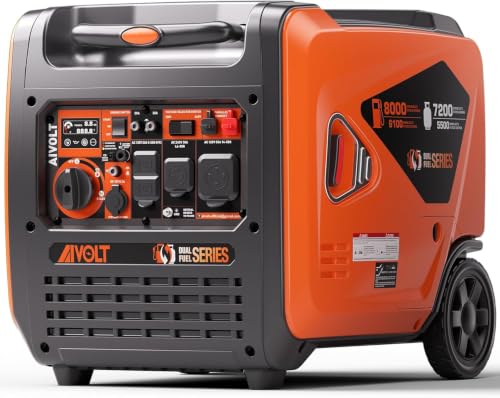
- 240V Pick AIVOLT 8000 Dual Fuel: The only listing here stating 120V and 240V output, with 6,100 running watts, dual fuel and CO auto-shutoff. Check price on Amazon
- Lowest Weight Pick Evernexta 4000 Inverter: 55 lb open-frame body with 3,400 running watts, a 30A outlet and a 2-year limited warranty for home use. Check price on Amazon
Picks for the garage
Westinghouse 13500 Peak Watt Tri-Fuel Home Backup
A tri-fuel portable generator with 10,500 running watts and 13,500 peak watts on gasoline, 50A and 30A outlets, remote electric start and a CO sensor shutdown.
Pros
- 10,500 running watts and 13,500 peak watts on gasoline
- Gasoline, propane or natural gas fuel options
- Remote electric start with backup recoil starting
- Up to 19 hours at 25% load on a 9.5-gallon tank
Cons
- 230.0 lb body needs a planned moving route
- Size label reads 13000W beside 13,500 peak watts
- Transfer switch and interlock kit sold separately
- 240V output: Not stated
AIVOLT 8000W Dual Fuel Inverter Generator 50A RV
A dual fuel inverter generator with 6,100 running watts and 8,000 surge watts, 120V and 240V output, a 50A outlet, CO auto-shutoff and electric start.
Pros
- 120V and 240V output with a 50A outlet
- 6,100 running watts and 8,000 surge watts
- Dual fuel with automatic fuel switching
- 62 dBA noise level from 23 feet
Cons
- Weight given as 129 lb in bullets and 130.7 pounds in the spec table
- Fuel tank size: Not stated
- Runtime at 50% load: Not stated
- 30A outlet: Not stated
Evernexta 4000W Gas-Powered Inverter Generator
A gas inverter generator with 3,400 running watts and 4,000 starting watts, a 30A outlet, under 3% THD and a 55 lb open-frame body.
Pros
- 55 lb open-frame body for moving by hand
- 3,400 running watts with under 3% THD
- One 30A outlet with two 120V AC outlets
- 2-year limited warranty for home use
Cons
- Title states a 9-hour runtime beside 6.5 hours at 50% load in bullets
- 240V output: Not stated
- Runtime at 25% load: Not stated
- No wheels or telescopic handle stated

Genkins 4500W Inverter Generator for Home
A gas inverter generator with 3,700 rated watts and 4,500 peak watts, a 30A outlet, pure sine wave output under 3% THD and a 56 lb open-frame body.
Pros
- 3,700 rated watts and 4,500 peak watts
- Pure sine wave output with THD under 3%
- 56 lb body with a 2.11-gallon tank
- Up to 8 hours at half load
Cons
- 120V output only, 240V output: Not stated
- No stated CO sensor shutdown
- No stated 50A outlet
- Warranty term stated as 1 year

Oxseryn 4400-Watts Inverter Generator
A gas inverter generator with 3,400 running watts and 4,400 peak watts, a 30A RV port, ECO mode and a 56 lb open-frame body.
Pros
- 3,400 running watts and 4,400 peak watts
- 14 hours runtime at 25% load
- 30A RV port with two 120V AC ports
- ECO mode with overload protection and low-oil shutdown
Cons
- Weight given as 56 lb in bullets and 57.0 pounds in the spec table
- 120V output only, 240V output: Not stated
- No stated CO sensor shutdown
- 1-year manufacturer warranty term
Compared on paper
| Model | Shop Score | Running watts | Peak watts | Outlets | Fuel | Runtime stated | Warranty |
|---|---|---|---|---|---|---|---|
| Westinghouse WGen10500 | 9.7/10 | 10,500 | 13,500 | 50A and 30A | Gas, propane, natural gas | Up to 19 hours at 25% load | 3 year limited |
| AIVOLT 8000 Dual Fuel | 9.6/10 | 6,100 | 8,000 | 50A, 120V/240V | Gas and propane | Over 10 hours at 25% load | 2 year |
| Evernexta 4000 Inverter | 9.4/10 | 3,400 | 4,000 | 30A, 120V | Gas | Up to 6.5 hours at 50% load | 2 year limited |
| Genkins 4500 Inverter | 9.4/10 | 3,700 | 4,500 | 30A, 120V | Gas | Up to 8 hours at half load | 1 year |
| Oxseryn 4400 Inverter | 9.4/10 | 3,400 | 4,400 | 30A, 120V | Gas | 14 hours at 25% load | 1 year |
These numbers are the tool makers’ rated figures, as their listings print them on 4 November 2026.
How the points were given
Each generator is scored on performance, build, value, safety and warranty, using the weights published on the How We Pick page. A CO sensor shutdown, low-oil shutdown or overload protection earns safety points, and a stated warranty term earns warranty points. The tables and product cards show the resulting scores.
| Product | Shop Score | Perf. /35 | Build /25 | Value /25 | Safety /10 | Warranty /5 |
|---|---|---|---|---|---|---|
| Westinghouse WGen10500 | 9.7 | 32 | 21 | 20 | 8 | 4 |
| AIVOLT 8000 Dual Fuel | 9.6 | 28 | 20 | 20 | 8 | 3 |
| Evernexta 4000 Inverter | 9.4 | 22 | 19 | 20 | 5 | 3 |
| Genkins 4500 Inverter | 9.4 | 24 | 19 | 20 | 5 | 2 |
| Oxseryn 4400 Inverter | 9.4 | 22 | 18 | 19 | 5 | 2 |
We map each tool’s weighted total onto a 9.2 minimum and 9.8 maximum in a straight line, so the point order and score order match.
What the listings tell you about the best generator for welding
Five listings were compared. Only one, the AIVOLT, states 120V and 240V output, while the Westinghouse lists 50A and 30A outlets and the other three list a 30A outlet with 120V output. Running watts range from 3,400 to 10,500 across the five, so the spread between the smallest and largest machine is wide, and matching a welder manual requirement matters more than picking the largest machine by default.
Fuel also splits the group. The Westinghouse runs on gasoline, propane or natural gas, the AIVOLT runs on gas and propane, and the other three run on gas. Runtime figures are stated at different loads, so a runtime at 25% load and a runtime at 50% load are not directly comparable, and the load figure beside each runtime is part of the comparison.
Buying guide: a generator for welding
Running watts and peak watts
A welder draws power while welding, so running watts describe the load a generator can carry for sustained work, while peak watts describe short surges. Compare the running watts figure against the welder manual requirement, and treat peak watts as a separate figure, not as sustained capacity. The Westinghouse lists 10,500 running watts on gasoline, and the smallest running figures here are 3,400 watts.
Outlets and voltage
A plug must fit, and voltage must match. The AIVOLT lists 120V and 240V output, and the Westinghouse lists 50A and 30A outlets. The other three list a 30A outlet and 120V output. For any 240V connection work, use a licensed electrician, and never adapt a plug type without checking the welder manual and the generator manual.
Fuel and runtime
Gasoline, propane and natural gas differ in storage and refilling, and the listings state runtime at a stated load. The Westinghouse runs up to 19 hours at 25% load on a 9.5-gallon gasoline tank, while the Oxseryn runs 14 hours at 25% load on a 2-gallon tank. Compare runtime only beside its load figure, and keep fuel storage away from the welding area.
Safety and placement
Run a fuel generator outdoors, never in a closed garage, and keep the area ventilated. A CO sensor shutdown, low-oil shutdown and overload protection are stated on some listings here, and each listing states its own combination. Check the generator manual before the first job, and keep a clear area around the machine while it runs.
Garage Fit Check
- The Westinghouse weighs 230.0 lb and measures 27.2 inches by 26.1 inches by 26.5 inches, so plan a firm, level spot and a route to move it.
- The AIVOLT has a telescopic handle and two 7 inch never-flat wheels for moving it into place.
- The Genkins weighs 56 lb and measures 17.0 inches by 15.0 inches by 18.0 inches, and the Evernexta weighs 55 lb, so both move by hand between storage and the work area.
- Check the welder plug against the stated outlets: 50A and 30A on the Westinghouse, 50A on the AIVOLT, and 30A on the other three.
- Store fuel away from the welding area, and confirm the tank and runtime figures for the planned job before starting.
Use rated jack stands on solid ground, wear eye protection with power and air tools, keep fuel-burning equipment out of a closed garage, and follow the manual for every tool. Read our Safety Disclaimer.
FAQ: garage tools
What generator is best for welding?
The best generator for welding depends on the welder manual requirement. The Westinghouse lists the highest running watts here, at 10,500 watts on gasoline, and the AIVOLT is the only listing here stating 120V and 240V output. Match the stated running watts and outlet type to the welder requirement, and use a licensed electrician for 240V connection work.
What size generator do I need for a welding machine?
Size by the running watts and outlet type stated in the welder manual, not by the generator peak watts figure. The listings here state running watts from 3,400 to 10,500 watts, and only the AIVOLT states 240V output, so a welder needing 240V narrows the comparison to the listings that state it.
How do I choose a generator for a welding machine?
Start with the welder manual power and plug requirements, then compare running watts, voltage, outlets, fuel and runtime in the generator listing. Check the stated warranty term and the stated safety shutdowns, and confirm the machine can be placed outdoors with ventilation before buying.
Does a generator for welding need 240V?
It depends on the welder. The AIVOLT lists 120V and 240V output. The Genkins, Oxseryn and Evernexta listings state 120V output with a 30A outlet, and the Westinghouse lists 50A and 30A outlets without a stated voltage in its listing. A welder manual states the voltage it needs, and 240V connection work calls for a licensed electrician.
How long will a generator run while welding?
Runtime depends on load, and listings state runtime at a stated load. The Westinghouse runs up to 19 hours at 25% load, the Oxseryn runs 14 hours at 25% load, and the Evernexta runs up to 6.5 hours at 50% load, so compare each runtime beside its load figure rather than comparing the hours alone.
Related: our engine and shop equipment hub, the best welding cart for home garage, the best MIG welder for small garage and the best welding cable extension.