Parts Washer on Wheels: How to Choose a Rolling Washer
Parts washer on wheels means a rolling cabinet washer on casters: what the wheels change, how tank size, pump flow and solvent rules compare, and when a benchtop washer fits better.

On this page
Top picks at a glance
As an Amazon Associate I earn from qualifying purchases.
- 1
 Jack Boss 3.5 Gallon Capacity Portable Steel Cabinet Parts9.6/10View on Amazon
- 2
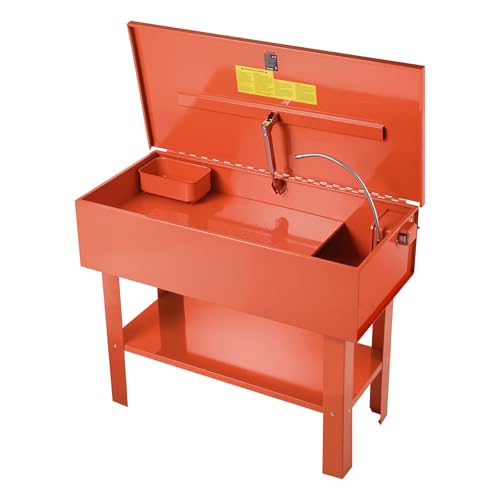 VEVOR Parts Washer 40-Gallon9.5/10View on Amazon
- 3
 VEVOR Parts Washer 5-Gallon9.5/10View on Amazon
A greasy gearbox on the bench and a parts washer fixed to the far wall do not work together, and the wash basin stays out of reach while the job waits. Parts washer on wheels is a parts washer built on casters, so the washer rolls to the job instead of the parts traveling to the washer. The rolling models are steel cabinets with a pump, a lidded tub and a drain tray. A benchtop washer stays where it sits, and a bucket-top washer sits on a bucket.
GarageToolHQ earns a commission when you buy through links on our product pages, at no extra cost to you. Read our affiliate disclosure.
Below: what the wheels change, how tank size and pump flow compare across the listings, and the solvent and safety rules that decide whether a rolling washer fits your garage.
Parts washer on wheels: what the wheels change
The wheels turn a fixed cabinet into a cart. The LuckyNote lists four caster wheels, two of them locking, on a 20-gallon washer, and the HIROHRTV rolling (on Amazon) cart lists four swivel casters with side handles at both ends. Locking casters hold the washer still while the pump runs, and the handles give a place to push from. A washer that rolls also needs floor space to park: the LuckyNote measures 38.5 inches by 21 inches by 36 inches, and the HIROHRTV rolling cart measures 38.50 inches by 21.00 inches by 36.00 inches. Both list a weight of 68 pounds, so the casters carry the washer and the fluid.
Wheels do not change what the washer cleans: the benchtop models list wheel bearings, gears and carburetors, and the LuckyNote rolling washer lists automotive parts and tools. The difference is where the cleaning happens. A rolling washer moves to the bench, the engine stand or the door, while a benchtop washer waits for parts to come to it.
| Washer type | Tank | Pump | Mobility |
|---|---|---|---|
| Rolling cabinet, LuckyNote | 20-gallon, 12-gallon working capacity | 325 GPH | Four casters, two locking |
| Rolling cart, HIROHRTV | 20-gallon | 325 GPH | Four swivel casters |
| Benchtop cabinet, BIG RED | 3.5-gallon | 325 gallon per hour | Bench top |
| Benchtop cabinet, AVGVLIJ | 3.5-gallon | Approximately 30 gallons per hour | Bench top |
| Bucket top, JEGS | Fits most standard 5-gallon buckets | One gallon per minute | Sits on a bucket |
Tank size, pump flow and weight: how the listings compare
Tank size decides how much fluid the washer holds and how large a part fits in the tub. The rolling cabinets list a 20-gallon tank, and the LuckyNote lists a 12-gallon working capacity inside that tank. The 3.5-gallon benchtop cabinets list a 3.5-gallon fluid reservoir, and the JEGS bucket-top washer fits most standard 5-gallon buckets instead of carrying its own tank.
Pump flow decides how fast the fluid moves over the part. The LuckyNote, the HIROHRTV rolling cart and the BIG RED benchtop washer each list a 325 GPH pump. The Homonova and ECARPATEYE 20-gallon (on Amazon) benchtop washers list a pump flow of 50 gallons per hour, and the AVGVLIJ benchtop washer lists approximately 30 gallons per hour. The Generic benchtop washer lists a pump that recycles liquid at 1/2 gallon per minute, and the JEGS bucket-top washer (on Amazon) lists a one gallon-per-minute submersible pump.
Weight and size decide where the washer can go. The rolling cabinets list 68 pounds, while the benchtop 20-gallon washers list 52.8 pounds for the Homonova and an approximate shipping weight of 58 pounds for the ECARPATEYE. The BIG RED benchtop washer lists 16.8 pounds, the AVGVLIJ lists 15.0 pounds, and the JEGS bucket-top washer lists 4.3 pounds. A rolling washer carries its own weight on casters, while a benchtop washer is lifted onto a bench.
Rolling cart or fixed stand: the HIROHRTV pair
One listing sells two washers that show the difference wheels make. The HIROHRTV 20-gallon model is a rolling cart with four swivel casters, a middle shelf, a lower tray and a hanging black container, and it measures 38.50 inches by 21.00 inches by 36.00 inches at 68 pounds. The HIROHRTV 40-gallon model is a fixed stand with four fixed legs and a broad lower shelf, and it measures 44.50 inches by 21.50 inches by 34.60 inches at 90 pounds. The stand model lists a 24-gallon solvent capacity and a maximum pump output of 5 gallons per minute, while the rolling cart lists a 325 GPH pump. The listing states that the structures, dimensions, weights and pump specifications are not interchangeable between the two, so read the figures for the model you mean.
Choose the cart when the washer has to move between jobs, and choose the stand when the washer has a fixed spot and the work comes to it. Either way, match the stated capacity and pump output to the parts you clean, not to the other model in the same listing.
Solvent rules and the lid: the safety checks
Solvent choice is the first safety check. The LuckyNote washer is designed specifically for water-based cleaning solutions, and the Generic and BIG RED 3.5-gallon benchtop washers state that they are not for use with flammable or combustible solvents such as mineral spirits. Read the solvent label for the washer you buy, and use only the kind of solution its maker states. A guide to mineral spirits in a parts washer covers that solvent in more detail.
The lid is the second safety check. The Generic and BIG RED benchtop washers list a hinged, fusible link lid that closes when not in use and helps prevent accidental fire, while the AVGVLIJ, ECARPATEYE and Homonova benchtop washers list a hinged lid with a fusible link that shuts automatically in the event of a flash fire. The LuckyNote lists a fusible link that automatically closes the lid in case of fire. Keep the lid closed when the washer is not in use, and keep flammable material away from the washer while it runs.
Power is the third check. The benchtop washers list a 110V electric pump, and the MOTORHOT 20-gallon washer (on Amazon) lists 120V and 43W. The JEGS bucket-top washer uses a submersible pump. Check the voltage the maker states for the washer you buy.
Match the cleaning solution to the washer before you fill the tank. Use only water-based solutions where the maker states them, never use flammable or combustible solvents such as mineral spirits where the maker states not to, and keep the lid closed when the washer is not in use.
Read the manual before first use, wear eye protection, keep the work area clear and ventilated, and stay within every stated rating. Read our Safety Disclaimer.
How to choose a parts washer on wheels, in order
- Measure the floor space where the washer will park, and check the stated dimensions for the rolling model.
- Check the tank size and the working capacity, such as the 20-gallon tank with a 12-gallon working capacity the LuckyNote lists.
- Match the pump flow to the parts you clean, such as the 325 GPH pump the rolling cabinets list.
- Check the casters: four casters, with two locking on the LuckyNote, hold the washer still while it runs.
- Check the solvent rules for the washer, and use only water-based solutions where the maker states them.
- Check the lid and the drain tray for the shelf or tray space the job needs.
Tools that sit next to this job
A rolling parts washer sits next to the rest of the cleaning bench. A guide to the best parts washer for a home garage compares cabinet washers side by side, and a guide to parts cleaner for a parts washer covers the cleaning solutions that go in the tank. Keep those choices tied to the maker instructions for your washer.
FAQ: garage tools
What is a parts washer on wheels?
A parts washer built on casters. The LuckyNote lists four caster wheels, two of them locking, on a 20-gallon washer, and the HIROHRTV rolling cart lists four swivel casters. The washer rolls to the job, and the locking casters hold it still while it runs.
How big is a rolling parts washer?
The LuckyNote measures 38.5 inches by 21 inches by 36 inches at 68 pounds, and the HIROHRTV rolling cart measures 38.50 inches by 21.00 inches by 36.00 inches at 68 pounds. Both list a 20-gallon tank, and the LuckyNote lists a 12-gallon working capacity.
Can I use mineral spirits in a parts washer on wheels?
Follow the maker rules for the washer you buy. The LuckyNote is designed specifically for water-based cleaning solutions, and the Generic and BIG RED 3.5-gallon benchtop washers state they are not for use with flammable or combustible solvents such as mineral spirits.
What pump flow does a rolling parts washer have?
The LuckyNote and the HIROHRTV rolling cart each list a 325 GPH pump. Some benchtop models list lower flows, such as 50 gallons per hour for the Homonova and the ECARPATEYE, and approximately 30 gallons per hour for the AVGVLIJ.
Is a rolling parts washer better than a benchtop parts washer?
It depends on the garage. A rolling washer moves to the job on casters, while a benchtop washer such as the BIG RED 3.5-gallon cabinet stays on the bench and lists 16.8 pounds. Choose the rolling washer when the work moves around the garage, and the benchtop washer when the work stays in one place.
Related: parts washer picks for a home garage, parts cleaner for a parts washer, mineral spirits in a parts washer and engine and shop equipment hub.