What Are Wheel Chocks? How They Work and Safe Setup Guide
What wheel chocks do to prevent vehicle rollaway, how rubber and plastic designs compare, and safe placement rules for lifting or parking in a home garage.

On this page
Top picks at a glance
As an Amazon Associate we earn from qualifying purchases.
- 1
 MaxxHaul Rubber Wheel Chock 2 Pack9.7/10View on Amazon
- 2
 MaxxHaul Solid Rubber Wheel Chock 2-Pack9.6/10View on Amazon
- 3
 PAULINN Camper RV Wheel Chock Stabilizer 2 Sets for Travel9.6/10View on Amazon
- 4
 Amazon Basics Automotive Wheel ChocksView on Amazon
- 5
 Vestil LWC-15 Laminated Rubber Wheel Chock 8 In. x 10-5/16View on Amazon
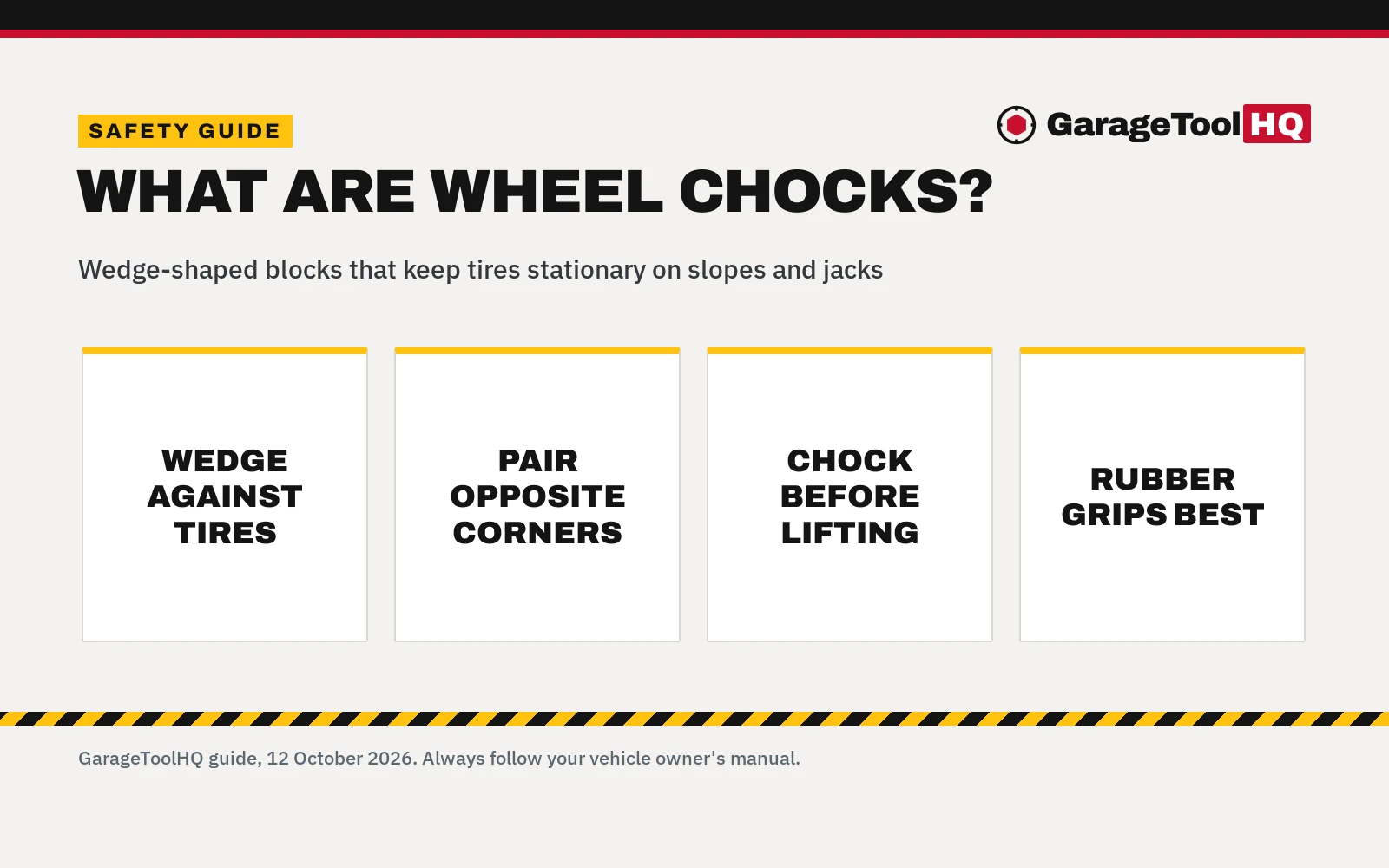
Before you roll a floor jack under your vehicle for an oil change or set up stands for a brake job, you need something solid holding the tires to the garage floor. What are wheel chocks? Wheel chocks are heavy, wedge-shaped blocks placed firmly against vehicle tires to prevent unintended rolling, shifting, and rollaway accidents. By wedging directly against the tire tread in the direction of gravity or lifting force, they establish a physical barrier that the wheel cannot easily climb. Wheel chocks serve as an essential secondary physical backup alongside your transmission parking pawl or emergency brake whenever a vehicle is raised or parked on an incline.
More options to compare
 Amazon Basics Automotive Wheel ChocksCheck price on Amazon
 Vestil LWC-15 Laminated Rubber Wheel Chock 8 In. x 10-5/16Check price on Amazon
GarageToolHQ earns a commission when you buy through links on our product pages, at no extra cost to you. Read our affiliate disclosure.
Below: what wheel chocks do, why factory parking systems are not enough on their own, how common chock materials compare, and the step-by-step placement checklist to follow before any lifting job.
What are wheel chocks, and what do wheel chocks do?
Wheel chocks are specialized wedge blocks engineered to keep parked or serviced vehicles completely stationary. When a car, truck, camper, or utility trailer rests on a surface, external forces like driveway slopes, vehicle vibrations, and lifting geometry encourage the tires to rotate. A wheel chock places an engineered incline directly in front of or behind the tire contact patch. To roll, the tire must climb the height of the chock, effectively locking the wheel in place.
Many vehicle owners assume that shifting an automatic transmission into Park or setting the emergency brake provides all necessary holding power. In a working garage, relying on those systems alone introduces serious hazards:
- Transmission parking pawls are vulnerable mechanical latches. In an automatic transmission, Park engages a small metal pawl into a notched ring on the output shaft. If the vehicle is bumped or subjected to heavy wrenching force, the pawl can slip, disengage, or shear off, freeing the driveline to rotate.
- Manual transmissions can roll if compression slips. Leaving a manual vehicle in gear relies on engine cylinder compression. If a vehicle receives a sharp jolt, compression can slip, allowing the crankshaft to turn and the vehicle to roll.
- Parking brakes operate on one axle only. In most passenger vehicles, the emergency brake locks only the rear wheels. If you raise the rear axle to service brakes, the parking brake is lifted off the ground. If the front wheels are unchocked, nothing prevents the front end from rolling.
- Jacking creates an angled pivot arc. When a hydraulic jack lifts one end of a vehicle, the chassis tilts along an arc. That motion exerts horizontal force against the tires remaining on the ground, pushing them forward or backward.
Wheel chock materials: rubber, plastic, foam, and tandem stabilizers
| Chock Type | Material and Stated Specifications | Best Garage Application |
|---|---|---|
| Dense Solid Rubber | Molded heavy-duty rubber with stepped slope traction and grooved bottoms. The OULEME TD-RWC16-2P 4-pack measures 6.3″ x 4.34″ x 4.01″, weighs 11.03 pounds, and includes 3 reflective yellow strips with a 52-inch braided nylon connecting rope. The Vacallity solid rubber 4-pack measures 5.31″ x 5.31″ x 7.87″ and weighs 17.24 pounds with a 14.2-inch connecting rope. Rhino USA lists a rubber 2-pack measuring 9 x 14 x 4 inches and weighing 14.96 pounds. | Home garage concrete slabs, asphalt driveways, passenger cars, light trucks, and shop maintenance. |
| Rigid Polypropylene Plastic | Lightweight molded hard plastic with textured gripping faces. The Reonite 4-pack measures 7.87 x 4.56 x 4.17 inches, weighs 2.79 pounds, includes built-in pull ropes and 5 mm thick non-slip mats, and is listed to accommodate tires up to 26 inches. | Lightweight passenger vehicles, small camping trailers, and mobile roadside kits where storage space and weight matter. |
| Structural Poly Foam | Lightweight structural poly foam with an integrated handle. The MaxxHaul 50503 2-pack measures 8″ x 4″ x 4″, weighs 1.8 pounds for the pair, and includes a slip-resistant bottom rubber strip. | Lawn equipment, compact utility trailers, and quick garage parking stops on dry, level surfaces. |
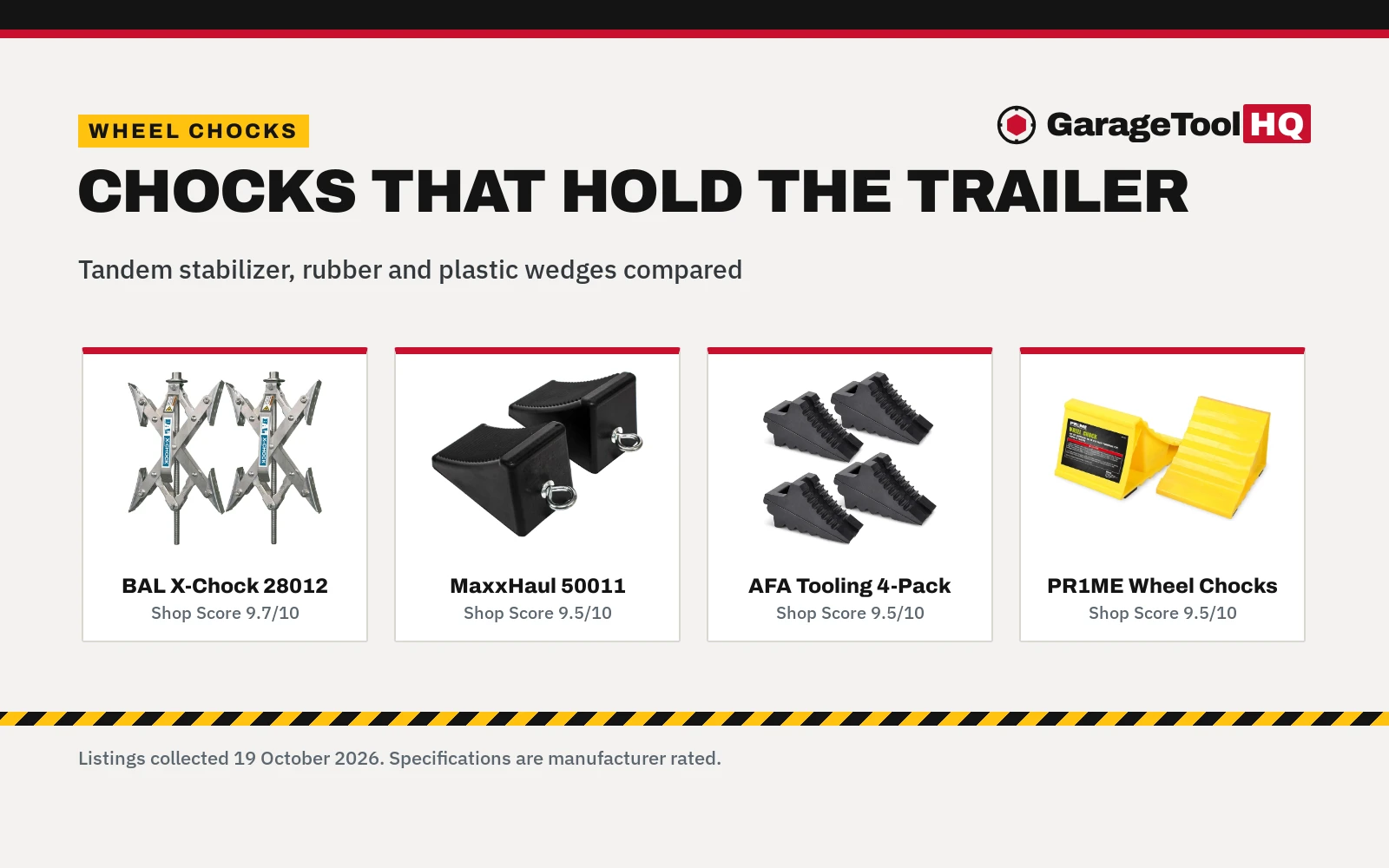
| Tandem X-Shaped Stabilizer | Cast iron mechanical scissor assembly with opposing expansion arms. WELLUCK lists a 2-set pack weighing 10 pounds that expands between tandem wheel clearances from 3.5″ to 12″ using an opposing-force X-frame. | Dual-axle travel trailers and RV campers parked on pads to eliminate rocking and roll. |
For routine maintenance on smooth garage floors, dense solid rubber remains the preferred choice because it grips sealed concrete without sliding. If you are comparing specific models for your garage, browse our roundup of the best wheel chocks.
How to use wheel chocks safely: the step-by-step checklist
- Park on a solid, level concrete surface. Position your vehicle on flat concrete before servicing. Never raise or service a vehicle on soft dirt or sloped ground where jack stands can sink or tilt.
- Set the parking brake and engage the transmission. Place automatic transmissions in Park or manual transmissions in reverse or low gear. Fully engage the parking brake before stepping out.
- Identify roll direction and lifting point. If the vehicle sits on any slight grade, identify the downhill direction. If raising one end with a jack, identify which axle stays on the ground.
- Chock the tires that stay on the garage floor. When raising the front wheels, chock the rear tires. When lifting the rear wheels, chock the front tires. Chocking tires that will be lifted off the floor provides zero safety.
- Position chocks centered against the tire tread. Place each chock squarely against the middle of the tire tread. Both the driver-side and passenger-side tires on the grounded axle should be blocked.
- Press the chock wedge firmly against the rubber. Push the wedge tightly into the tire contact patch by hand or tap it snug with your work boot so no gap remains.
- Block both directions on flat ground. For standard garage work on a level slab, block the front and back of the grounded tires to prevent shifting in either direction while wrenching.
- Confirm vehicle stability before working. After raising the vehicle onto rated jack stands, give the bumper a firm push to verify that the stands are stable and the chocks remain seated before crawling underneath.
A hydraulic floor jack or bottle jack is designed solely to lift a vehicle, never to hold it in place. Hydraulic pressure can drop without warning, causing the vehicle to fall. Always lower the chassis onto rated jack stands placed directly beneath the manufacturer lift points specified in your vehicle owner’s manual before starting work.
A jack is for lifting, not holding. Never work under a vehicle supported only by a jack: set it on rated jack stands, on solid, level ground, at the manufacturer's lift points, chock the wheels, and give the car a firm shake before you go under. Read our Safety Disclaimer.
Why wheel chocks are mandatory when using floor jacks and jack stands
Lifting a vehicle fundamentally alters its center of gravity. As a hydraulic jack raises the chassis, the car tilts across an angle, pivoting on the tires that stay on the floor. Without wheel chocks, this pivot movement can cause the grounded wheels to roll forward or backward, pulling the jack off its saddle or tipping jack stands off their bases.
This hazard is especially dangerous on front-wheel-drive vehicles. In a front-wheel-drive car, the transmission parking pawl locks only the front transaxle. When you raise the front end for an oil change or tire rotation, the rear wheels are completely free to roll if the emergency brake is weak or slips. Positioning heavy rubber chocks behind both rear wheels prevents the car from rolling backward off the jack.
Before lifting, review our complete guide on how to use a floor jack safely and verify what size jack stands do I need to match your vehicle’s weight and working height. You can also compare durable support options in our review of the best jack stands.
Why scraps of wood and bricks make poor wheel chocks
Many garage owners are tempted to grab spare items from around the shop, such as scraps of dimensional lumber, bricks, or concrete blocks. Using improvised stops is an unsafe garage habit:
- Concrete blocks and bricks crumble under load. Bricks and hollow concrete blocks are brittle masonry materials. When vehicle weight rolls against them, they can crack and shatter abruptly under stress.
- Flat wood lacks the proper wedge angle. A rectangular piece of lumber does not match the curve of a radial tire. The tire can easily roll up and over a flat board rather than being stopped by a rising ramp profile.
- Smooth lumber slides on sealed concrete. Plain wood has low friction against smooth garage floors. Under lateral vehicle pressure, a wooden board will slide across the concrete rather than bite into the floor.
Proper wheel chocks feature angled faces engineered to cradle radial tire curves and textured bases that bite into concrete, gravel, and asphalt. For more details on correct placement technique, read our guide on how to use wheel chocks.
Frequently Asked Questions
How many wheel chocks do you need?
For standard maintenance on a level concrete floor, you need at least a pair of chocks to block both sides of the axle remaining on the ground. For sloped driveways, heavy trucks, or trailers, using four chocks to block both the front and rear of tires on both sides provides maximum stability. Reference listings in data commonly provide two-pack or four-pack sets for this reason.
Which wheels should you chock when lifting a car?
Always chock the wheels that remain on the ground. When raising the front wheels for an oil change, place chocks against the rear tires. When lifting the rear wheels for brake service, place chocks against the front tires. Chocking a wheel that will be lifted into the air provides zero holding power once the tire leaves the ground.
Should wheel chocks go in front of or behind the tires?
Place chocks in the direction the vehicle would naturally roll. If facing downhill, place chocks in front of the downhill tires. If facing uphill, place chocks behind the rear tires. On a level garage floor with a floor jack, placing chocks on both sides of the grounded tires stops movement in either direction.
Can you use wheel chocks on a sloped driveway?
Wheel chocks help keep a parked vehicle stable on minor inclines, but you should never raise a car with a jack or place it on jack stands on a sloped driveway. Lifting equipment must always be used on a solid, level concrete floor to prevent stands from tipping sideways under angled loads.
Are rubber wheel chocks better than plastic chocks?
For home garage workshops, heavy solid rubber chocks are generally superior. Rubber provides dependable grip on smooth concrete and resists sliding when force is applied. Plastic chocks are lighter and easier to stow, but they require textured rubber base pads or aggressive teeth to hold firmly on slick surfaces.
Can you use wood blocks or bricks instead of wheel chocks?
No. Improvised blocks such as bricks, cinder blocks, or flat boards should never replace dedicated wheel chocks. Masonry blocks can crack or crumble abruptly under vehicle weight, and flat boards lack both the wedge geometry to stop tire roll and the grip needed to prevent sliding across smooth garage floors.
Related: our step-by-step guide on how to use wheel chocks, our detailed comparison of the best wheel chocks, our safety walkthrough on how to use a floor jack safely, our top picks for the best jack stands, our sizing guide on what size jack stands do I need, and our full jacks and stands hub.