How Many Wheel Chocks Do I Need? What to Know
How many wheel chocks you need for garage repairs and trailer parking: 2 chocks for level maintenance, 4 chocks for slopes, and safe tire placement rules.

On this page
Top picks at a glance
As an Amazon Associate we earn from qualifying purchases.
- 1
 MaxxHaul Rubber Wheel Chock 2 Pack9.7/10View on Amazon
- 2
 MaxxHaul Solid Rubber Wheel Chock 2-Pack9.6/10View on Amazon
- 3
 PAULINN Camper RV Wheel Chock Stabilizer 2 Sets for Travel9.6/10View on Amazon
- 4
 Amazon Basics Automotive Wheel ChocksView on Amazon
- 5
 Vestil LWC-15 Laminated Rubber Wheel Chock 8 In. x 10-5/16View on Amazon
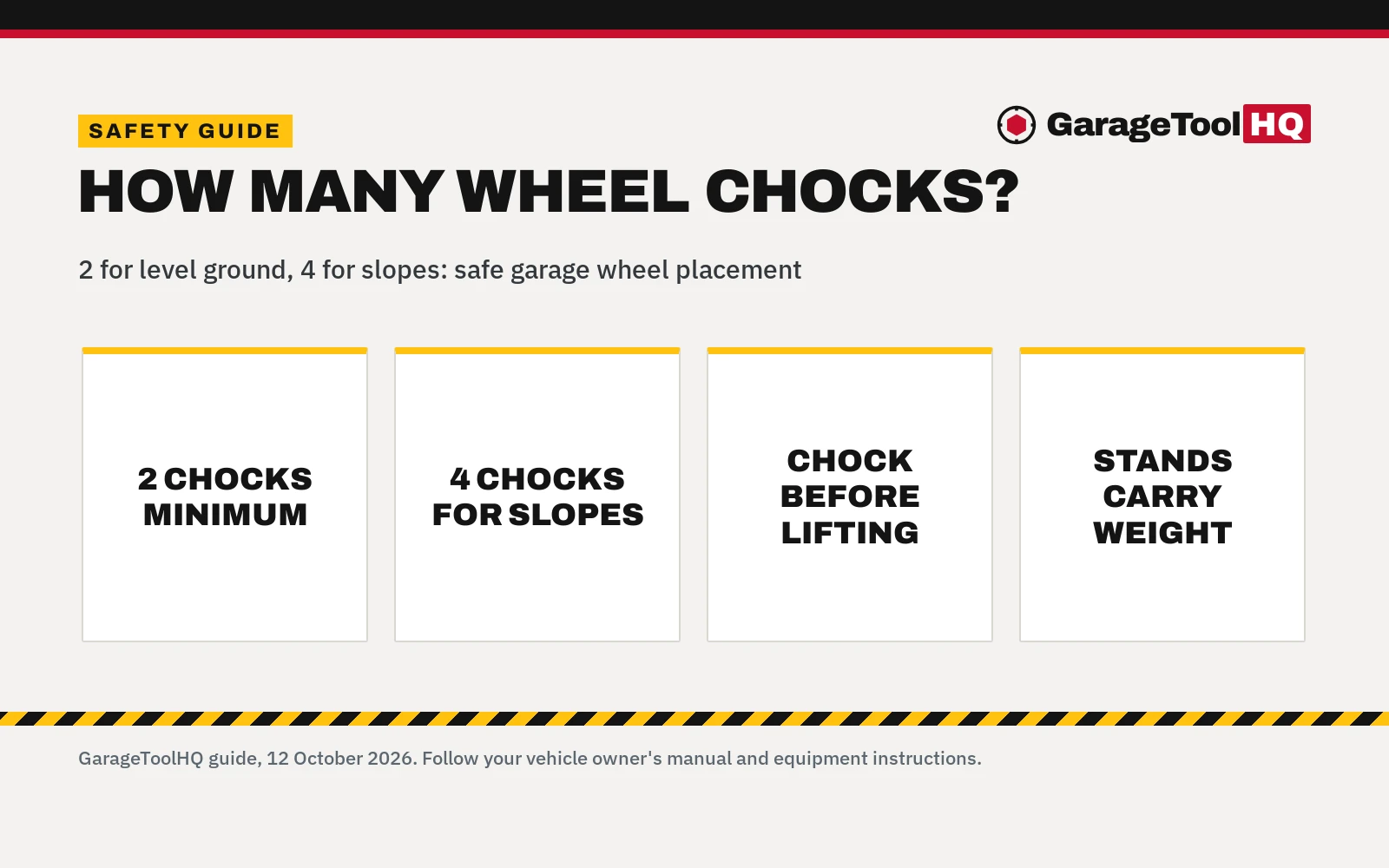
Setting up for a front brake job or an oil change in the driveway brings up an immediate question: how many wheel chocks do I need? For standard vehicle maintenance on a flat garage floor, you need at least 2 wheel chocks placed snugly against the tires on the axle that stays grounded, while 4 wheel chocks give complete stability when parking on slopes, securing tandem trailers, or locking wheels in both directions. Using only a single chock leaves the unblocked wheel free to pivot or roll if the vehicle shifts, which risks pulling the car off your lifting points. A matched pair of chocks keeps the grounded axle stationary before your hydraulic floor jack begins to raise the car.
More options to compare
 Amazon Basics Automotive Wheel ChocksCheck price on Amazon
 Vestil LWC-15 Laminated Rubber Wheel Chock 8 In. x 10-5/16Check price on Amazon
GarageToolHQ earns a commission when you buy through links on our product pages, at no extra cost to you. Read our affiliate disclosure.
Below: how many wheel chocks you need for common home garage jobs, how positioning changes on slopes, a safe vehicle lifting checklist, and how rubber, plastic, and poly foam chock dimensions compare.
How many wheel chocks do I need? Breakdown by garage task
Wheel chocks are heavy wedges placed tight against tire treads to stop unintended rolling through physical resistance. When you lift one end of a car or truck, the vehicle wants to pivot on the tires remaining on the concrete. The number of chocks you require depends directly on the slope of the surface and how many wheels leave the floor:
- Lifting one axle on level concrete: 2 wheel chocks. If you raise the front end for an oil change or steering check, place 2 chocks behind both rear tires. If you lift the rear end for differential service or rear brake work, place 2 chocks in front of both front tires.
- Parking on an incline or sloped driveway: 4 wheel chocks. Gravity pulls downhill continuously. Chocking both sides of both downhill tires, or placing 4 chocks on the downhill side of all grounded wheels, prevents the vehicle from overcoming a single contact point.
- Tandem-axle travel trailers and campers: 4 wheel chocks, or 2 sets of opposing wheel chock stabilizers between the tires. Tandem setups shift weight between axles, so blocking both tires prevents rocking and rolling.
- Long-term garage vehicle storage: 4 wheel chocks. Placing chocks in front and behind both sides of the vehicle keeps it firmly anchored even if tire pressure slowly drops or a parking cable stretches over time.
Never rely on your transmission park pawl or emergency brake alone. On rear-wheel-drive vehicles, lifting the rear axle lifts the emergency brake drums or rotors completely off the floor. Without 2 wheel chocks locked against the front tires, the front wheels are completely free to roll, which can drop the car off your jack.
Wheel chock counts by vehicle setup and job type
| Vehicle Setup or Garage Job | Chocks Needed | Where to Place Them |
|---|---|---|
| Raising front wheels on level floor | 2 chocks | Behind both rear tires to block backward roll |
| Raising rear wheels on level floor | 2 chocks | In front of both front tires to block forward roll |
| Parking on a slope or driveway incline | 4 chocks | Downhill side of both grounded wheels, or both sides of lower axle tires |
| Tandem-axle camper or utility trailer | 4 chocks (or 2 sets of X-chocks) | Between adjacent tandem tires or on both sides of each wheel |
| Full vehicle lift on 4 jack stands | None (wheels off ground) | All wheels off floor; vehicle must rest completely on rated stands on solid concrete |
The table above assumes solid, flat concrete flooring. If your driveway has any slope, treat it as an incline and upgrade from 2 chocks to 4 chocks for added safety.
How to position wheel chocks safely: the garage checklist
- Park on solid, level ground. Concrete garage slabs are ideal. Soft asphalt, dirt, or gravel can allow chocks to slip under pressure.
- Engage the parking brake firmly and put the transmission in Park (or Reverse for a manual transmission) before exiting the driver seat.
- Identify the roll direction. If you raise the front axle, the vehicle will want to roll backward, so chocks belong behind the rear tires. If you raise the rear axle, place chocks in front of the front tires.
- Center the chock wedge square against the tire tread. Never angle the chock or place it off to the sidewall. The wedge must sit perpendicular to the tread face.
- Push the chock firmly into the rubber. Press the wedge snug by hand or tap it lightly with your boot heel so the teeth, ridges, or rubber base grip the floor surface.
- Place chocks before positioning your floor jack. Never pump a jack handle while the vehicle tires remain unblocked.
- Lower the vehicle onto rated jack stands immediately. Once lifted to working height, lower the chassis onto rated jack stands placed at manufacturer lift points on the frame or pinch welds.
- Remove chocks only after the job is finished. Lower the vehicle fully back onto its tires, clear your stands and tools, and only then pull the chocks away.
Wheel chocks keep tires from rolling, but they do not support vehicle weight. Never crawl under a car held only by a hydraulic floor jack or bottle jack. Always lower the vehicle onto rated jack stands placed at manufacturer lift points on a flat, solid floor before starting work.
A jack is for lifting, not holding. Never work under a vehicle supported only by a jack: set it on rated jack stands, on solid, level ground, at the manufacturer's lift points, chock the wheels, and give the car a firm shake before you go under. Read our Safety Disclaimer.
Rubber vs plastic vs poly foam wheel chocks
Selecting the right chock material ensures your wedges grip the garage floor instead of sliding when weight presses against them:
- Heavy-duty solid rubber: Rubber offers high traction on smooth, sealed garage concrete. ROBLOCK lists a 4-pack of rubber wheel chocks measuring 6.3″ x 4.3″ x 4″ with 3 yellow reflective strips. OULEME lists a 4-pack measuring 8″ x 5″ x 4″ weighing 2.45 lb per chock (10.56 pounds pack weight) with eyebolts, and a separate model measuring 6.3″ x 4.34″ x 4.01″ with a 52-inch braided nylon rope. Vacallity lists solid rubber chock blocks measuring 5.31″ x 5.31″ x 7.87″ weighing 17.24 pounds for a 4-pack with a 14.2-inch connecting rope. Rhino USA lists a 2-pack measuring 9 x 14 x 4 inches weighing 14.96 pounds with a tri-point design. WEYCALI lists a 4-pack of solid rubber chocks measuring 8 x 4 x 6 inches weighing 9.86 pounds with a bilateral curve design.
- Hard plastic: Plastic chocks are lightweight and resist shop fluids like oil and coolant. Reonite lists a 4-pack of hard PP plastic chocks measuring 7.87 x 4.56 x 4.17 inches weighing 2.79 pounds with 5 mm thick non-slip mats rated for tires up to 26 inches. Amazon Basics lists a 2-pack of automotive wheel chocks measuring 8.27″L x 6.06″W x 4.53″H weighing 0.18 kg.
- Lightweight structural poly foam: MAXXHAUL lists an 8″ x 4″ x 4″ poly foam chock weighing 1.8 pounds for a 2-pack in safety yellow with a slip-resistant rubber base strip.
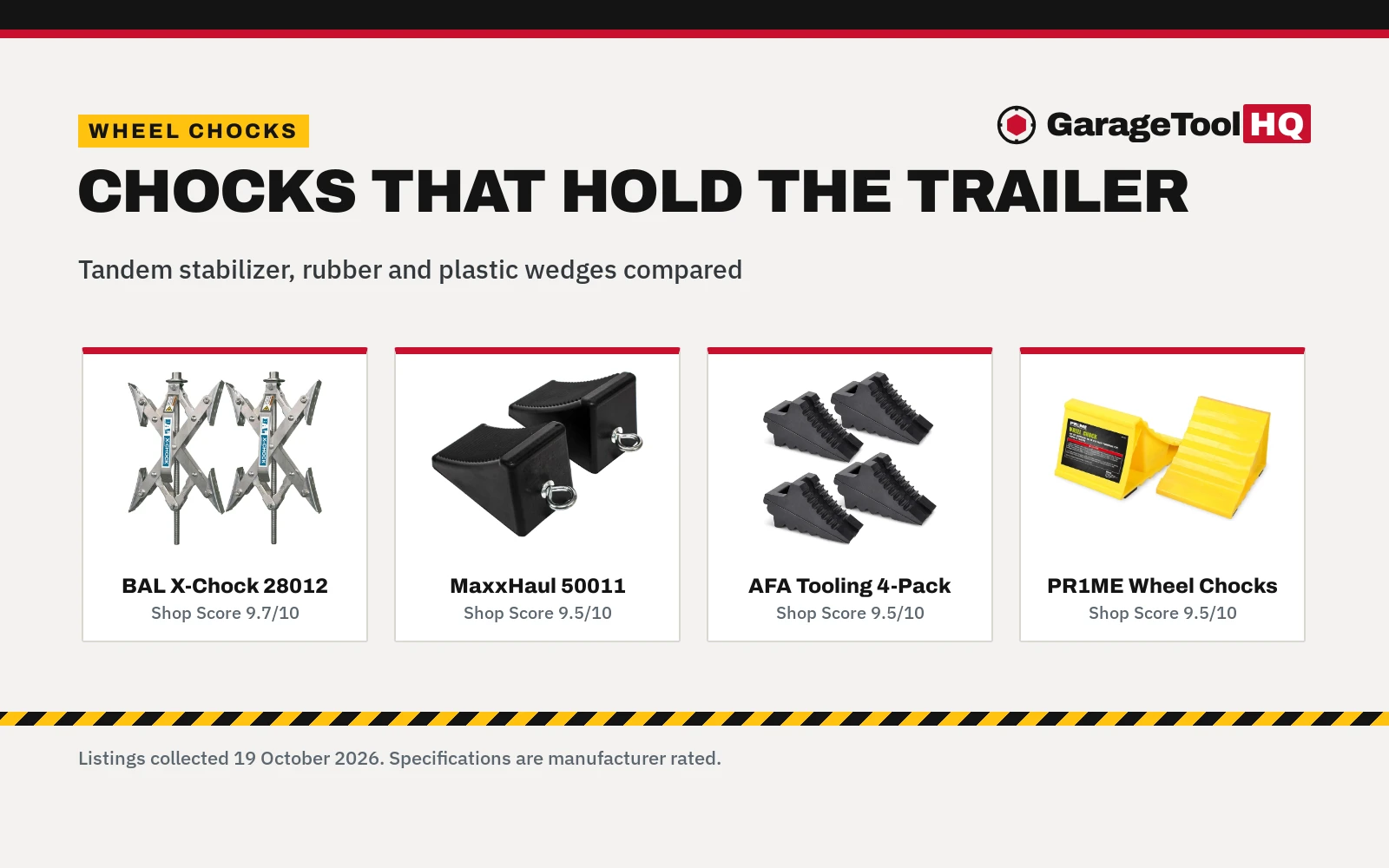
- Camper and trailer X-chocks: For tandem-axle trailers, WELLUCK lists 2 sets of heavy-duty X-shaped camper wheel chock stabilizers made from cast iron weighing 10 pounds that fit wheel clearances ranging from 3.5 inches to 12 inches.
For standard garage maintenance, compare your options in our roundup of the best wheel chocks, or read our complete walkthrough on how to use wheel chocks. To pair your chocks with reliable shop lifting gear, explore what size floor jack do I need and review our guide to how to use a floor jack safely.
What size wheel chock do you need for your tires?
A wheel chock can only stop a vehicle if its height prevents the tire from rolling up and over the incline. A wedge that is too short acts like a speed bump under heavy load. The chock face should sit tall against the tire tread curve to block movement firmly.
Tire diameter determines the height required. For example, Reonite rates its 4.17-inch tall chocks for tires up to 26 inches. Larger truck, trailer, or SUV tires require taller chocks, such as WEYCALI at 6 inches tall or Vacallity at 7.87 inches tall. Chock width also matters: narrow wedges can allow wide treads to twist past them, while wider options like Amazon Basics at 6.06 inches wide or Rhino USA at 14 inches provide broader tire coverage. Connected ropes, like the 14.2-inch rope on Vacallity or the 52-inch rope on OULEME, let you retrieve chocks quickly from under deep wheel wells without awkward reaching.
Before lifting any car or truck, verify your support gear with our guide on how many jack stands you need and consult what size jack stands do I need to match stand capacity to your vehicle curb weight.
Frequently Asked Questions
How many wheel chocks do I need for an oil change?
For an oil change on flat garage concrete, you need 2 wheel chocks. When you lift the front axle to access the oil drain plug and filter, place 2 chocks behind both rear wheels. This prevents the rear axle from rolling backward while the front wheels are off the ground.
Can I use only 2 wheel chocks on a steep slope?
On a noticeable slope or driveway incline, you should use 4 wheel chocks. Gravity puts extra force on the tires, and 2 chocks can slip if surface friction is low. Placing 4 chocks provides dual-wheel blocking and keeps the vehicle stable.
Do wheel chocks go in front of or behind the tires?
Position wheel chocks on the side facing the direction of potential roll. When raising the front of the car, place chocks behind the rear tires. When raising the rear of the car, place chocks in front of the front tires. On an incline, always chock the downhill side of the tires.
Do I need wheel chocks if my car is in Park with the emergency brake set?
Yes. Parking pawls in automatic transmissions have mechanical play and can snap under sudden stress. Emergency brakes typically operate on the rear wheels only. If you raise the rear axle, the emergency brake provides zero holding force on the front wheels. Always set 2 wheel chocks on the grounded wheels.
Can I use wood blocks instead of wheel chocks?
Scrap lumber or wooden blocks lack the angled curve, tread grip, and slip-resistant base required to lock a tire securely. Wood easily splits, cracks under load, or skids across slick garage concrete. Purpose-built rubber, plastic, or foam chocks grip both the floor and the tread.
How many wheel chocks does a travel trailer need?
A travel trailer requires at least 4 wheel chocks when unhitched, blocking both the front and rear of the tires on both sides. For tandem-axle trailers, using 2 sets of X-chocks between adjacent tires provides rigid stabilization to stop sway and movement while parked.
Related: how to use wheel chocks, the best wheel chocks, our jacks and stands hub, how many jack stands do you need, and what size jack stands do I need.