Best Professional Battery Checker (2026): 5 Analyzers Compared
Five professional battery analyzers compared by voltage compatibility, cold cranking amps range, display size, printer hardware and warranty terms.

On this page
Top picks at a glance
As an Amazon Associate we earn from qualifying purchases.
- 1
 Top Commercial PickTOPDON BT6009.7/10View on Amazon
- 2
 Best for Solo DiagnosticsFOXWELL BT7059.6/10View on Amazon
- 3
 Best Compact Printer UnitTOPDON BT300P9.5/10View on Amazon
- 4
 Best Heavy-Duty Load UnitSchumacher BT-1009.4/10View on Amazon
- 5
 TOPDON BT600 Plus Car Battery TesterView on Amazon
- 6
 Battery Load TesterView on Amazon
- 7
 ANCEL BT310 Battery Tester 12V 24VView on Amazon
- 8
 BT906 Car Battery Tester 6V 12V 24V with Lithium BatteryView on Amazon
- 9
 AUTOOL BT360 Car Battery TesterView on Amazon
When a neighbor’s truck turns over sluggishly on a freezing Saturday morning, guessing whether the alternator, the starter, or the battery is dying gets expensive fast. Pinpointing weak cells before winter requires the best professional battery checker, giving you cold cranking amp readouts, charging voltage analysis, and starter motor draw in seconds. This roundup compares five professional automotive battery analyzers across voltage support, CCA range, screen clarity, hard-copy reporting, and warranty terms.
GarageToolHQ earns a commission when you buy through links on this page, at no extra cost to you. Read our affiliate disclosure.
Quick picks
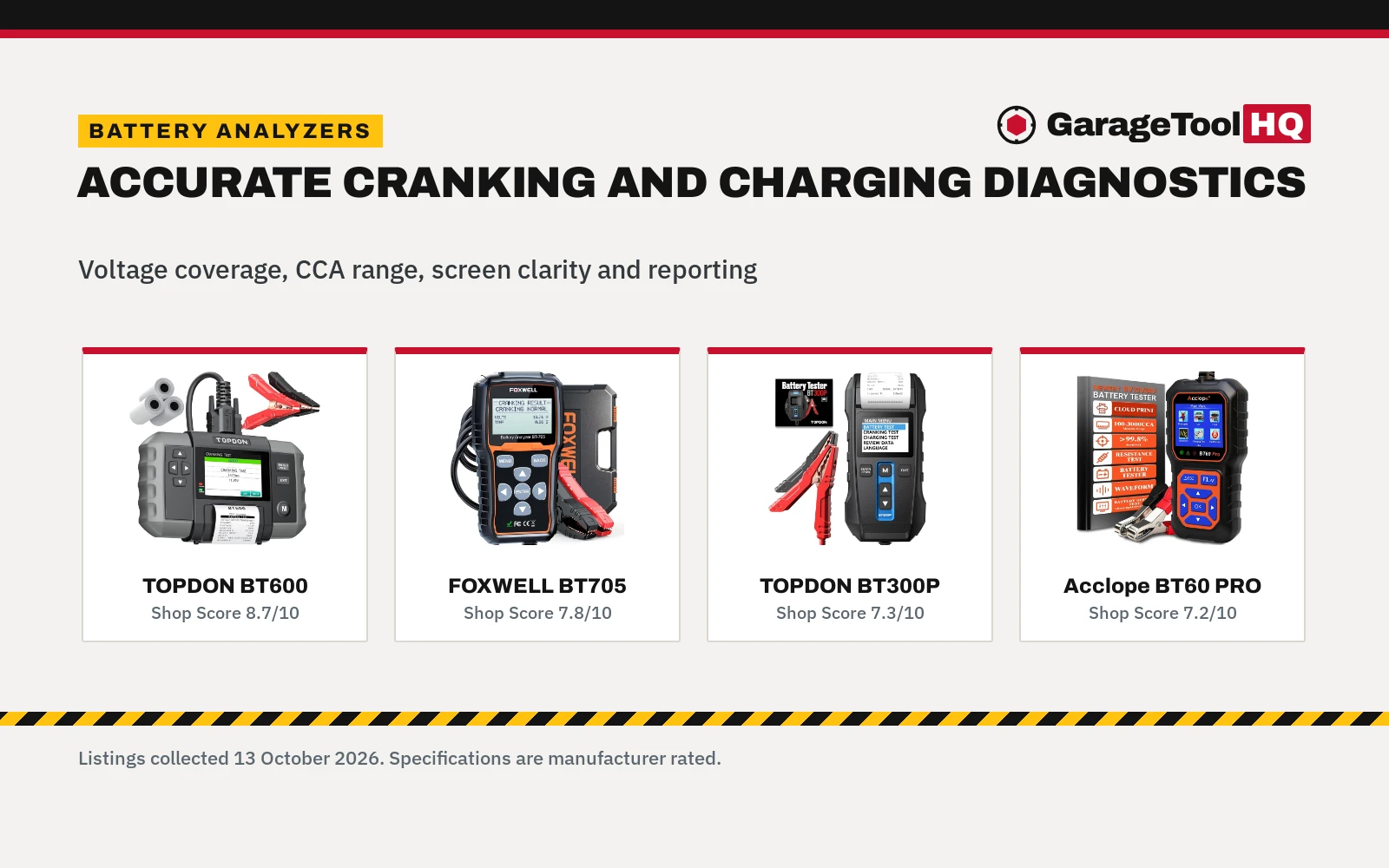
- Top Commercial Pick TOPDON BT600: 3.5-inch color display, built-in thermal printer, UL certification and 12V/24V system diagnostics. Check price on Amazon
- Best for Solo Diagnostics FOXWELL BT705: 5.9-foot connection cable reaches the driver seat for one-person starting checks, backed by a 24-month warranty. Check price on Amazon
- Best Compact Printer Unit TOPDON BT300P: Integrated thermal printer with three paper rolls, spark-free copper clamps and 99.5 percent diagnostic accuracy. Check price on Amazon
- Best Heavy-Duty Load Unit Schumacher BT-100: True 100-amp resistive load draw for 12V and 50-amp for 6V with a clear analog dial and CSA listing. Check price on Amazon
The picks


TOPDON BT600 12V 24V Car Battery Tester
A commercial-grade 12V and 24V battery and alternator analyzer with a 3.5-inch color display, integrated thermal printer and UL listing.
Pros
- Covers 12V and 24V systems from 100 to 2,000 CCA
- Integrated thermal printer delivers instant hard-copy receipts
- Large 3.5-inch color display with data playback
- UL and CE safety specifications met
Cons
- Weighs 1.29 kg, the heaviest unit in this roundup
- Mini-USB software updates require a Windows computer
- One-year warranty is shorter than some standalone units
- Thermal printer requires dedicated paper roll refills

FOXWELL BT705 Car Battery Tester 24V 12V
A digital 12V and 24V cranking and charging analyzer featuring a 5.9-foot cable for solo vehicle operation and a hard carrying case.
Pros
- 5.9-foot cable reaches driver seat for one-person cranking checks
- 24-month warranty provides the longest coverage here
- Analyzes 12V and 24V lead-acid batteries from 100 to 2,000 CCA
- Includes a durable molded hard carrying case
Cons
- No built-in printer for paper documentation
- No UL, ETL, or CSA safety certification stated
- Screen is 2.8 inches, smaller than modern bench analyzers
- Spec table lists power source with promotional text
12V/24V Car Battery Tester
A compact 12V and 24V electrical analyzer featuring an integrated thermal printer, spark-free copper clamps and three included paper rolls.
Pros
- Built-in ink-free thermal printer with 3 paper rolls included
- Spark-free copper clamps with reverse polarity protection
- Analyzes 100 to 2,000 CCA across regular flooded, AGM, GEL, and EFB
- Fast 3-second diagnostic response with 99.5 percent claimed accuracy
Cons
- Contradiction on screen size: 2.4-inch color vs 2-inch backlit
- Spec table contradicts voltage coverage, stating 12V only
- No UL, ETL, or CSA electrical safety certification
- Cable length is 31.5 inches, shorter than shop bench models

BT60 PRO 2–120Ah Battery Tester 6V/12V/24V
A multi-voltage conductance analyzer covering 6V, 12V and 24V batteries up to 3,000 CCA with smartphone QR code cloud sharing.
Pros
- Broadest capacity range from 100 to 3,000 CCA and 2 to 120Ah
- Covers 6V, 12V, and 24V batteries including dedicated 6V mode
- QR code cloud sharing allows viewing and printing from a phone
- Built-in LED work light integrated into clamp assembly
Cons
- No concrete warranty term stated on the listing
- Lithium support is limited to voltage and cannot measure CCA
- No built-in printer hardware
- Lacks UL, ETL, or CSA safety listings
Schumacher Electric Battery Load Tester, 6V/12V
A traditional 6V and 12V analog load unit providing a true 100-amp draw on 12V batteries and a 50-amp draw on 6V batteries.
Pros
- Applies genuine resistive load: 100A on 12V and 50A on 6V
- Specification Met lists official CSA safety certification
- Simple analog meter and top-mounted rocker switch
- Requires no internal batteries, running directly off vehicle power
Cons
- Spec table contains erroneous dimensions: 37.6 x 17.3 x 9.4 inches
- Cannot measure internal resistance or individual battery chemistries
- No concrete warranty duration stated on the listing
- Limited to 1,000 CA, lower than modern digital analyzers
More options to compare
 TOPDON BT600 Plus Car Battery TesterCheck price on Amazon
 Battery Load TesterCheck price on Amazon
 ANCEL BT310 Battery Tester 12V 24VCheck price on Amazon
 BT906 Car Battery Tester 6V 12V 24V with Lithium BatteryCheck price on Amazon
 AUTOOL BT360 Car Battery TesterCheck price on Amazon
Compare the picks
| Model | Shop Score | Type | Voltage | CCA range | Display | Printer | Warranty |
|---|---|---|---|---|---|---|---|
| TOPDON BT600 | 9.7/10 | Conductance analyzer | 12V, 24V | 100–2,000 CCA | 3.5 in color | Built-in thermal | 1 year |
| FOXWELL BT705 | 9.6/10 | Conductance analyzer | 12V, 24V | 100–2,000 CCA | 2.8 in LCD | No | 24 months |
| TOPDON BT300P | 9.5/10 | Conductance analyzer | 12V, 24V | 100–2,000 CCA | 2.4 in color | Built-in thermal | 30 days return & 12-month service |
| Acclope BT60 PRO | 9.5/10 | Conductance analyzer | 6V, 12V, 24V | 100–3,000 CCA | 3.2 in HD | Cloud QR code | Not stated |
| Schumacher BT-100 | 9.4/10 | Resistive load tool | 6V, 12V | Up to 1,000 CA | Analog meter | No | Not stated |
Specifications are manufacturer rated, as published on each listing and collected 13 October 2026. Where a listing contradicts itself, both figures are shown.
How we scored them
Each battery analyzer is scored out of 10 on performance, build, value, safety and warranty, with the weights published on our How We Pick page. Two units hold formal safety certifications (UL and CSA), two include stated manufacturer warranties, and two feature onboard thermal printers.
| Product | Shop Score | Perf. /35 | Build /25 | Value /25 | Safety /10 | Warranty /5 |
|---|---|---|---|---|---|---|
| TOPDON BT600 | 9.7 | 33 | 22 | 21 | 8 | 2 |
| FOXWELL BT705 | 9.6 | 32 | 22 | 20 | 0 | 4 |
| TOPDON BT300P | 9.5 | 30 | 20 | 21 | 0 | 2 |
| Acclope BT60 PRO | 9.5 | 30 | 20 | 21 | 0 | 0 |
| Schumacher BT-100 | 9.4 | 24 | 18 | 20 | 5 | 0 |
Scores run from 9.2 to 9.8: each product’s point total is placed on that range, so more points always means a higher score.
What the listings tell you
Analyzing the five product listings highlights significant differences between digital conductance tools and traditional resistive load units. All five evaluate 12V batteries, three cover 24V commercial systems, and two support 6V batteries. Only two listings confirm verified electrical safety standards: the TOPDON BT600 notes a UL listing and the Schumacher BT-100 notes CSA compliance. Only two provide clear manufacturer warranty terms: FOXWELL BT705 with 24 months and TOPDON BT600 with 1 year. Two listings contain noticeable internal contradictions between spec tables and bullet points regarding dimensions, screen size, or system voltage.
How to choose the best professional battery checker
Conductance analysis versus resistive load
Modern electronic analyzers use micro-processor conductance profiling to evaluate battery condition without drawing high current or generating heat. They measure internal plate resistance to calculate remaining capacity and cold cranking amps in seconds. By contrast, a resistive load unit draws real amperage across an internal heating coil (typically 50A on 6V and 100A on 12V). While resistive tools provide a direct physical load check, digital conductance units can evaluate deeply discharged batteries and start-stop chemistries without sparking or draining the pack.
Voltage and cold cranking amps capacity
Standard automotive batteries require 12V compatibility, but multi-vehicle garages benefit from wider voltage ranges. Commercial diesel trucks, RVs, and heavy equipment frequently run 24V starting configurations, requiring analyzers like the TOPDON BT600 or FOXWELL BT705. For motorcycles, vintage equipment, and lawn tractors, 6V support is essential. Ensure the tool’s cold cranking amps (CCA) rating matches your fleet, from 100 CCA on small engine batteries up to 2,000 or 3,000 CCA on heavy commercial diesels.
Display clarity and printed documentation
A readable color display makes navigating diagnostic menus straightforward in dim engine bays. Units like the TOPDON BT600 and BT300P integrate onboard thermal printers, producing instant receipts detailing measured voltage, calculated CCA, internal resistance, and system health status. For shop environments and fleet maintenance, having a tangible printout helps document starting and charging condition before performing repairs.
Lead cable reach and clamp design
Cable length directly affects how easily a solo mechanic can evaluate starting systems. When checking cranking voltage drop, an extended lead like the 5.9-foot cable on the FOXWELL BT705 reaches straight into the driver seat, allowing one person to turn the ignition key while watching the screen. Clamps should feature heavy insulation, spark-free copper jaws, and built-in reverse polarity protection to safeguard vehicle control modules against accidental reversed connections.
Recharging before diagnosing weak cells
A discharged battery can produce misleading diagnostic readouts even if its internal plates remain healthy. Before condemning a suspicious battery, hook it up to a quality car battery charger to bring it to full charge. If your diagnostic tool still indicates high internal resistance or failing cranking output after a complete charging cycle, replacement is necessary. For routine maintenance and parasitic draw troubleshooting, pairing your analyzer with an automotive multimeter provides thorough electrical diagnostic coverage.
Garage Fit Check
- Bench space and storage: Handheld digital units like the Acclope BT60 PRO (0.27 kg) and FOXWELL BT705 (325 g) tuck neatly into tool chest drawers, with FOXWELL including a molded hard carrying case. Larger units like the TOPDON BT600 weigh 1.29 kg and require dedicated shelf space, while the Schumacher BT-100 steel frame weighs 2 lb.
- Power requirements: Every digital analyzer in this roundup powers directly from the vehicle battery clamps during evaluation, requiring no internal disposable batteries or wall outlets.
- Thermal paper supply: If selecting a printer model like the TOPDON BT600 or BT300P, verify that standard thermal paper rolls are on hand in your garage so you do not run out of receipt paper during a job.
- Pre-job inspection: Check clamp spring tension and inspect cable jackets for pinches or fraying before connecting to terminals. On analog tools like the Schumacher BT-100, ensure the vented housing is unobstructed to dissipate coil heat safely.
Lead-acid batteries can release hydrogen while charging, so charge in a ventilated space away from sparks and flames, connect positive first and negative last, set the charger to the battery type (flooded, AGM, gel, lithium), and wear eye protection. Read our Safety Disclaimer.
Frequently Asked Questions
How does an automotive battery checker work?
A modern digital battery checker connects heavy-duty clamps to the battery terminals and sends a small alternating current signal through the cells. By measuring conductance and internal plate resistance, its onboard microprocessor calculates the battery’s available cold cranking amps, voltage, state of health, and state of charge without draining the battery.
What is the difference between a conductance analyzer and a load tool?
A conductance analyzer uses digital signal processing to calculate health and cranking capacity in seconds without drawing significant power or producing heat. A resistive load tool physically pulls high current (such as 50 amps on 6V or 100 amps on 12V) through an internal heating element, measuring real-time voltage sag under heavy physical draw.
Can a 12V battery checker evaluate 6V or 24V vehicles?
Only if the manufacturer explicitly designs the hardware for multi-voltage operation. Units like the TOPDON BT600 and FOXWELL BT705 support both 12V passenger cars and 24V commercial trucks. For smaller 6V batteries on vintage tractors or motorcycles, models like the Acclope BT60 PRO and Schumacher BT-100 provide dedicated 6V modes.
Why does a battery show good voltage but fail during starter cranking?
A resting battery may show normal surface voltage with no load attached, yet suffer from high internal resistance or sulfated plates. When the starter motor demands heavy current, internal resistance causes system voltage to plummet below the starting threshold. A dedicated analyzer evaluates internal resistance to reveal cell degradation that a basic voltmeter misses.
How does cold weather affect battery health readings?
Low temperatures slow down electrochemical reactions inside lead-acid batteries, temporarily reducing available cranking amps and increasing internal resistance. Advanced analyzers like the FOXWELL BT705 account for cold operating conditions down to 32°F (0°C) to give accurate health determinations before winter temperatures strand you.
Related: our diagnostics and electrical hub, the best car battery charger, our guide on battery checker vs multimeter, and our garage safety notes. Also see the best battery checker for cars. Also see how to use automotive multimeter. Also see why does my car battery die in cold weather. Also see the best jump starter. Also see the best battery charger maintainer. Also see how long does it take to charge a car battery with a charger. Also see jump starter vs battery charger. Also see battery charger vs battery maintainer. Also see the best automotive multimeter. Also see the best jump starter for cold weather. Also see what size jump starter do i need. Also see jump starter vs jumper cables. Also see can you leave a battery maintainer on all winter. Also see the best brand for portable jump starter. Also see the best jump starter for trucks and diesel. Also see the best battery maintainer for motorcycles. Also see the best battery platform for mechanics.