Car Lift Alternatives: Which One Should You Buy?
A guide to car lift alternatives for home garages: comparing floor jacks with stands, vehicle ramps, and portable scissor frames by clearance and safety.

On this page
Top picks at a glance
As an Amazon Associate we earn from qualifying purchases.
- 1
 QISHIDA 7000 LBS Portable Car Lift Mid Rise Scissor Lift 110V9.6/10View on Amazon
- 2
 KATOOL Portable Car Lift Mid Rise Scissor Lift 110V Electric9.6/10View on Amazon
- 3
 APlusLift HW-8S 8000LB 4-Post Storage Service Car Lift 3 Year9.6/10View on Amazon
When you slide under a vehicle for an oil change, a brake job, or an exhaust repair, installing a permanent post lift is not always practical. Car lift alternatives give home mechanics safe ways to raise a vehicle without dedicating an entire bay or pouring specialized concrete slabs. The right car lift alternative depends on your job: drive-on ramps handle fluid service where wheels stay loaded, while a hydraulic floor jack paired with rated stands is the standard solution for brake jobs, tire rotations, and suspension work. For elevated height and wheels-free access without permanent posts, portable scissor frames offer shop convenience in a compact footprint.
GarageToolHQ earns a commission when you buy through links on our product pages, at no extra cost to you. Read our affiliate disclosure.
Below: comparing the main lifting options for residential garages, safe operating rules, and selecting equipment for your space.
Car lift alternatives: where each option fits your garage
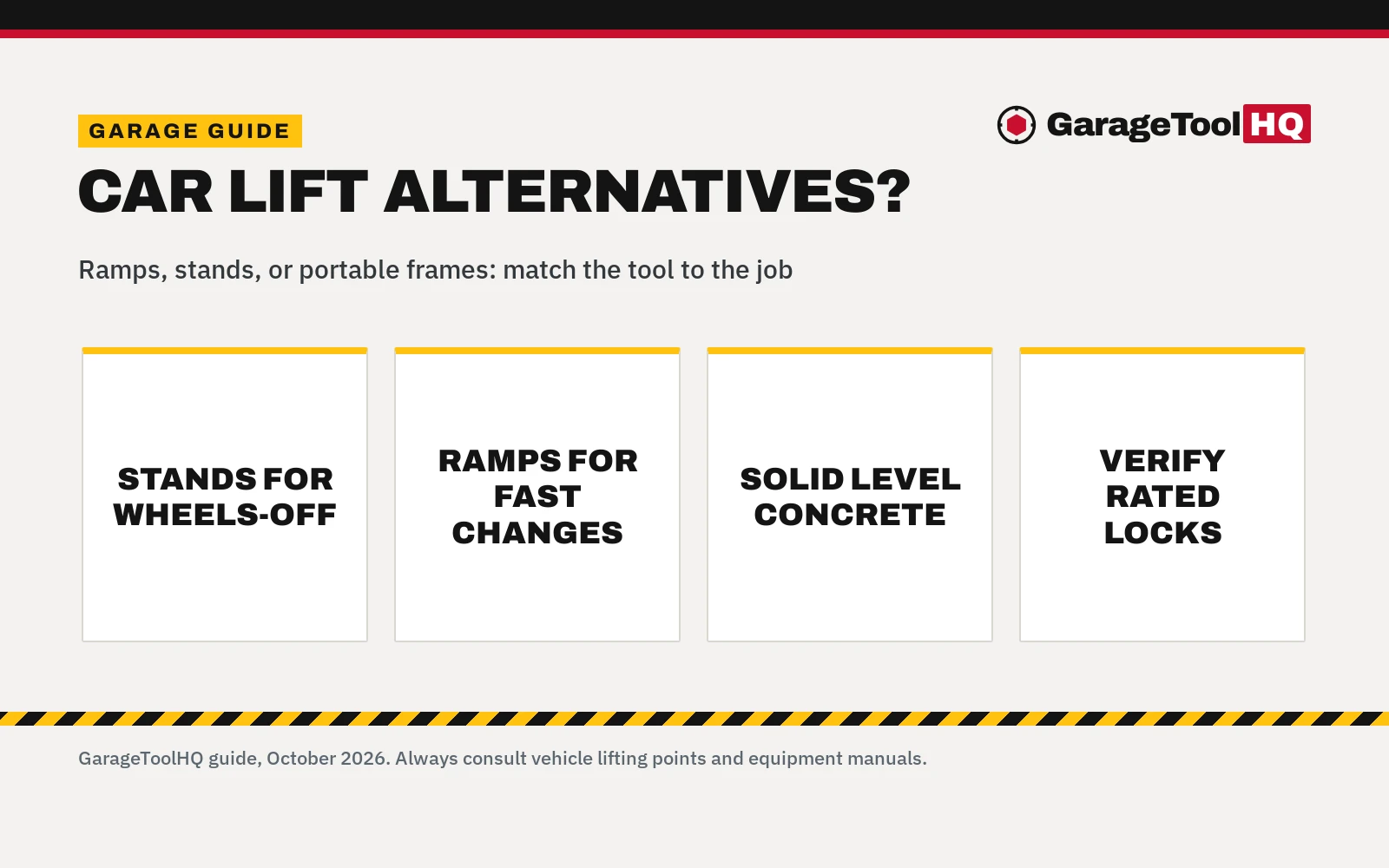
Permanent car lifts require high ceilings, dedicated floor space, and specific slab depth. For home garages, car lift alternatives offer practical elevation with minimal storage demands:
- Drive-on vehicle ramps: Fastest setup for fluid maintenance. Drive forward onto the cradles and set the parking brake. Because tires stay on the ramps, suspension stays loaded at ride height. Trade-off: cannot perform wheel-off maintenance such as brake pad changes or tire rotations.
- Floor jacks and jack stands: Most versatile setup for DIY repairs. Lift at factory points and lower the load onto rated stands. Provides full wheels-free access for brake service and suspension overhauls while storing easily along a wall.
- Portable scissor frames: Low-profile assemblies that slide beneath rocker panels to raise the vehicle evenly via an external hydraulic pump unit. Several models roll or hang on walls, providing accessible underbody working room without permanent posts.
- Mobile single-post lifts: A movable column on casters using lifting arms to elevate the chassis, leaving the opposite side clear for major repairs. Requires taller ceiling clearance and dedicated electrical service.
Comparing car lift alternatives for home mechanics
| Alternative | Primary Garage Jobs | Vehicle Access | Key Trade-Off |
|---|---|---|---|
| Solid vehicle ramps | Oil changes, fluid checks, exhaust inspection | Drive-on access with wheels loaded | Suspension stays loaded; cannot do wheel-off brake work |
| Floor jack and jack stands | Brake service, tire rotations, suspension work | Full wheels-off access at corners or axles | Requires positioning per corner; lower overall lift height |
| Portable scissor frames | Complete vehicle service, detailing, underbody repairs | Entire vehicle raised; wheels free with pads | Heavier units to position; requires level concrete |
| Mobile single post lift | Drivetrain swaps, side access, chassis restoration | High vertical lift with movable column | Requires taller ceiling clearance and dedicated circuit |
For routine fluid maintenance, our picks for the best car ramps provide fast drive-on access. For brake overhauls and suspension repairs, pairing a floor jack with the best jack stands gives you reliable, corner-by-corner flexibility.
How to lift a vehicle safely without a full lift: the checklist
- Park on solid, level ground: Position the vehicle on smooth, level concrete. Never lift on asphalt in hot weather, gravel, dirt, or unlevel ground. Lift makers warn that slopes over 4 degrees are unsafe.
- Chock the wheels: Place wheel chocks firmly against tires remaining on the floor. See our guide on how to use wheel chocks to prevent rolling.
- Identify owner’s manual lift points: Locate designated pinch welds, frame rails, or crossmembers specified by the manufacturer before positioning saddles or pads.
- Never get under a vehicle on a jack alone: A hydraulic jack is for lifting only. Always lower the vehicle onto rated stands on solid level ground before starting work.
- Engage mechanical safety locks: On portable scissor or column lifts, raise past the locking point and lower onto mechanical locks to relieve hydraulic pressure.
- Perform a stability check: Grip the vehicle bumper and give it a firm push to verify it sits solidly before crawling underneath.
Hydraulic seals can fail and hoses can rupture. Never get under a vehicle on a jack alone, and never rely on hydraulic pressure to support a load. Always lower the vehicle onto rated stands on solid level ground or engage mechanical safety locks before beginning work.
Check the lift's rated capacity against your heaviest vehicle, and its ceiling and concrete requirements (thickness and strength) before you buy. Install it exactly as the manufacturer specifies, use the mechanical locks before you go under, and look for ALI certification on the model. See the Automotive Lift Institute (ALI). Read our Safety Disclaimer.
Portable lifts vs traditional floor jacks and stands
Comparing portable lifts with jacks involves evaluating capacity, height, power, and garage footprint. In reference listings, makers publish these concrete specifications:
- VEVOR portable lifts: The maker lists a 5,000 lbs model (JT-5000) lifting from 9.06 inches to 25.6 inches with pads spanning 5.12 inches to 18.5 inches, and a 7,000 lbs model (JT-7000) lifting from 10.24 inches to 26.8 inches. Both use four adjustable lifting columns, a 120V power unit, an 11 inches extension plate, and four nylon pulleys.
- Albott portable lifts: Constructed from Q355B steel (stronger than Q235B steel). Albott lists a 7,000 lbs lift (17.7 inches to 25.4 inches lift range, 7.1 inches extension plate) and an 8,000 lbs model (JSJ111, up to 27.4 inches, 8.3 inches extension plate, up to 75 inches overall length). Frame units weigh approximately 120 lbs or 130 lbs. Safe use requires a flat surface avoiding slopes over 4 degrees and No. 46 hydraulic oil.
- Real Relax portable lifts: Lists a 7000 lbs model built with Q235B steel, offering a 10.24 inches to 26.8 inches range via a 120V power unit. It requires a minimum load of about 220 lbs to lower, a flat surface without slopes over 4 degrees, and No. 46 hydraulic oil.
- KATOOL mid-rise scissor lifts: Lists a 7,000 lbs scissor lift on 110V power with a 39 inches maximum lift height and an ultra-low 4.3 inches minimum height for low-clearance vehicles.
- XK mobile single post lifts: Lists a mobile single post lift (M6200) rated for 6200 lbs with an 1800mm lift height, requiring 220V power, a 30A circuit breaker, 10 wide chain plates, and AW32 or AW46 hydraulic oil.
To decide which suits your garage, see our guides on floor jack types, how to use a floor jack safely, and car lift types.
Garage clearance and concrete requirements for lifting
Permanent post lifts demand strict compliance with the lift maker’s concrete and ceiling requirements. Commercial designs require overhead space well above typical residential ceilings and specific slab thickness to anchor posts safely.
Portable car lift alternatives distribute weight across multiple contact points without anchor bolts, avoiding slab drilling. However, concrete must be sound and flat. Cracked or crumbling concrete can cause stands or ramps to tilt. For heavy mobile column lifts or high-tonnage stands, slab integrity is essential to handle concentrated wheel loads.
Storage is another advantage. Portable frames from VEVOR and Real Relax include handles for wall hanging, while Albott units fold flat. Check our guides on car lift size and how to choose a car lift for home garage spaces.
Frequently Asked Questions
How to jack up a car without a lift?
Park on solid level ground, set the parking brake, and chock tires remaining on the floor. Identify owner’s manual lift points along the frame, pinch welds, or central crossmembers. When lifting an axle, raise from the manufacturer’s central jack point so both sides lift together, place rated jack stands beneath side support points on solid level ground, and slowly lower the jack onto the stands before checking stability.
Do car lifts fail?
Lifts can fail if neglected, overloaded, or improperly operated. Hydraulic line leaks or seal wear can cause pressure loss, which is why commercial and portable lifts feature mechanical safety locks that engage as the lift rises. When resting on steel locks rather than fluid pressure, the vehicle is secure. Regular inspections and observing rated capacities prevent failures.
What size car lift do I need?
Check your vehicle door jamb placard for exact curb weight and axle ratings. In reference listings, KATOOL lists a 7,000 lbs model with a 4.3 inches minimum height for low cars, VEVOR lists 5,000 lbs and 7,000 lbs models lifting to 25.6 inches and 26.8 inches, and Albott offers an 8,000 lbs model with extension plates up to 75 inches. Match your vehicle weight and lift points to the equipment rating.
What size car lift for F-350 trucks?
An F-350 has a heavy curb weight, heavy front diesel axle, and long wheelbase. While makers list portable lifts rated at 7,000 lbs or 8,000 lbs with extension plates up to 75 inches for trucks and SUVs, an F-350 can approach or exceed portable limits depending on configuration and payload. Check the door jamb placard for gross ratings; heavy trucks often require high-capacity commercial lifts or rated truck stands.
How does a car lift compare in cost to portable alternatives?
Permanent lifts represent a major investment in equipment, freight delivery, electrical work, and potential slab reinforcement. Drive-on ramps and floor jacks with stands require minimal expenditure for routine repairs. Portable scissor frames sit comfortably between jacks and permanent lifts, offering full underbody access without building modifications.
Can you use car ramps for brake repairs?
Generally no for wheel-end work. Drive-on ramps keep tires attached and suspension loaded. Because brake pad, rotor, and caliper service requires removing wheels, ramps cannot support that work. While ramps allow underbody inspection of hard brake lines along the chassis, wheel-off repairs require a floor jack and rated jack stands on solid level ground.
Related: car lift types, car ramps vs jack stands, floor jack types, how to use a floor jack safely, how to choose a car lift for home garage, our picks for the best car lift for home garage, and our car lifts hub.