4 Post Lift vs Scissor Lift: Which One Should You Buy?
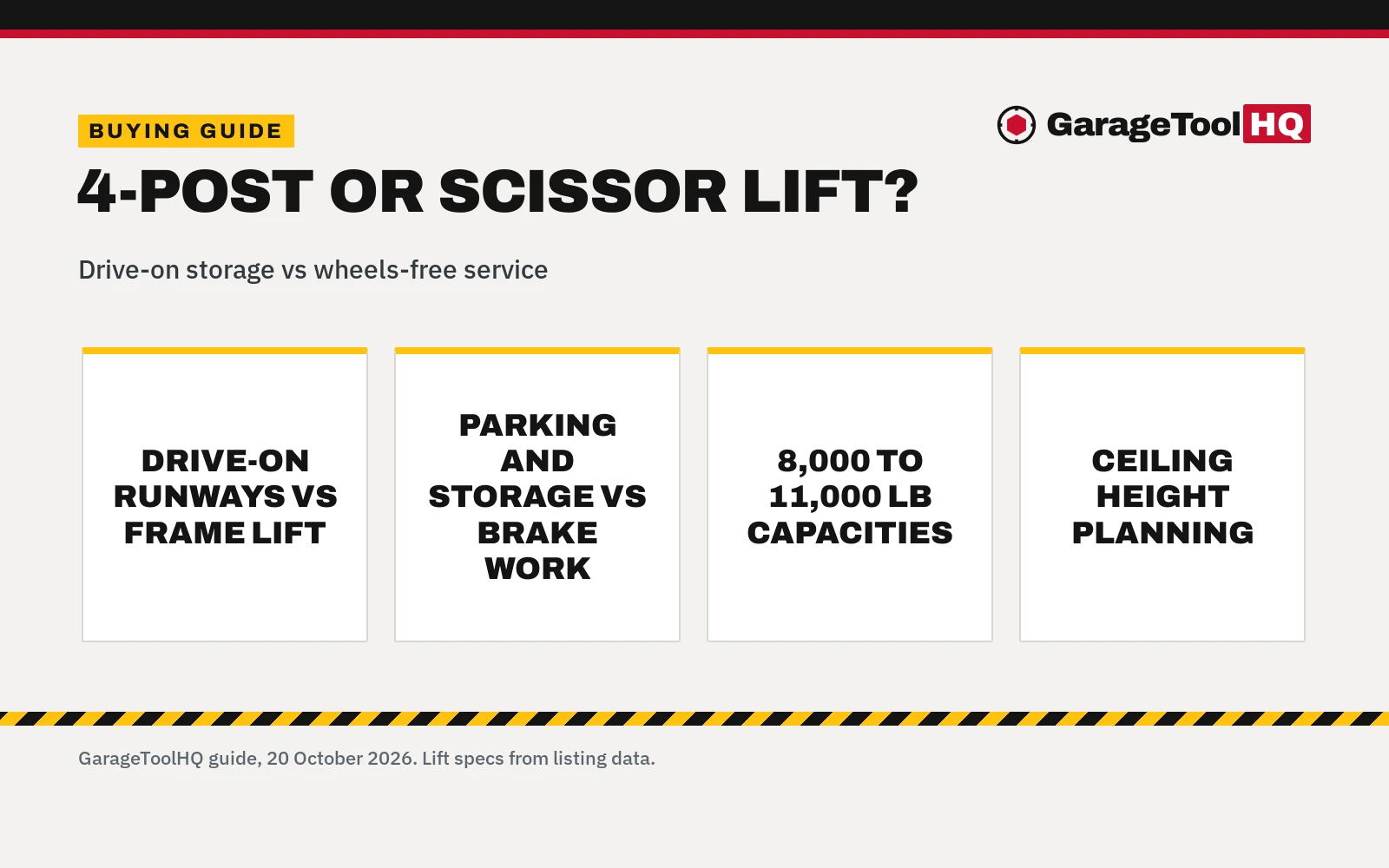
4 post lift vs scissor lift: a 4-post lift drives on for parking, storage and underbody work, while a scissor lift raises the car off its wheels for brakes, tires and suspension.

On this page
Top picks at a glance
As an Amazon Associate we earn from qualifying purchases.
- 1
 APlusLift HW-8S 8000LB 4-Post Storage Service Car Lift 3 Year9.6/10View on Amazon
- 2
 VIVOHOME Motorcycle Lift 1100 Lbs Scissor Lift Jack with9.7/10View on Amazon
- 3
 XK 2 Post Auto Car Lift 9000 lb Capacity Truck Hoist 220V9.6/10View on Amazon
- 4
 XK 2 Post Auto Car Lift 10000 lb Capacity Truck Clear FloorView on Amazon
- 5
 ME 11000lbs Double S Design 2 Post Lift Car Lift AutomotiveView on Amazon
- 6
 12000 Lbs 4.0HP Two Post Lift Single Lock Release Auto LiftView on Amazon
- 7
 2 Post Lift 11000lbs Two Post Lift Auto Lift Car Lift HoistView on Amazon
In the 4 post lift vs scissor lift choice, the answer is what you want to reach. Buy a 4-post lift if you want to drive on, park one car over another, or work under the car with its wheels loaded. Buy a scissor lift if you want the wheels off the ground for brakes, tires, wheels and suspension work. A 4-post lift carries the car on runways; a scissor lift raises it from below and leaves the wheels hanging free. Storage and drive-on convenience point to the 4-post; wheel and brake work points to the scissor.
More options to compare
 XK 2 Post Auto Car Lift 10000 lb Capacity Truck Clear FloorCheck price on Amazon
 ME 11000lbs Double S Design 2 Post Lift Car Lift AutomotiveCheck price on Amazon
 12000 Lbs 4.0HP Two Post Lift Single Lock Release Auto LiftCheck price on Amazon
 2 Post Lift 11000lbs Two Post Lift Auto Lift Car Lift HoistCheck price on Amazon
GarageToolHQ earns a commission when you buy through links on our product pages, at no extra cost to you. Read our affiliate disclosure.
Below: how the two lifts differ, where each one wins, what the listings say about capacity and height, and how to fit either one in your garage.
4 Post Lift vs Scissor Lift: the core difference
A 4-post lift is a drive-on platform. You drive the car onto two runways between four columns, and the hydraulics raise the whole car with its wheels still on the runways. A scissor lift sits under the car and pushes it up from the frame or pinch welds, so the wheels hang free and you can pull them off. That single difference decides almost everything: on a 4-post the car is supported exactly the way it sits on the ground, which is perfect for parking, storage and underbody work, and awkward for anything that needs a wheel removed without a jack tray. On a scissor lift the car is in the air on its jacking points, which is perfect for brakes, tires and suspension, and useless for stacking a second car underneath. The reference listings here are all 4-post lifts, so their figures describe that side; the scissor side is explained from the type, and our scissor lift types guide covers it in full.
| 4-post lift | Scissor lift | |
|---|---|---|
| How the car sits | Drive-on runways; wheels stay loaded | Raised from the frame; wheels hang free |
| Best jobs | Parking and storage, oil changes, exhaust, underbody inspection | Brakes, tires, wheels, suspension, detailing wheels |
| Wheel removal | Not without a jack tray or rolling jacks; the KT-4H950 listing includes a jack tray | Yes, wheels come off freely |
| Storage | Parks one car over another; several listings include casters to move the lift | No stacking; the car stays at working height |
| Footprint | Four columns plus runways; needs the length and width of the car plus working room | Smaller footprint under the car; some are portable or surface-mounted |
| Capacity in the sample | 8,000 to 11,000 lb across the listings | No scissor listings in the sample |
| Lifting height in the sample | 70.8 to 84.5 in across the listings | No scissor listings in the sample |
When a 4-post lift is the better choice
Choose the 4-post when the car needs to stay drivable while it is up, or when the lift doubles as parking. Drive onto the runways and the car is up in the air with no jacking, no stands and no crawling under a jack. That is why 4-post lifts own the storage job: park one car on the runways and another underneath, and a two-car garage holds three vehicles. The listings show the range: 8,000 lb hobbyist lifts like the APlusLift 8SXLT and the Atlas Garage Pro 8000 up to 11,000 lb heavy-duty lifts like the AUTOKATO KT-4H110 and the MutsMover 11,000, with lifting heights from 70.8 in on the KATOOL 8500 to 84.5 in on the KT-4H110. Several listings include caster kits, so the lift can be moved around the shop, and the APlusLift lists a 3 year warranty with CE certification. For service work, the 4-post is the oil change and exhaust lift: everything under the car is open, and the car sits exactly as it drives. The one thing it cannot do on its own is wheel work, because the wheels stay on the runways; the Motool KT-4H950 listing includes a jack tray for exactly that reason, lifting the wheels off the runways once it is up. See our 4 post lift size guide for dimensions and clearances.
When a scissor lift is the better choice
Choose the scissor lift when the wheels have to come off. Brakes, rotors, tires, wheels, suspension and anything that needs the car supported on its frame points at full droop is scissor work. A mid-rise scissor gets the car to a comfortable working height for wheel and brake jobs without the ceiling height a full-rise lift demands, and a full-rise scissor stands the car up for underbody access with the wheels free. The trade is storage: a scissor lift cannot park a second car underneath, so it is a service tool, not a parking tool. It also has the smaller footprint, which suits a garage that cannot swallow four columns and two runways. There are no scissor lift listings in this sample, so compare real models in our scissor lift types guide and the car lift types overview.
Ceiling height, floor space and power
Both lifts need ceiling height. The 4-post listings top out at 84.5 in of lifting height, and you need the car’s height plus the lift height plus working room under the ceiling; measure before you buy with our clearance for car lift guide. Floor space is the 4-post’s other demand: four columns and full-length runways need the car’s length and width plus room to open the doors and walk around. Power is simpler: the listings run hydraulic power units on 110V, mostly 3.0HP with 220V optional on some models, so a 110V circuit usually does it, though the Atlas listing calls for a 30-amp breaker. Keep the hydraulics healthy with our car lift maintenance guide and the right hydraulic oil for car lifts.
Check the lift's rated capacity against your heaviest vehicle, and its ceiling and concrete requirements (thickness and strength) before you buy. Install it exactly as the manufacturer specifies, use the mechanical locks before you go under, and look for ALI certification on the model. See the Automotive Lift Institute (ALI). Read our Safety Disclaimer.
Frequently Asked Questions
Can you do brakes on a 4-post lift?
Not directly, because the wheels stay on the runways. With a jack tray or rolling bridge jacks you can lift the car off the runways once it is up; the Motool KT-4H950 listing includes a jack tray for this. Without one, brake and tire work belongs on a scissor lift or a two-post.
Which lift is better for storing cars?
The 4-post, by a wide margin. It is designed to hold a car at height long-term, and several listings include casters so the lift can be repositioned around the shop. A scissor lift is a service tool and cannot stack cars.
How much ceiling height do I need?
More than the lift’s max height plus the car’s height. The 4-post listings here reach 70.8 to 84.5 in of lifting height, so a tall truck on a tall lift needs a high ceiling. Work it out with our clearance for car lift guide before you order.
Do 4-post lifts need to be bolted to the floor?
Many are designed to stand free or roll on casters, which is why the listings emphasize portable storage use. Always follow the manual for your model: anchoring rules, concrete requirements and caster use are stated there, not guessed.
Can a scissor lift do an oil change?
A full-rise scissor can, with the car up and the wheels free. A mid-rise scissor gets the car high enough for comfortable drain-plug and filter access. For oil changes alone, though, the drive-on 4-post is faster: no positioning under jacking points.
What capacity lift do I need?
More than the heaviest vehicle you will lift, with margin. The 4-post listings here span 8,000 to 11,000 lb: 8,000 covers most cars and light SUVs, 11,000 covers heavy trucks. Check the listing’s rated capacity against your vehicle’s weight, not the lift’s looks.
Related: the car lift alternatives guide, car lift size and garage fit, Vevor portable car lift vs QuickJack and best car lift for lowered cars.