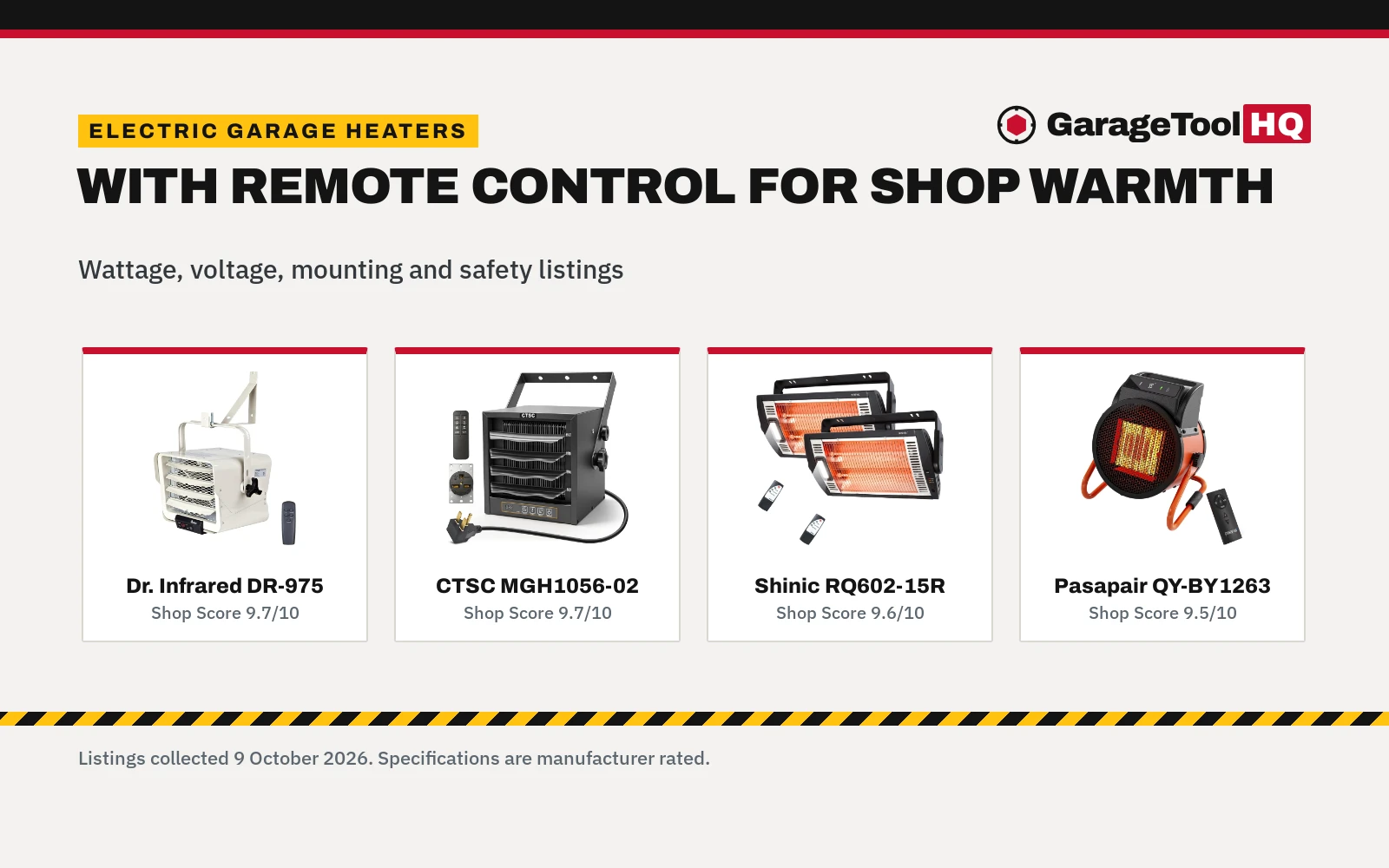
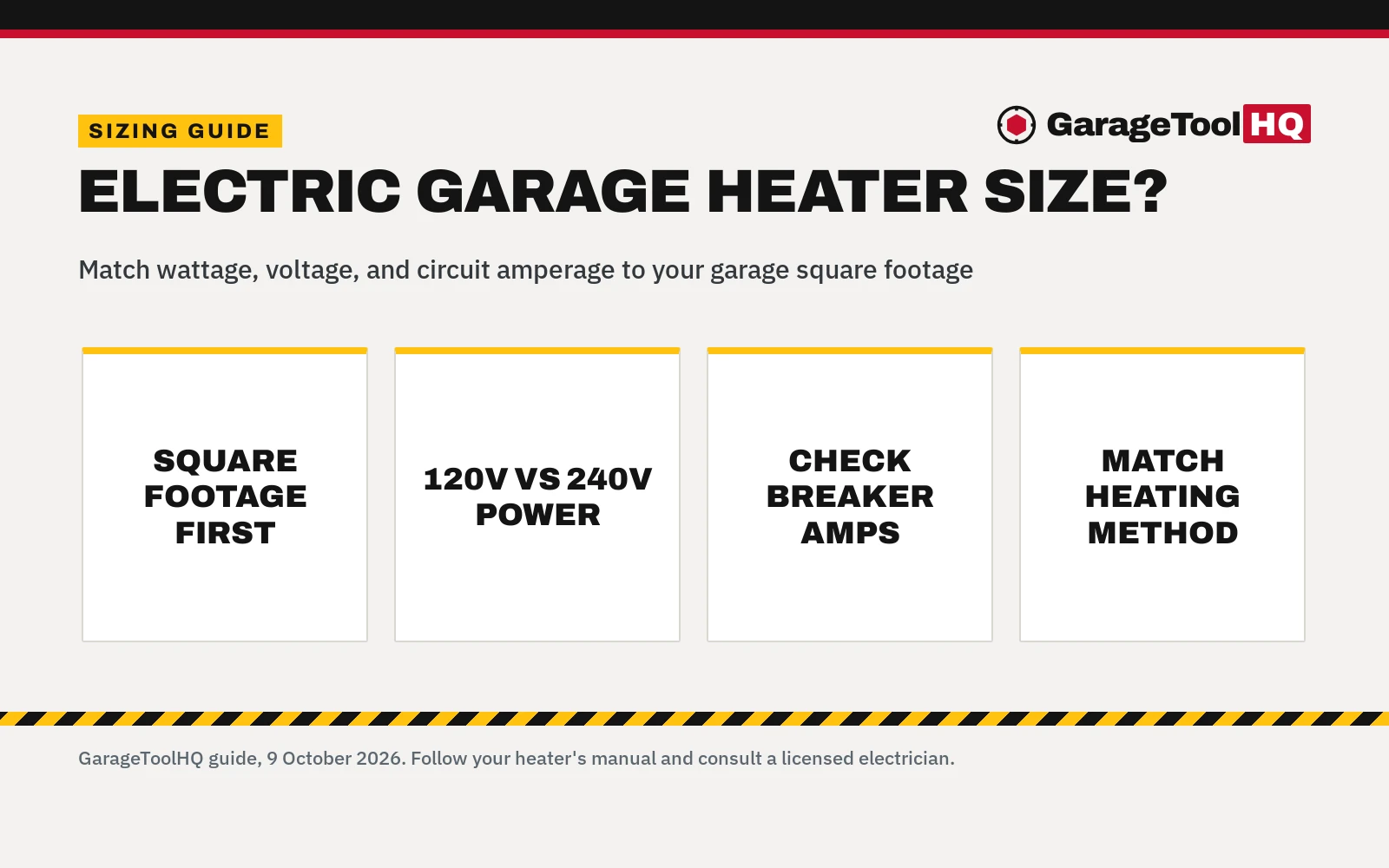
Electric Garage Heater Size: How to Choose the Right Wattage and Voltage
How to determine the right electric garage heater size by matching room square footage and heating methods with 120V and 240V electrical requirements.

On this page
Top picks at a glance
As an Amazon Associate we earn from qualifying purchases.
- 1
 Comfort Zone Hard-Wired Ceiling Mount Garage Electric Space9.7/10View on Amazon
- 2
 CTSC 8500W Garage Heater Electric9.7/10View on Amazon
- 3
 DR. INFRARED HEATER NEW Upgraded DR-975 7500-Watt 240-Volt9.7/10View on Amazon
- 4
 DR. INFRARED HEATER DR-PS11024 Salamander ConstructionView on Amazon
- 5
 Dura Heat EUH1465 Electric Forced Air Heater with PivotingView on Amazon
- 6
 Dura Heat Electric Forced Air HeaterView on Amazon
- 7
 Electric Patio Heater with LED LightView on Amazon
- 8
 EconoHome Wall Heater Panel with ThermostatView on Amazon
- 9
 blessny 1500W Wall Mounted Electric Heater for Outdoor PatioView on Amazon
What electric garage heater size do you need? The right electric garage heater size depends on your workspace square footage, ceiling height, insulation level, and electrical panel capacity. For small work bays or supplemental workbench heat up to 250 sq ft, a 120V electric heater producing 1500 watts and 5,120 BTU is typical. For a standard two-car garage or larger workshop up to 1500 sq ft, maintaining comfortable working temperatures requires a 240V electric heater producing between 5,000 watts and 10,000 watts (up to 34,122 BTU) on a dedicated circuit installed by a licensed electrician.
More options to compare
 DR. INFRARED HEATER DR-PS11024 Salamander ConstructionCheck price on Amazon
 Dura Heat EUH1465 Electric Forced Air Heater with PivotingCheck price on Amazon
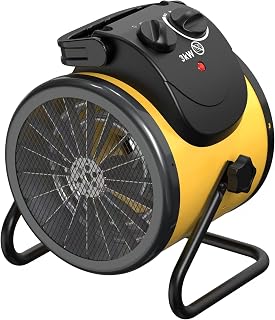 Dura Heat Electric Forced Air HeaterCheck price on Amazon
 Electric Patio Heater with LED LightCheck price on Amazon
 EconoHome Wall Heater Panel with ThermostatCheck price on Amazon
 blessny 1500W Wall Mounted Electric Heater for Outdoor PatioCheck price on Amazon
GarageToolHQ earns a commission when you buy through links on our product pages, at no extra cost to you. Read our affiliate disclosure.
Below: what factors determine your heating demand, how 120V and 240V heater sizes compare across published manufacturer specifications, a step-by-step sizing checklist, and answers to common garage heating questions.
Electric garage heater size: what factors determine your heating needs
Electric garage heaters convert electrical energy directly into heat. Unlike residential living spaces with finished drywall, continuous insulation, and central HVAC, home garages present unique heating challenges. Sizing an electric heater requires accounting for several key factors:
- Square footage and room volume. Floor area provides the baseline for heater sizing. A compact single-car bay requires far less heat output than an expansive workshop. Ceiling height also expands the total volume of air that must be heated, as warm air naturally rises toward the rafters.
- Insulation and draft control. An uninsulated garage with bare stud walls, an unfinished ceiling, and uninsulated metal overhead doors loses heat rapidly. In poorly insulated buildings, a heater must produce continuous output just to offset heat loss through exterior surfaces. In contrast, finished garages with insulated walls and weatherstripped doors hold thermal energy far longer.
- Electrical circuit capacity. Every electric heater is limited by available voltage and circuit amperage. Standard household 120V circuits cap continuous portable heating output at 1500 watts. Exceeding 1500 watts requires a dedicated 240V circuit supplied by an appropriately sized circuit breaker.
- Heating method. Fan-forced heaters circulate warmed air throughout an enclosed space for ambient heating. Radiant and infrared heaters emit directional heat that warms objects and people directly in front of the element, making them practical for uninsulated or drafty spaces where heating the entire air volume is inefficient.
Common electric garage heater sizes, and how they match your space
| Heater Class | Power & Voltage | Stated Heat Output | Manufacturer Coverage | Best Application |
|---|---|---|---|---|
| Compact Convection Panel | 400 watts (120V, 3.33 A) | Not stated | Up to 120 sq ft | Supplemental spot heat, small utility rooms, workbenches (EconoHome) |
| Portable Ceramic Fan Heater | 1500 watts (120V, 12.5 A) | 5,120 BTU | Up to 200 to 250 sq ft | Single-car work bays, localized shop heating (Dura Heat, Buyplus) |
| Compact Directional Workshop Heater | 1500 watts (120V, 15 A) | Not stated | Up to 200 ft² | Targeted workbench warmth, personal work areas (Karveden) |
| Oscillating Ceramic Tower | 1500 watts (120V, 15 A) | Not stated | Up to 500 sq ft | Enclosed rooms, wide heat circulation (AKIRES) |
| Commercial Ceiling-Mount Heater | 10,000 watts (240V, 41.67 A) | 34,122 BTU | Up to 1500 sq ft | Full two-car or three-car garage heating (Comfort Zone) |
| Salamander Construction Heater | 10,000 watts (240V, 55 A) | 10000 watts | Not stated | Large workshops, high-output industrial heating (Dr. Infrared Heater) |
The manufacturer listing and product specification label determine the true heating capabilities of any unit. For instance, the Comfort Zone CZ260ERBK ceiling-mount heater publishes a 10,000W title rating and 34,122 BTU heat output covering up to 1500 sq ft on 240V, while its specification table also notes a 5,000W setting. Citing published listing numbers ensures you match the physical heater to your actual workshop dimensions.
How to choose the right electric garage heater size: the checklist
- Measure your garage floor area. Calculate total square footage by multiplying room length by width. Compare your result to published manufacturer coverage ratings, such as 250 sq ft for compact 1500W units or 1500 sq ft for 10,000W commercial models.
- Assess your building insulation. Check whether your garage walls, ceiling, and vehicle doors are insulated. If your space has uninsulated drywall or bare framing, expect to choose a higher-capacity 240V unit rather than relying on a small 120V plug-in heater.
- Verify available electrical voltage. Determine whether you are plugging into an existing 120V wall outlet or connecting to a 240V power source. Standard 120V portable heaters max out at 1500 watts. If your space demands more thermal output, plan for a 240V line.
- Check circuit breaker amperage. A 1500W heater on 120V draws between 12.5 A and 15 A, requiring an adequate branch circuit. A heavy-duty 10,000W heater on 240V draws 41.67 A and specifies a 55-Amp circuit breaker, as noted on the Dr. Infrared Heater DR-PS11024.
- Select the right heating technology. Fan-forced ceramic or coil heaters push air across a heating element to warm ambient room air. Radiant carbon fiber or quartz heaters warm surfaces and technicians directly, which works well in drafty bays.
- Confirm safety certifications and automatic shutoffs. Choose models with third-party electrical certifications such as UL or ETL listings, integrated overheat protection, and tip-over shutoff switches for portable units.
High-wattage electric garage heaters place a continuous electrical load on your panel. Never run high-draw heating equipment on shared general-purpose circuits, and never undersize supply wiring. For all 240V electrical connections and panel upgrades, use a licensed electrician.
Never run a fuel-burning heater, generator or engine in a closed garage: carbon monoxide builds up fast and has no smell. Fit a CO alarm, keep clearances to cars and storage, use vented gas heaters installed to code, and put 240V electric heaters on a dedicated circuit. See CPSC carbon monoxide guidance. Read our Safety Disclaimer.
120V vs 240V electric garage heaters
When deciding on an electric garage heater size, your available electrical supply defines your maximum heat output:
- 120V portable heaters: Standard 120V plug-in units are limited by household receptacle ratings to 1500 watts (producing approximately 5,120 BTU). Units from Dura Heat, Buyplus, and Karveden draw between 12.5 A and 15 A. These heaters work well for personal spot heating at a workbench or taking the chill out of an insulated single-bay space up to 200 to 250 sq ft. They require no special wiring installation, but they cannot comfortably heat an entire uninsulated two-car garage in freezing weather.
- 240V hardwired heaters: Units operating on 240V deliver substantial thermal output, ranging from 5,000 watts up to 10,000 watts (producing up to 34,122 BTU, as listed on the Comfort Zone CZ260ERBK). Drawing 41.67 A to 55 A, these commercial-grade units require heavy-gauge copper wiring and a dedicated circuit breaker installed by a licensed electrician. They are built to maintain warm ambient temperatures across 500 to 1500 sq ft workshops.
- Installation requirements: A 120V heater plugs directly into an existing outlet, whereas a 240V ceiling-mount or floor-mount unit requires dedicated panel space, conduit, and hardwiring.
- Operating cost: Both 120V and 240V electric heaters convert consumed electrical watts into heat. To calculate what your electric heater will cost to run based on your local utility rates per kilowatt-hour, consult our guide on how much does it cost to heat a garage.
To determine proper breaker ratings and wire gauges before installing high-voltage equipment, read our detailed guide on what size breaker for a 240V garage heater. For overall heating requirements measured by British Thermal Units across different garage dimensions, visit our guide on what size garage heater do I need, or explore our recommendations in the best electric garage heater and best electric garage heater 240V reviews.
High-draw heaters and garage power limits
Garages frequently serve as workshop hubs where air compressors, power tools, and battery maintainers share electrical capacity. Running a 1500W electric space heater drawing 12.5 A or 15 A on the same 120V branch circuit as an air compressor or power saw will promptly trip the breaker. High-draw garage heaters require dedicated circuits to prevent unexpected outages and wire overheating. When planning workshop power layout or comparing equipment across our garage upgrades hub, ensure continuous heating loads do not compete with intermittent tool demands. If you are comparing electric options with combustion alternatives, check our analysis on whether is it safe to use a propane heater in a garage, or see our recommendations for heating larger multi-vehicle spaces in our guide to the best garage heater for a 2-car garage.
Frequently Asked Questions
What size electric garage heater do I need for a 2-car garage?
A typical two-car garage requires a 240V electric heater rated between 5,000 watts and 10,000 watts (delivering up to 34,122 BTU). While small 1500W heaters on 120V circuits provide localized spot warmth, they lack the capacity to maintain comfortable working temperatures across an entire two-car garage in cold winter conditions.
Can a 1500-watt electric heater heat a garage?
A 1500-watt electric heater produces 5,120 BTU and is rated by manufacturers like Dura Heat, Buyplus, and Karveden to heat spaces between 200 sq ft and 250 sq ft. In a garage, a 1500W unit is best suited for spot heating at a workbench or warming an insulated, sealed single-car bay rather than heating a large, drafty building.
What size breaker is needed for an electric garage heater?
Breaker size depends on heater wattage and operating voltage. A standard 1500W heater on a 120V circuit draws 12.5 A to 15 A and operates on a standard household branch circuit. In contrast, large 240V electric heaters require dedicated breakers: a 10,000W heater drawing 41.67 A typically specifies a 55-Amp circuit breaker, as listed on the Dr. Infrared Heater DR-PS11024. Sizing must account for continuous load rules, and installation should be performed by a licensed electrician.
Is a 120V or 240V electric garage heater better?
A 120V heater offers plug-in portability and convenience for small work zones without requiring electrical modifications. A 240V heater delivers significantly more thermal output (up to 10,000 watts and 34,122 BTU), making it the superior choice for heating an entire workshop or multi-vehicle garage.
Do electric garage heaters produce carbon monoxide?
No. Electric garage heaters generate heat through electrical resistance elements and do not burn fuel. Because there is no combustion process, electric heaters produce zero carbon monoxide, zero emissions, and zero moisture inside your garage space.
How many BTUs does a 10,000-watt electric garage heater produce?
A 10,000-watt electric heater produces 34,122 BTU, as published on the Comfort Zone CZ260ERBK. This output is capable of heating large workshops and garages up to 1500 sq ft when connected to an appropriate 240V electrical supply.
Related: garage heater sizing by BTU, our guide to what size breaker for a 240V garage heater, the best electric garage heater 240V, our picks for the best garage heater for a 2-car garage, and our garage upgrades hub.