Best Natural Gas Garage Heater: 4 Gas Heaters Compared (2026)
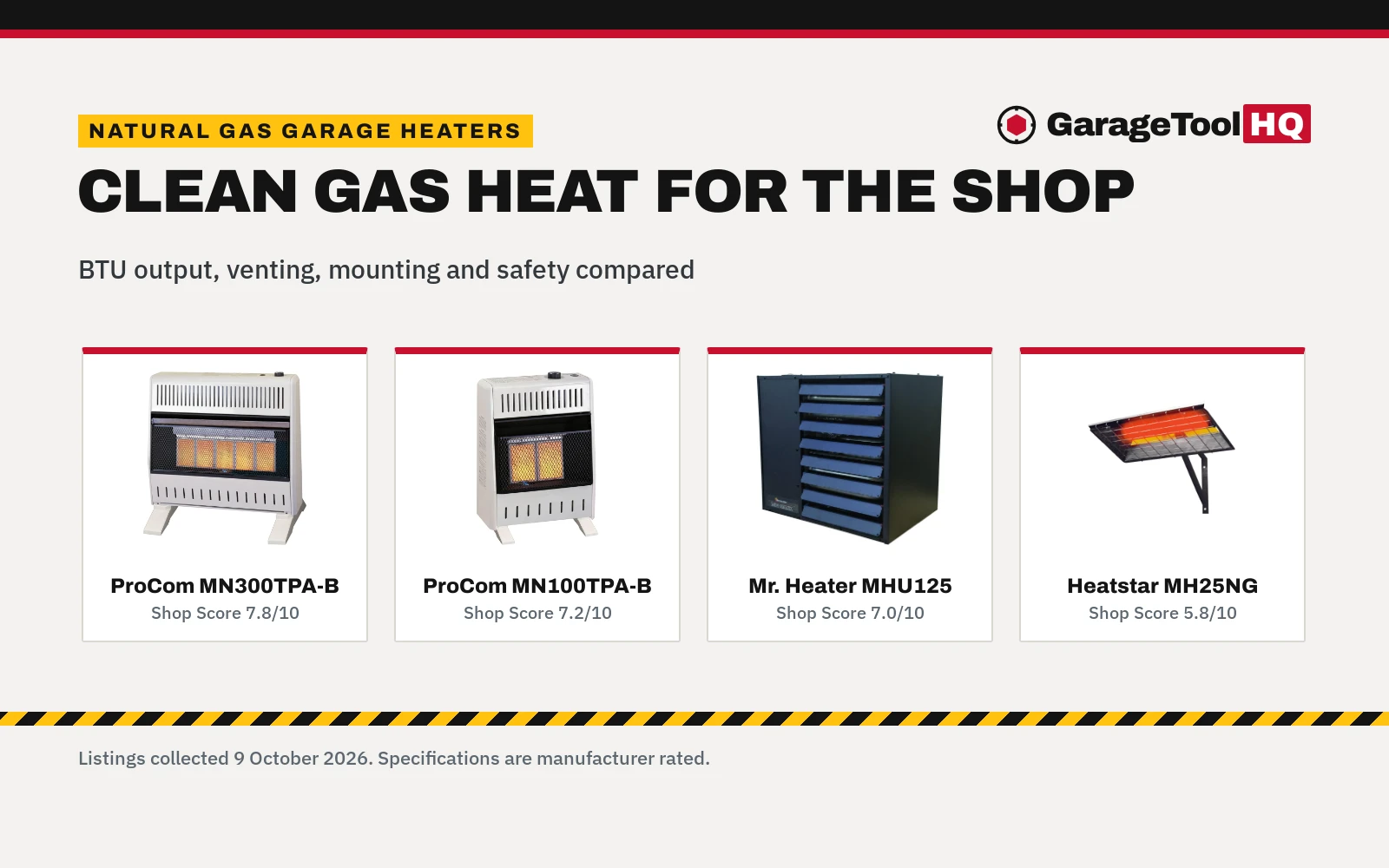
Four natural gas garage heaters compared by BTU heat output, square foot heating coverage, venting method, thermostat controls and safety features.

On this page
Top picks at a glance
As an Amazon Associate we earn from qualifying purchases.
- 1
 Best OverallProCom MN300TPA-B9.6/10View on Amazon
- 2
 Best CompactProCom MN100TPA-B9.5/10View on Amazon
- 3
 Best High-OutputMr. Heater MHU1259.5/10View on Amazon
- 4
 Best Overhead RadiantHeatstar MH25NG9.3/10View on Amazon
- 5
 Modine HD45AS0111Natural Gas Hot Dawg Garage Heater 45View on Amazon
- 6
 ProCom Heating Natural Gas Ventless Blue Flame Heater WithView on Amazon
- 7
 Mr. Heater 30View on Amazon
- 8
 Mr. Heater 50View on Amazon
- 9
 Mr. Heater 80View on Amazon
- 10
 DR. INFRARED HEATER Portable Infrared Indoor and OutdoorView on Amazon
Choosing the best natural gas garage heater depends on whether you need high-capacity vented forced-air circulation for a large workshop or compact radiant plaque heat that operates without electricity. Natural gas provides continuous heating without refilling propane tanks, making it a dependable fuel source for cold winter workspaces. This guide compares four natural gas garage heaters by heat output, heating coverage, venting design, mounting hardware and safety features.
GarageToolHQ earns a commission when you buy through links on this page, at no extra cost to you. Read our affiliate disclosure.
Quick picks
- Best Overall ProCom MN300TPA-B: 30,000 BTU radiant heat, heats up to 1,400 sq. ft., includes base feet and wall hardware, with an ANSI-certified ODS sensor. Check price on Amazon
- Best Compact ProCom MN100TPA-B: 10,000 BTU radiant plaque heater for spaces up to 500 sq. ft., with 3 thermostat settings and no electricity needed. Check price on Amazon
- Best High-Output Mr. Heater MHU125: 125,000 BTU forced-air unit heater with powered exhaust, electronic ignition, and 2,000 sq. ft. heating coverage. Check price on Amazon
- Best Overhead Radiant Heatstar MH25NG: 25,000 BTU natural gas radiant heater designed for overhead bracket mounting in cold garages from 500 to 600 sq. ft. Check price on Amazon
The picks

ProCom Heating Natural Gas Ventless Infrared
A 30,000 BTU natural gas ventless infrared plaque heater with 3-speed thermostat control, base feet, wall hardware and an ANSI-certified ODS sensor.
Pros
- 30,000 BTU output heats up to 1,400 sq. ft.
- Push button ignition with ANSI-certified ODS pilot sensor
- No electricity required for operation during power outages
- Includes both wall mount hardware and floor base feet
Cons
- No warranty term is stated on the listing
- Spec table lists floor mount only while bullets include wall mounting
- Ventless design requires adequate fresh air ventilation
- Listing states item weight only in kilograms (15.58 kg)

ProCom Heating Natural Gas Ventless Infrared
A compact 10,000 BTU natural gas ventless infrared heater with 3-speed thermostat control, base feet and an ANSI-certified ODS sensor.
Pros
- 10,000 BTU output heats areas up to 500 sq. ft.
- ANSI-certified ODS shutoff and overheat protection
- Operates without electricity during winter power outages
- Wall mount hardware and floor base feet included
Cons
- No warranty term is stated on the listing
- Item weight is not stated on the listing
- Spec table lists floor mount only while bullets include wall mounting
- 10,000 BTU output is insufficient for multi-car uninsulated garages
Mr. Heater 125,000 BTU Forced-Air Unit Heater
A 125,000 BTU forced-air commercial garage heater with powered exhaust, electronic ignition, LP conversion kit and ceiling brackets.
Pros
- 125,000 BTU heat output with forced-air circulation
- Powered exhaust vents combustion gases outside the garage
- Includes LP conversion kit and 2 angle ceiling brackets
- Compatible with digital and Wi-Fi thermostats
Cons
- Listing contradicts itself with 125,000 BTU in title and 50,000 BTU in spec table
- Heating coverage contradicts between 2,000 sq. ft. and 1,667 sq. ft.
- No concrete warranty term stated (listed only as Other)
- Heavy 109.1 lb cabinet requires ceiling mounting and 61 A service listed
Heatstar By Enerco F125444 Radiant Overhead Garage
A 25,000 BTU overhead radiant natural gas garage heater designed for ceiling bracket mounting in cold garages of 500 to 600 sq. ft.
Pros
- 25,000 BTU radiant heat warms garage surfaces directly
- Overhead bracket mounting keeps floor and wall space clear
- Natural gas powered with no electrical blower needed
- Heats garage areas from 500 to 600 sq. ft.
Cons
- Listing has empty bullet points and no control specs
- Spec table contains an absurd weight listing of 16 ounces (1 pound)
- Form factor is erroneously listed as Tower despite overhead bracket mount
- No warranty term or safety certification stated on the listing
More options to compare
 Modine HD45AS0111Natural Gas Hot Dawg Garage Heater 45Check price on Amazon
 ProCom Heating Natural Gas Ventless Blue Flame Heater WithCheck price on Amazon
 Mr. Heater 30Check price on Amazon
 Mr. Heater 50Check price on Amazon
 Mr. Heater 80Check price on Amazon
 DR. INFRARED HEATER Portable Infrared Indoor and OutdoorCheck price on Amazon
Compare the picks
| Model | Shop Score | Heating Method | Heat Output | Coverage | Mounting | Safety | Warranty |
|---|---|---|---|---|---|---|---|
| ProCom MN300TPA-B | 9.6/10 | Radiant infrared | 30,000 BTU | 1,400 sq. ft. | Wall or floor mount | ANSI certified (ODS, overheat) | Not stated |
| ProCom MN100TPA-B | 9.5/10 | Radiant infrared | 10,000 BTU | 500 sq. ft. | Wall or floor mount | ANSI certified (ODS, overheat) | Not stated |
| Mr. Heater MHU125 | 9.5/10 | Forced air | 125,000 BTU (spec table lists 50,000) | 2,000 sq. ft. (spec table lists 1,667) | Ceiling mount (brackets included) | Not stated | Not stated (listed as “Other”) |
| Heatstar MH25NG | 9.3/10 | Radiant | 25,000 BTU | 500 to 600 sq. ft. | Overhead brackets | Not stated | Not stated |
Specifications are manufacturer rated, as published on each listing and collected 9 October 2026. Where a listing contradicts itself, both figures are shown.
How we scored them
Each heater is scored out of 10 on performance, build, value, safety and warranty, with the weights published on our How We Pick page. Two models state ANSI certification with built-in oxygen depletion sensors and overheat protection, while two list no safety certifications. None of the listings states a concrete warranty term, so all four score zero for warranty.
| Product | Shop Score | Perf. /35 | Build /25 | Value /25 | Safety /10 | Warranty /5 |
|---|---|---|---|---|---|---|
| ProCom MN300TPA-B | 9.6 | 29 | 20 | 21 | 8 | 0 |
| ProCom MN100TPA-B | 9.5 | 26 | 19 | 20 | 8 | 0 |
| Mr. Heater MHU125 | 9.5 | 30 | 21 | 19 | 0 | 0 |
| Heatstar MH25NG | 9.3 | 26 | 16 | 16 | 0 | 0 |
Scores run from 9.2 to 9.8: each product’s point total is placed on that range, so more points always means a higher score.
What the listings tell you
Reviewing the four natural gas garage heater listings reveals wide gaps in specification accuracy. All four listings provide heat output figures ranging from 10,000 to 125,000 BTU, though one listing contradicts itself between 125,000 BTU and 50,000 BTU. Only two models publish safety certification details, both noting ANSI certification with oxygen depletion shutoff sensors. Not a single listing states a concrete warranty term with years or months. Three listings publish item weights, including one in kilograms and one listing an erroneous weight of 16 ounces for an overhead steel heater, while one listing leaves feature bullets entirely blank.
Buying guide: choosing the best natural gas garage heater
Vented forced-air vs ventless radiant heat
Natural gas heaters fall into two main categories: vented forced-air unit heaters and ventless radiant plaque heaters. Forced-air unit heaters use a blower fan to circulate warmed air throughout the entire garage volume and feature powered exhaust fans that vent combustion gases through an exterior pipe. Radiant plaque heaters warm objects, vehicles and people directly using infrared energy without requiring an electrical fan. Radiant heaters provide silent heat and operate during power outages, but unvented units introduce moisture and combustion byproducts into the workspace.
Heating capacity and garage square footage
Heater output should match the physical dimensions and heat loss of your garage. The listings in this comparison range from 10,000 BTU for spaces up to 500 square feet, up to 125,000 BTU for areas reaching 2,000 square feet. An undersized unit will run constantly without raising room temperature, while an oversized heater can cycle rapidly. Before selecting a unit, check our sizing guide on what size garage heater do I need to evaluate your garage square footage, ceiling height and insulation levels.
Combustion ventilation and carbon monoxide safety
Safety is critical when burning natural gas inside an enclosed garage. Unvented gas heaters consume oxygen from the room and produce water vapor and carbon monoxide. Look for models equipped with an oxygen depletion sensor (ODS) and overheat protection that automatically cut gas flow if oxygen drops. Regardless of the heater design, always install an operable carbon monoxide alarm in the garage, ensure adequate fresh air intake per the manufacturer’s manual, and never leave an unvented gas heater running in a closed space without ventilation.
Thermostat and ignition options
Temperature control affects comfort and fuel usage. Units with built-in multi-setting thermostats allow you to select between high, medium and low heat output to maintain a baseline working temperature. Larger commercial unit heaters often support low-voltage wall-mounted digital or Wi-Fi thermostats, letting you program schedules or adjust temperatures from across the room. Piezo push button ignition systems require no household electricity, whereas electronic spark ignition systems depend on building electrical supply.
Professional gas line installation
Connecting any heating equipment to a residential natural gas supply requires rigid black pipe or approved flexible gas connectors sized for the heater’s maximum demand. Fuel gas codes dictate proper pipe sizing, shutoff valve placement, sediment traps and leak verification. Always hire a licensed professional plumber or HVAC technician to run gas piping, verify supply pressure, and install flue exhaust venting rather than attempting DIY gas connections.
Never run a fuel-burning heater, generator or engine in a closed garage: carbon monoxide builds up fast and has no smell. Fit a CO alarm, keep clearances to cars and storage, use vented gas heaters installed to code, and put 240V electric heaters on a dedicated circuit. See CPSC carbon monoxide guidance. Read our Safety Disclaimer.
Frequently Asked Questions
Can I use an unvented natural gas heater in my garage?
Unvented natural gas heaters can be used in garages only if local building codes permit them and adequate combustion air ventilation is provided. Models with pilot oxygen depletion sensors (ODS) shut off fuel if oxygen levels fall, but they still release moisture and combustion byproducts into the air. Many jurisdictions require vented units or active fresh air intake.
What is the difference between radiant and forced-air gas heaters?
Radiant gas heaters emit infrared waves that directly warm surfaces, tools and people without moving air, making them quiet and efficient for spot heating. Forced-air unit heaters use an internal fan to heat and circulate ambient air throughout the entire garage, warming the overall space more evenly but requiring electrical power for the blower.
Do natural gas garage heaters require electricity to operate?
Radiant natural gas plaque heaters with push button piezo ignition operate entirely without electricity, providing heat during winter storm power outages. In contrast, forced-air unit heaters require electrical connections to power electronic igniters, powered exhaust draft fans and warm air circulating blowers.
How many BTU do I need to heat a garage?
Required BTU depends on the square footage of the garage, insulation quality and local winter temperatures. The models reviewed here range from 10,000 BTU for spaces up to 500 square feet to 125,000 BTU for spaces up to 2,000 square feet. Check our garage sizing guide to calculate the exact heating requirements for your workshop.
Why is professional installation recommended for gas garage heaters?
Natural gas systems operate under pressure and present fire and carbon monoxide hazards if plumbed or vented incorrectly. A licensed contractor ensures correct gas line diameter, checks for fuel leaks, installs proper shutoff valves and verifies that flue venting complies with local mechanical codes.
Related: the best garage heaters, the best propane garage heater, and our garage upgrades hub. Also see our propane vs natural gas heater comparison. Also see our garage heater gas vs electric guide. Also see our best garage heater for 2-car garage. Also see our how to keep a garage warm in winter. Also see our how much does it cost to heat a garage.