Floor Jack Alternative: Which One Should You Buy?
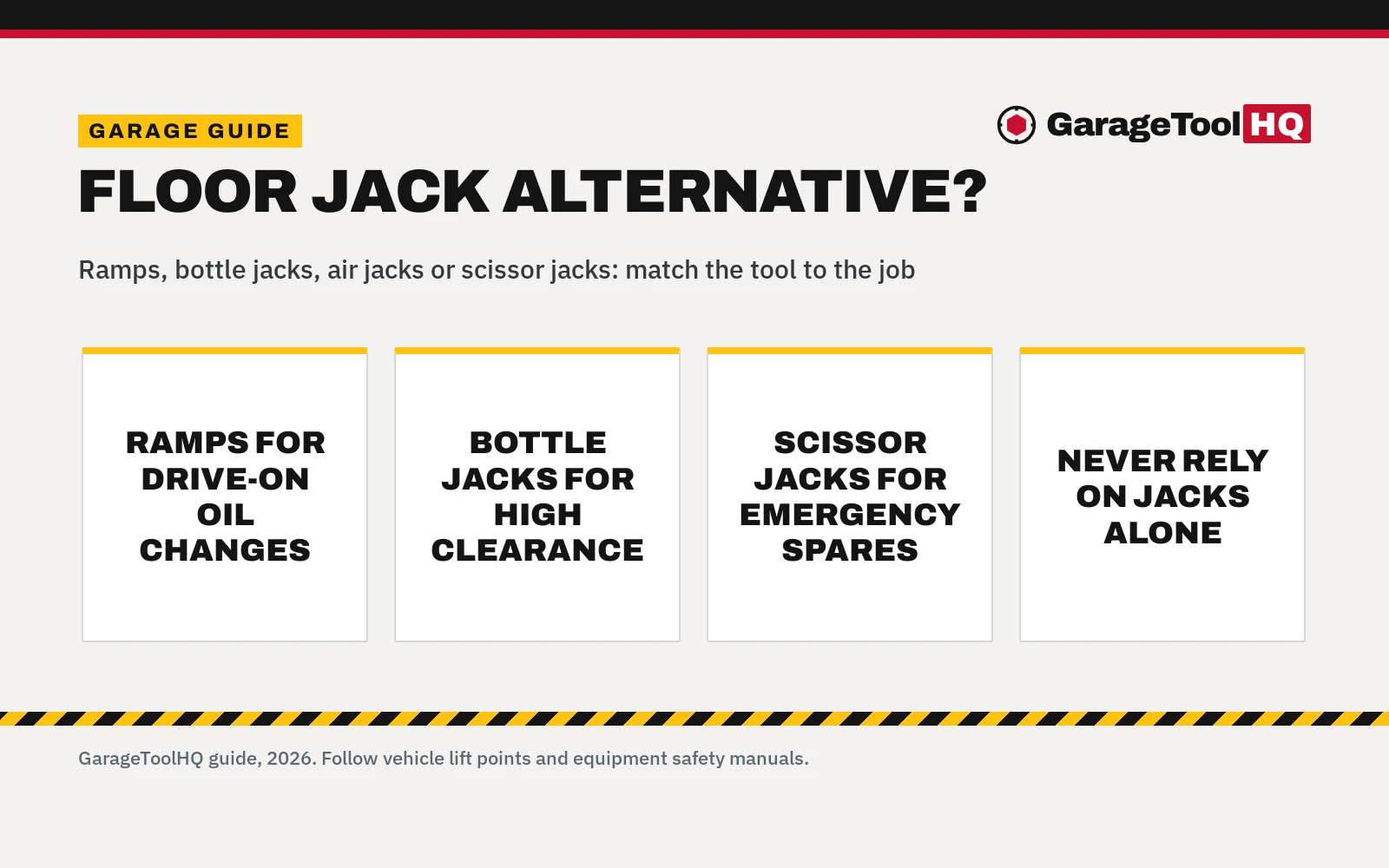
Finding a reliable floor jack alternative depends on the job: car ramps for oil changes, bottle jacks for trucks, scissor jacks for emergencies and portable lifts for full underbody access.

On this page
Top picks at a glance
As an Amazon Associate we earn from qualifying purchases.
- 1
 AV Steel Low Profile Floor Jack 3 Ton9.7/10View on Amazon
- 2
 Jack Boss 3 Ton Low Profile9.7/10View on Amazon
- 3
 AV Steel 3 Ton Floor Jack9.7/10View on Amazon
When you roll out a drain pan for a Saturday oil change or pull off a wheel for a brake job, a heavy trolley jack is not your only option. A floor jack alternative lifts or supports your vehicle safely when matched to the job. Car ramps give instant drive-on access for underside work, hydraulic bottle jacks lift truck axles, portable scissor jacks handle roadside wheel swaps, and pneumatic air jacks or portable car lifts raise vehicles in home workshops. Whenever you elevate a vehicle off its wheels with a jack, always lower it onto rated jack stands resting on solid level ground before sliding underneath.
GarageToolHQ earns a commission when you buy through links on our product pages, at no extra cost to you. Read our affiliate disclosure.
Below: why you might want an alternative to a traditional trolley jack, how the primary alternatives compare side by side, and essential rules for safe lifting in a home garage.
Floor Jack Alternative: Why Look Beyond a Standard Trolley Jack?
Standard hydraulic trolley jacks are common in home shops, but they are not always ideal for every vehicle or repair. Heavy steel jacks take up substantial floor space and are awkward to drag across rough floors or store in a trunk for roadside emergencies.
Different garage tasks demand different lifting methods:
- Underbody maintenance without wheel removal. For oil changes, fluid swaps, or exhaust inspection, driving onto ramps is faster and leaves suspension naturally loaded.
- Solid axle lifting on trucks and trailers. Placing a compact bottle jack directly beneath an axle tube raises the tire with minimal stroke, avoiding full suspension travel.
- Emergency roadside portability. When a tire goes flat, compact mechanical scissor jacks or electric jacks stow neatly inside the spare tire well.
- Limited garage footprint. In narrow garages, compact alternatives maneuver in tight quarters where long pump handles cannot swing.
Primary Floor Jack Alternatives Compared
| Alternative Type | Best Garage Job | Ground Clearance Needed | Stand Required? |
|---|---|---|---|
| Car Ramps | Oil changes, fluid services, exhaust inspection | Low to moderate approach angle | No (wheel chocks required) |
| Hydraulic Bottle Jack | Truck axles, heavy trailers, high-clearance frames | Moderate to high clearance | Yes, always support with jack stands |
| Mechanical Scissor Jack | Emergency spare tire changes, roadside repair | Low clearance | Yes, always support with jack stands |
| Pneumatic Air Bag Jack | Rapid shop lifting, body work, exhaust service | Low to moderate clearance | Yes, always support with jack stands |
| Portable Car Lift | Full brake jobs, suspension rebuilds, detailing | Low clearance drive-over | No (built-in mechanical locking bars) |
If wheels can stay mounted, drive-on ramps offer superior speed and stability. If wheels must come off for brake or suspension work, choose a lifting tool that allows placing rated jack stands under structural chassis points.
How to Use a Floor Jack Alternative Safely: The Checklist
- Confirm vehicle weight and axle ratings. Check the door jamb sticker and owner manual before lifting. Never exceed tool or stand weight limits.
- Work exclusively on solid, level concrete. Never lift on sloped driveways, soft asphalt, dirt, or gravel, which cause jacks to tilt and slip.
- Engage the parking brake and chock the wheels. Set the emergency brake firmly. Place wheel chocks against tires remaining on the ground to prevent vehicle rolling.
- Identify factory lift points. Consult the owner manual to locate reinforced pinch welds, frame rails, or suspension points. Never lift against sheet-metal floor pans.
- Never get under a vehicle supported only by a jack. Hydraulics and mechanical threads can fail instantly. A jack is an elevating tool, not a holding device.
- Support the vehicle mechanically before working. When using jacks, lower the load onto rated jack stands under structural frame members. For ramps, center tires on top platforms with chocks set.
- Confirm stability with a firm bumper push. With the vehicle resting on stands or centered on ramps, push firmly against the bumper with hands flat to verify stability before getting underneath.
- Inspect lifting gear before use. Check bottle jacks for oil leaks, air bags for rubber cracks or fitting leaks, and scissor jacks for stripped threads.
- Keep the work zone clear. Remove air hoses, cords, drain pans, and creepers from around the vehicle before raising or lowering.
No hydraulic cylinder, bottle jack, or air bag is designed to hold a vehicle while you work underneath. Hydraulic seals can fail without warning. When lifting with jacks, always lower the load onto rated jack stands on solid level concrete before starting work.
A jack is for lifting, not holding. Never work under a vehicle supported only by a jack: set it on rated jack stands, on solid, level ground, at the manufacturer's lift points, chock the wheels, and give the car a firm shake before you go under. Read our Safety Disclaimer.
Car Ramps vs Bottle Jacks vs Scissor Jacks
Understanding how lifting alternatives function helps you choose the right setup:
- Car ramps for drive-on simplicity. Where wheels remain mounted, sturdy drive-on ramps eliminate locating jack points. As explained in our guide comparing car ramps vs jack stands, ramps distribute weight across a wide footprint. They are especially practical when using car ramps for oil changes, provided bumper clearance allows an easy approach.
- Hydraulic bottle jacks for concentrated vertical force. Bottle jacks use a vertical hydraulic ram over a compact base to generate tremendous power in a small package. As noted in our guide to floor jack vs bottle jack designs, their tall retracted profile and narrow saddle suit solid axles on trucks and trailers rather than low unibody cars.
- Scissor jacks for emergency wheel service. Mechanical scissor jacks use a lead screw to raise a central saddle. While they fit tight underbody clearances and stow in spare tire wells, their narrow footing offers limited lateral stability. Reserve them for emergency tire swaps, and always pair them with best jack stands for garage work.
- Pneumatic air bag jacks for speed. Air jacks use rubber bellows connected to shop air to raise a vehicle corner quickly. They work well for rapid wheel service on smooth concrete floors, but require an active air supply and must be lowered onto stands before repair work.
To compare standard trolley jacks with these tools, see our overview of floor jack types and review how to use a floor jack safely.
High-Lift Bottle Jacks and Heavy Capacity Options
When you need heavy lifting capacity in a compact footprint, a heavy-duty bottle jack provides an effective alternative. For example, VEVOR lists an air hydraulic bottle jack with a lifting range of 10.4 to 19.7 inches and a load capacity of 44,092 lbs (rated for 20 ton applications). That model features an integrated 2.6 inch screw extension, weighs 13.5 kg, and measures 8.7 x 6.3 x 10.4 inches. Pneumatic mode allows quick lifting from shop air fittings, while a manual pump handle provides backup in the field.
However, because that bottle jack features a minimum height of 10.4 inches, it cannot slide beneath the low rocker panels of passenger sedans. For smaller vehicles needing roadside assistance, manufacturer specifications for STANDTALL cite a compact electric car jack rated for 3 ton capacity running on 12V vehicle power. Whether using a 12V electric unit or a 20 ton hydraulic ram, verify that minimum saddle height fits beneath your vehicle lift point before buying.
For truck setups, compare ratings and base styles in our guide to the best bottle jack for trucks.
Frequently Asked Questions
What is the safest floor jack alternative for an oil change?
Drive-on car ramps are the safest and quickest alternative for an oil change. Ramps provide a wide, rigid base without hydraulic failure risks while keeping vehicle weight on the tires. Always set the parking brake, chock the wheels on the ground, and check bumper clearance before driving on.
Can I use a bottle jack as a floor jack alternative on a sedan?
Generally no. Many bottle jacks are too tall to fit under sedan ground clearance. Furthermore, sedans use unibody pinch welds that require a broad saddle rather than a small metal bottle jack pad, which can crush sheet metal or slip off. Bottle jacks suit solid axles and truck frames.
Can a scissor jack replace a floor jack for regular garage maintenance?
No. Scissor jacks are emergency tools for roadside spare tire changes. Their narrow base and screw mechanism offer limited lateral stability during shop work. If you must lift with a scissor jack at home, transfer the load onto a rated jack stand immediately.
What does low profile mean when choosing lifting equipment?
A low profile rating means the tool features a reduced collapsed height to slide under vehicles with limited ground clearance. Standard jacks often sit too high for unibody lift points. If your car sits low, select low profile ramps or dedicated low-clearance lifting tools.
Do I still need jack stands when using a floor jack alternative?
Yes, whenever elevating a vehicle off its wheels with a jack. Bottle jacks, air bags, electric jacks, and scissor jacks are lifting tools, not holding devices. Never crawl under a vehicle held only by a jack. With ramps or lifts with locked mechanical safety bars, separate stands are not needed.
Related: guide to floor jack types, our comparison of floor jack vs bottle jack, our guide to car ramps vs jack stands, car ramps for oil changes, and our jacks and stands hub. Also see how to use a floor jack safely.