Propane Heaters Pros and Cons: What to Know
A complete breakdown of propane heaters pros and cons for workshops and garages, covering heat speed, fuel runtime, moisture risks and essential safety rules.

On this page
Top picks at a glance
As an Amazon Associate we earn from qualifying purchases.
- 1
 Mr. Heater 99.7/10View on Amazon
- 2
 ProCom Heating Liquid Propane Ventless Blue Flame Heater With9.7/10View on Amazon
- 3
 Mr. Heater 809.7/10View on Amazon
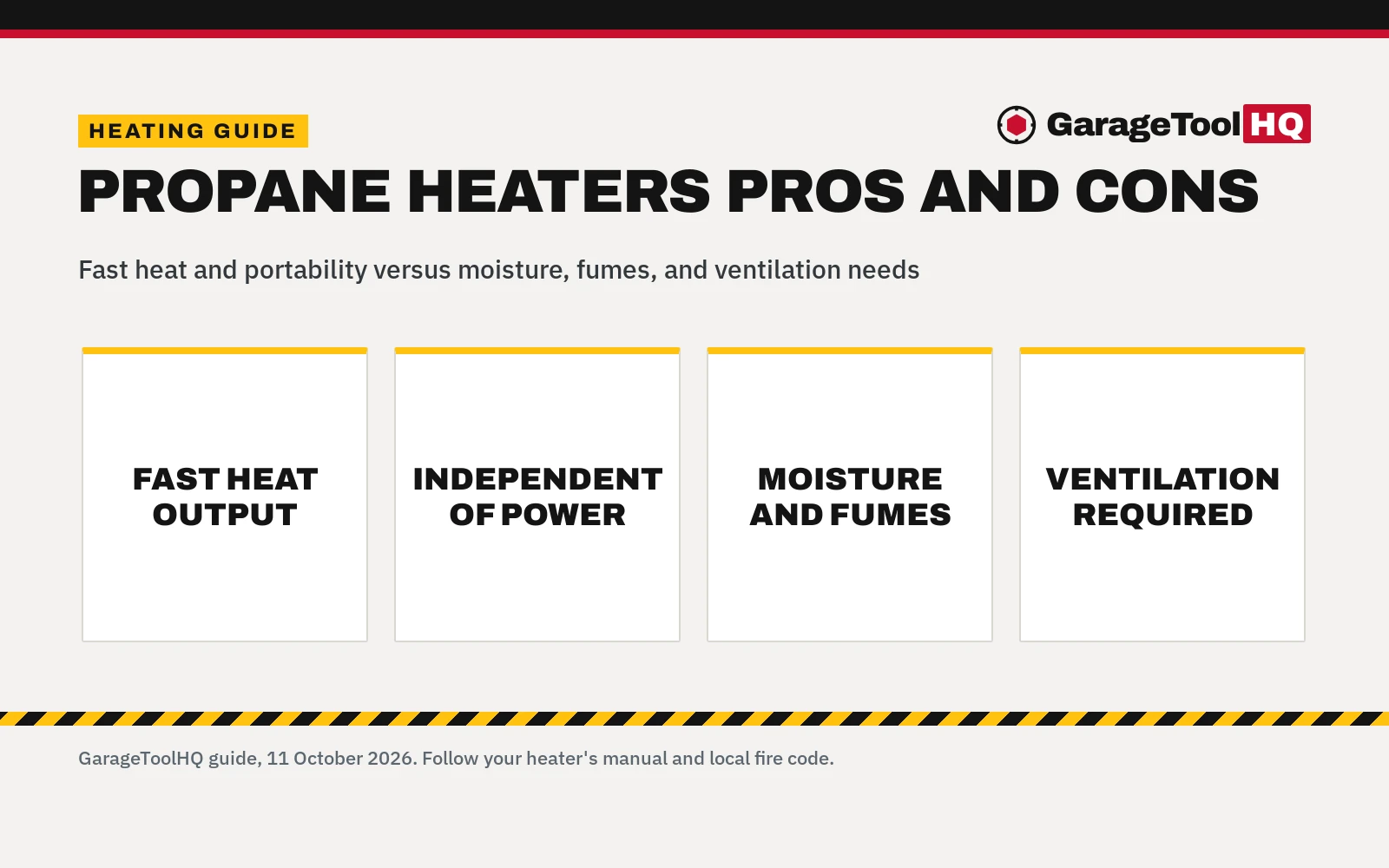
Understanding propane heaters pros and cons helps you decide whether portable gas heat fits your workshop or garage. The primary pros are rapid warming, high heat output, and independence from heavy wiring, while the main cons are combustion emissions, moisture accumulation, open flames, and mandatory ventilation. Weighing these factors keeps your workspace warm while maintaining carbon monoxide safety.
GarageToolHQ earns a commission when you buy through links on our product pages, at no extra cost to you. Read our affiliate disclosure.
Below: core advantages and drawbacks, heater designs compared, an operating safety checklist, and propane versus electric heat.
Propane heaters pros and cons: what to consider for your workspace
Propane heats workspaces and garages quickly, but because open flames consume oxygen and produce exhaust, unvented units must never run in a closed garage without fresh-air ventilation. Below are the key benefits and drawbacks.
- Pro: rapid, high-capacity heat. Propane warms cold air far faster than electric space heaters. Forced-air units deliver massive output; InoKraft lists a 125,000 BTU unit that starts raising space temperatures in as little as 5 minutes across spaces up to 3,200 sq. ft., while Mr. Heater lists a 125,000 BTU model heating up to 3,125 square feet.
- Pro: minimal electrical demand. Propane heaters do not require heavy wiring. Convection heaters like the Dura Heat LPC80 require no electricity, running off-grid. Forced-air models only use electricity for an internal fan; GASLAND lists just 2 A at 115 volts for its 60,000 BTU unit.
- Pro: portable fuel supply. Propane heaters connect to portable cylinders. A 20 lb cylinder provides long runtimes at lower output; thermomate lists up to 69 hours on a 20 lb tank at 6,000 BTU. For larger spaces, Dura Heat lists up to 17 hours on a 40 lb cylinder.
- Con: carbon monoxide risk. Fuel combustion consumes oxygen and produces carbon monoxide if airflow is restricted. A working carbon monoxide alarm is mandatory, as oxygen sensors do not detect carbon monoxide.
- Con: moisture and condensation. Burning propane releases water vapor into the air. In unvented spaces, this moisture condenses on cold concrete, vehicle bodywork, and steel tools, promoting rust.
- Con: open flame hazards. Garages hold volatile vapors from gasoline, brake cleaner, and paint thinners. Because these vapors sink, floor-level flames risk ignition.
- Con: tank storage rules. Cylinders require refilling, and fire codes prohibit storing spare propane tanks inside residential homes and attached garages.
Propane heater designs: forced-air, radiant cabinet, and convection
| Heater Type | Heat Distribution | Stated Output Range | Power Needed | Best Application |
|---|---|---|---|---|
| Forced-Air Torpedo | Fan-forced air | 30,000 to 125,000 BTU | 115V or 120V (GASLAND: 2 A) | Rapid heat in ventilated shops; verify indoor rating |
| Radiant Cabinet | Direct infrared | 6,000 to 18,000 BTU | None (piezo) | Quiet spot heating; indoor-rated with ODS |
| Convection Tower | 360-degree rising air | 50,000 to 80,000 BTU | None (piezo) | Ventilated spaces without power cords |
Always verify the manufacturer rating. High-output torpedo heaters like the BILT HARD 125,000 BTU unit (adjustable from 75,000 to 125,000 BTU for up to 3,125 sq. ft.) are outdoor or jobsite units and must not run in an enclosed garage. For ventilated shops, look for indoor-rated models like the GASLAND 60,000 BTU forced-air unit (heats up to 1,500 square feet) or the InoKraft 125,000 BTU heater (heats up to 3,200 sq. ft.). If you need quiet operation, radiant cabinet models like the thermomate 18,000 BTU heater run at no more than 32 dB. For cord-free heating, the Dura Heat LPC80 warms up to 2,000 sq ft. Compare options in our guides to the propane gas heater for shop and propane gas heaters for indoor use.
How to safely use a propane heater: setup and ventilation checklist
- Confirm the indoor rating. Check the label and manual. If marked for outdoor or construction use only, never use it in a garage.
- Install a carbon monoxide alarm. Place a CO alarm in the garage and another inside the house near the connecting door. Exit to fresh air immediately if it sounds.
- Provide fresh air. Never run an unvented heater in a closed space. Maintain the fresh-air opening specified by the manufacturer.
- Check safety shutoffs. thermomate includes an ODS pilot and tip-over shutoff. GASLAND includes an overheat sensor and flameout valve. Note that an ODS does not detect carbon monoxide.
- Maintain clearances. Keep clear distance from wood, cardboard, vehicle panels, and solvents.
- Place on level concrete. Stand the heater on clean, level concrete away from traffic, jacks, and hoses.
- Perform a soapy water leak check. Brush soapy water over valve threads and fittings each time you connect a tank. Tighten fittings if bubbles appear.
- Never leave burning heaters unattended. Extinguish the flame and close the cylinder valve before leaving.
- Store spare cylinders outside. Keep spare cylinders outdoors, upright and away from building openings, per fire codes.
Combustion consumes oxygen and produces carbon monoxide. Running an unvented fuel heater in a sealed garage without fresh air ventilation is hazardous. Never operate outdoor torpedo units or charcoal grills in an enclosed shop.
Never run a fuel-burning heater, generator or engine in a closed garage: carbon monoxide builds up fast and has no smell. Fit a CO alarm, keep clearances to cars and storage, use vented gas heaters installed to code, and put 240V electric heaters on a dedicated circuit. See CPSC carbon monoxide guidance. Read our Safety Disclaimer.
Propane vs electric garage heaters: comparing workshop heating options
Compare these core factors when choosing between propane and electric heat:
- Emissions: Electric heaters produce zero emissions, no carbon monoxide, and no moisture. Unvented propane heaters release water vapor and combustion exhaust into the workspace.
- Heat capacity: Propane units deliver high output quickly, reaching 125,000 BTU (from BILT HARD, InoKraft, and Mr. Heater). Electric garage heaters deliver steady warmth better suited to insulated spaces.
- Wiring: Radiant cabinet and convection propane units require no electricity, while forced-air models plug into standard 115V or 120V outlets (GASLAND draws 2 A). High-capacity electric heaters require dedicated circuits; always size wiring properly and hire a licensed electrician to install dedicated lines.
- Grid independence: Non-electric radiant and convection propane heaters work during winter utility blackouts. Forced-air units need electricity to run the fan and will not operate without power.
Calculate your heat requirements with our guide on what size garage heater do I need. Compare models in our reviews of the best propane garage heater and best electric garage heater, or read our breakdown of an electric vs propane garage heater.
Open flames, solvent vapors, and battery charging
Garages present chemical hazards that demand strict caution around open flames:
- Heavy solvent vapors: Brake cleaner, gasoline, and paint vapors sink toward the floor where floor-mounted heaters can ignite them. Never use volatile solvents or spray paint while operating a fuel heater.
- Hydrogen gas from battery charging: Charging lead-acid batteries releases combustible hydrogen gas. Keep charging batteries separated from heaters with open flames. Using a battery charger maintainer with automatic float regulation limits gassing, but ventilation remains essential.
Frequently Asked Questions
Can I use a propane heater indoors?
Only if the heater is explicitly rated for indoor use by its manufacturer, such as cabinet heaters with an Oxygen Depletion Safety (ODS) pilot. Outdoor-only torpedo and patio heaters must never be used indoors. Always confirm the rating on the label and maintain the required ventilation opening.
How to safely use propane heater indoors?
Install a working carbon monoxide alarm, maintain continuous fresh air ventilation per the manual, and place the heater on level concrete clear of combustibles. Never use flammable solvents nearby and never leave the heater burning unattended.
How to light propane heater?
Check fittings with soapy water first and open the tank valve slowly. For radiant cabinet models, turn the knob to pilot, push down, and click the piezo igniter until lit. For forced-air heaters with electronic ignition (like GASLAND or BILT HARD), plug into a 115V or 120V outlet and turn the switch on. If it fails to light, shut the gas off to let fuel disperse before retrying.
Where to buy a propane heater?
Propane heaters are available at home improvement centers, farm supply stores, hardware retailers, and online merchants. Verify safety certifications, check if a hose and regulator are included, and ensure the unit matches your indoor or outdoor application.
Do propane heaters produce moisture and condensation in a garage?
Yes. Burning propane produces water vapor, which condenses on cold steel tools, vehicle panels, and concrete in unvented spaces. Providing fresh air ventilation helps remove moisture, while electric or vented gas heaters eliminate indoor combustion moisture entirely.
Related: garage heater sizing by BTU, our guide to the best garage heater for a 2-car garage, our garage upgrades hub, and is it safe to use a propane heater in a garage. Also see our breakdown of how much does it cost to heat a garage and tips on how to keep a garage warm in winter.