Rubber vs Poly Wheel Chocks: Which One Should You Buy?
Rubber vs poly wheel chocks: rubber grips and takes weight, poly stays light and clean. Material choice for the garage.

On this page
Top picks at a glance
As an Amazon Associate we earn from qualifying purchases.
- 1
 MaxxHaul Rubber Wheel Chock 2 Pack9.7/10View on Amazon
- 2
 MaxxHaul High Visibility Poly Foam Wheel Chock 2-Pack9.5/10View on Amazon
- 3
 MaxxHaul 50019 Heavy Duty 3-Sided Rubber Wheel Chock with9.7/10View on Amazon
- 4
 Vestil LWC-15 Laminated Rubber Wheel Chock 8 In. x 10-5/16View on Amazon
- 5
 Parking Stopper for Garage Heavy Duty Rubber Parking CurbView on Amazon
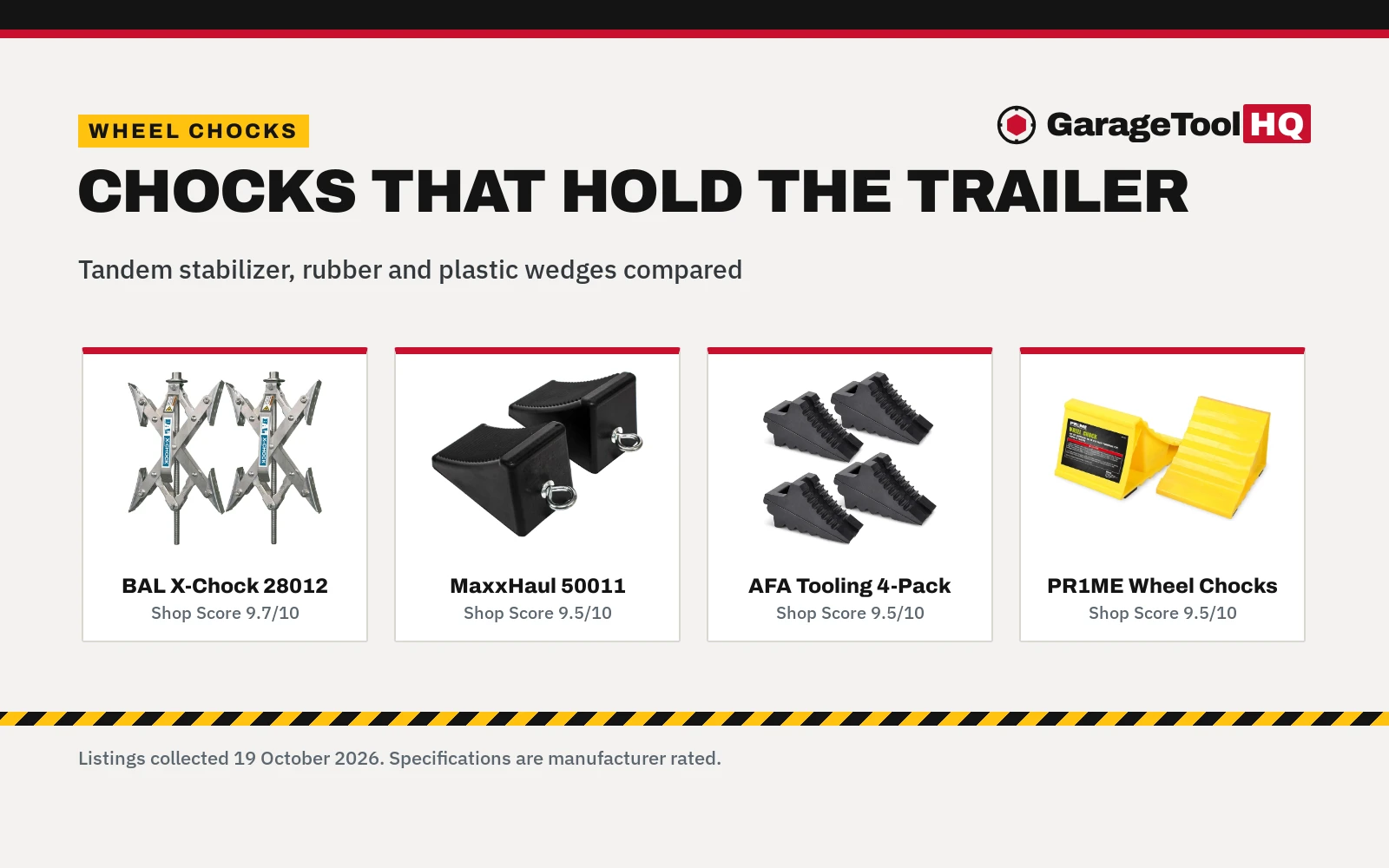
Rubber vs poly wheel chocks comes down to grip against weight: solid rubber chocks grip pavement, gravel and ramps with their own weight and treaded faces, and one listing backs rubber to 20,000 lbs, while polyurethane chocks trade some of that bite for light weight, clean floors and resistance to oil and chemicals. Pick rubber for heavy trailers and shop duty; pick poly for the trunk kit and finished floors.
More options to compare
 Vestil LWC-15 Laminated Rubber Wheel Chock 8 In. x 10-5/16Check price on Amazon
 Parking Stopper for Garage Heavy Duty Rubber Parking CurbCheck price on Amazon
GarageToolHQ earns a commission when you buy through links on our product pages, at no extra cost to you. Read our affiliate disclosure.
The quick answer
Buy rubber chocks for the heaviest, hardest-held work: trailers, RVs and trucks on slopes and loose surfaces. The SECURITYMAN listing states its solid rubber chocks hold trucks and trailers weighing up to 20,000 lbs even on inclined surfaces, with treaded grips for slippery ground, a molded grab handle and a predrilled hole for a rope or chain, at 3.98 pounds and 8.19 by 7.4 by 6.73 inches. Buy poly chocks for light duty where weight and floors matter: they ride in the trunk, will not scuff an epoxy floor, and shrug off oil and solvents. The listings here are all rubber, so the poly side below is general guidance without listing figures.
What rubber chocks do well
Rubber wins on grip and mass. The weight of the chock itself resists sliding: the OULEME chocks run 8.3 by 4.4 by 4 inches with rope and reflective strips, and the CertBuy listing credits the chocks inherent weight plus a pleated anti-slip surface for grip and stability. Treaded or pleated faces bite pavement, concrete and packed gravel. Rubber also takes abuse: the AFA Tooling 4T chocks brace tires front and back with tie-off eyebolts, and the MAXXHAUL 50019 is a 3-sided rubber chock with reflective strips, a nylon rope and a non-slip base, backed by a 90-day warranty. On a slope, mass plus tread is the combination that holds.
Rubber shrugs off weather. The SECURITYMAN listing states reliable performance in any climate, and rubber does not crack in cold the way some plastics can. The tradeoff is weight in the hand and marks on the floor: rubber can scuff finished concrete and epoxy, and a pair of heavy chocks is a workout to carry across the lot.
What poly chocks do well
Polyurethane wins on weight and cleanliness. A poly chock weighs a fraction of its rubber equivalent, so the pair lives in the trunk or the trailer toolbox without complaint. Poly will not mark finished floors, which matters in a showroom garage with coated concrete. It resists oil, fuel and solvents that can soften or stain rubber over time, and it will not rust or corrode because there is nothing metal in it.
The tradeoff is grip. Poly is lighter, so it relies on its tread pattern and the wedge angle rather than mass to stay put. On clean dry concrete it holds fine; on ice, mud or loose gravel, rubber mass wins. No listing here states poly figures, so treat poly as the light-duty pick: passenger cars and light trailers on level, clean surfaces.
Rubber vs poly wheel chocks: the real difference
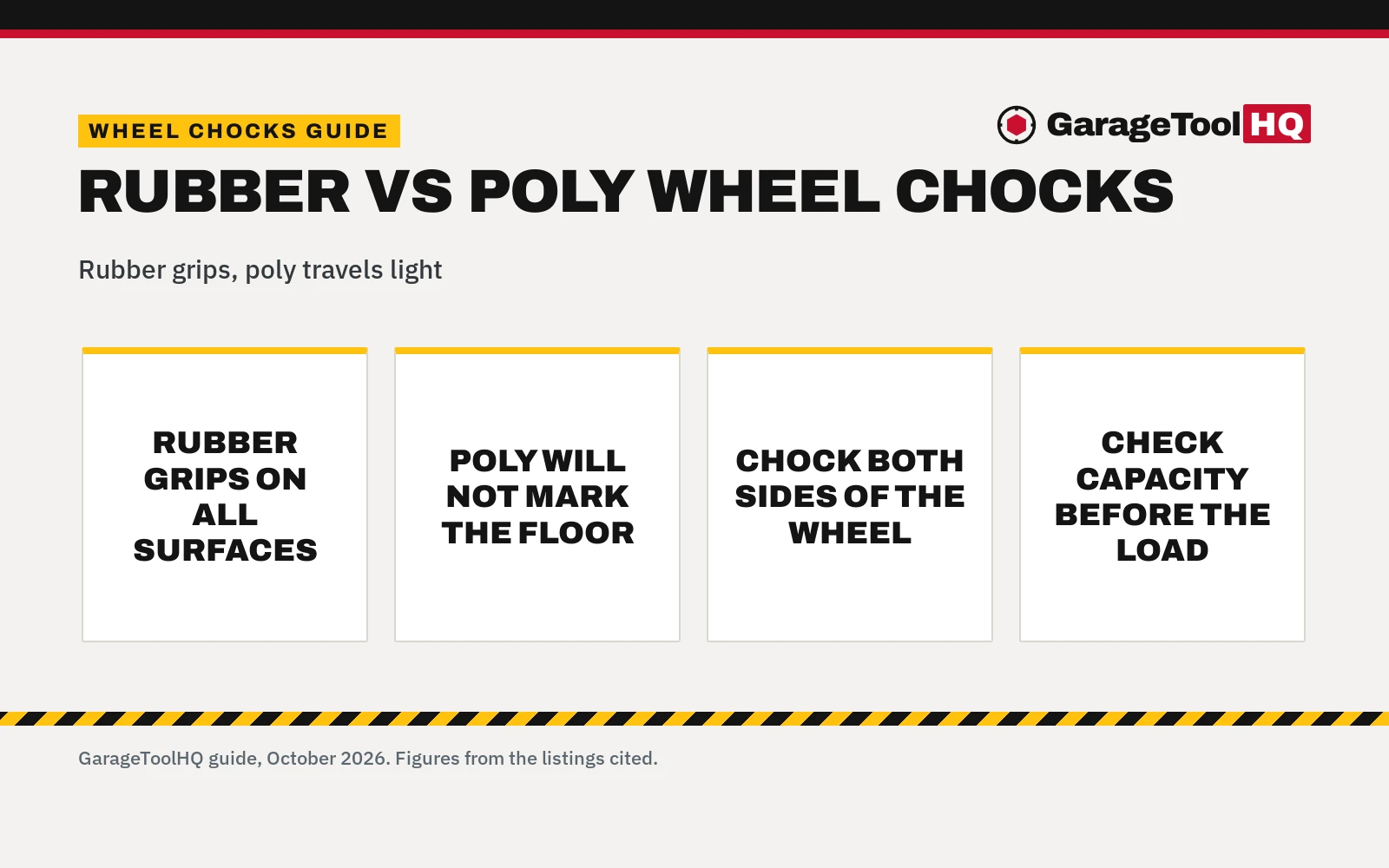
The real difference is what each material brings to the tire. Rubber brings mass and friction: the chock stays where you kick it and the tire climbs the treaded face and stops. Poly brings lightness and manners: easy to carry, kind to floors, immune to chemicals. Neither is universally better. A 20,000-lb trailer on a sloped gravel drive wants the SECURITYMAN rubber pair with its treaded grips and rope hole. A daily driver parked on a coated garage floor wants poly that will not leave black marks. Match the material to the vehicle, the surface and the slope, in that order.
Sizing and placement
Size the chock to the tire: the wedge face should meet the tire low and the chock should sit flat on the ground. The listings run from the 8.19-inch SECURITYMAN to the compact 8.3-inch OULEME, all sized for car, truck, trailer and RV tires. Place chocks on both sides of the wheel when the grade allows, front and back, so the vehicle cannot roll either way; the AFA Tooling 4-pack is built for exactly that, bracing both tires front and back. Set the parking brake first, then kick the chocks tight against the tread. On a slope, chock the downhill side first. See how to use wheel chocks for the full setup and what wheel chocks are for the basics.
Features worth having
Rope or chain holes matter more than they look: the SECURITYMAN predrilled hole and the MAXXHAUL nylon rope let you pull chocks from under the tire without kneeling in traffic, and they keep the pair together in storage. Grab handles, like the SECURITYMAN molded handle and the Fasmov ergonomic carry handles at 4.2 pounds, save fingers on cold mornings. Reflective strips, on the MAXXHAUL and OULEME chocks, make the chocks visible in a dark driveway. Tie-off eyebolts, on the AFA Tooling 4T chocks, let you link pairs together. None of these replace proper placement, but each one makes the chock easier to use correctly.
A jack is for lifting, not holding. Never work under a vehicle supported only by a jack: set it on rated jack stands, on solid, level ground, at the manufacturer's lift points, chock the wheels, and give the car a firm shake before you go under. Read our Safety Disclaimer.
Frequently Asked Questions
Are rubber or poly wheel chocks better?
Rubber for heavy loads, slopes and loose surfaces; poly for light cars, finished floors and trunk kits. The listings here back rubber to 20,000 lbs; no poly figures are stated.
How many wheel chocks do I need?
Chock both sides of the wheel when the grade allows, front and back. See how many wheel chocks you need for the full answer.
Do wheel chocks work on slopes?
Yes, with the right chock: the SECURITYMAN rubber listing states holding up to 20,000 lbs even on inclined surfaces. Chock the downhill side first and set the parking brake.
Will rubber chocks damage my garage floor?
Rubber can scuff finished concrete and epoxy. If the floor matters, poly chocks will not mark it.
Do I still need the parking brake with chocks?
Yes. Chocks are the backup, not the primary hold. Set the brake first, then place the chocks. See car ramps vs jack stands for lifting safety alongside chocks.
Related guides
Also see pin type vs ratchet jack stands and floor jack types.