Best 1/4 Inch Air Ratchet (2026): 5 Picks Compared
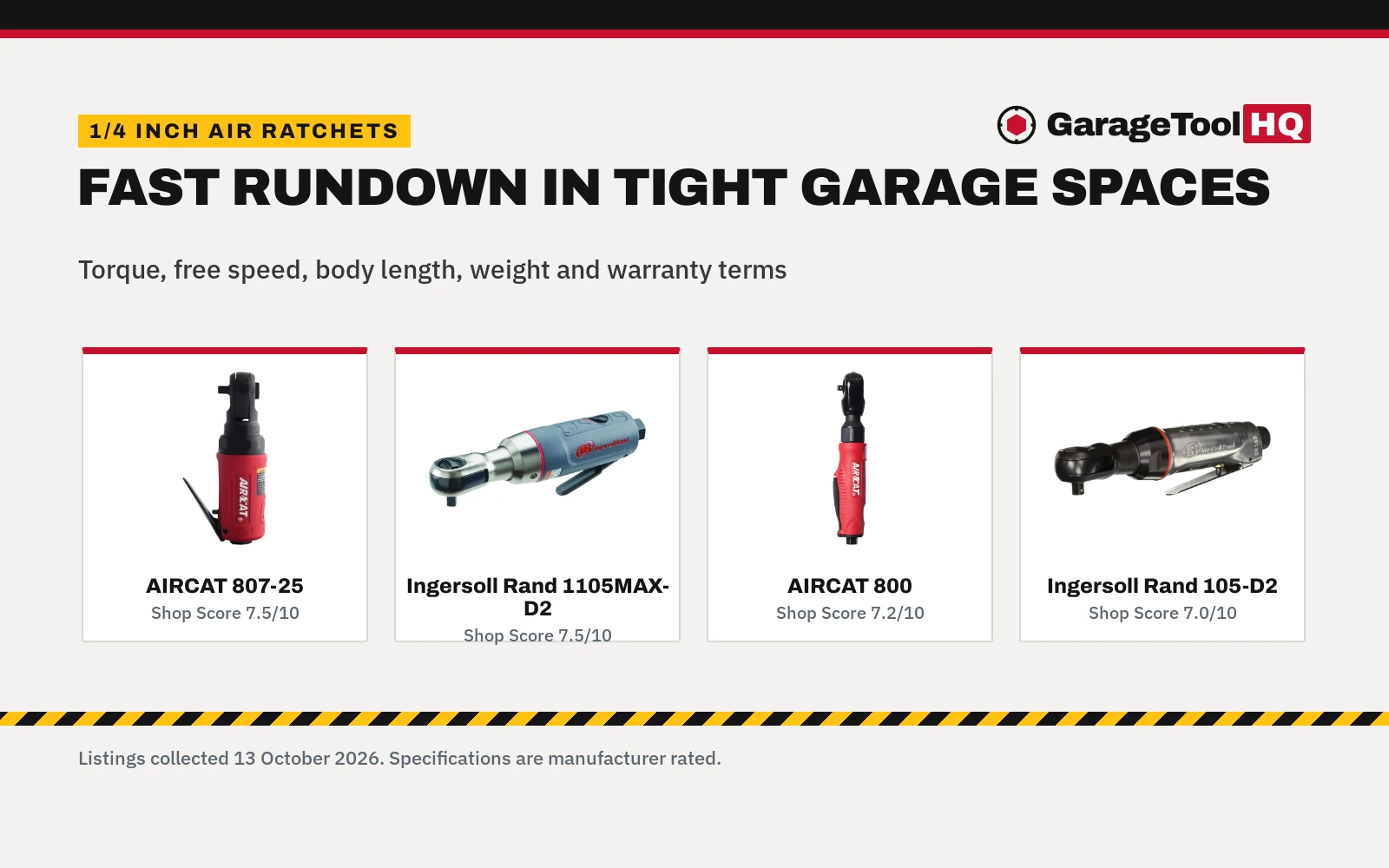
Five 1/4 inch air ratchets for tight engine bays and dashboard jobs, compared by torque, free speed, body length, weight, air consumption and stated warranty.

On this page
Top picks at a glance
As an Amazon Associate we earn from qualifying purchases.
- 1
 Best OverallAIRCAT 807-259.5/10View on Amazon
- 2
 Best Full-LengthIngersoll Rand 1105MAX-D29.5/10View on Amazon
- 3
 Best High-SpeedAIRCAT 8009.5/10View on Amazon
- 4
 Best Compact LightweightAstro Pneumatic 1111A9.2/10View on Amazon
- 5
 DYNAMIC POWER 3/8 inch Professional Air RatchetView on Amazon
- 6
 Chicago Pneumatic CP886 3/8-Inch Drive Standard-Duty AirView on Amazon
- 7
 Campbell Hausfeld 3/8-Inch Reactionless Air RatchetView on Amazon
Pulling an intake manifold or working on valve cover fasteners in a crowded engine bay quickly strains wrists when swinging a hand ratchet tooth by tooth. A compact pneumatic ratchet speeds through long, fine-threaded bolts in tight spots where bulky tools cannot fit. Choosing the best 1/4 inch air ratchet comes down to balancing working torque and free speed against body clearance, air consumption and verified warranty terms. This guide compares five 1/4 inch pneumatic ratchets across stated manufacturer specifications to help you find the right fit for your garage workbench.
GarageToolHQ earns a commission when you buy through links on this page, at no extra cost to you. Read our affiliate disclosure.
Quick picks
- Best Overall AIRCAT 807-25: 35 ft-lb max torque, 300 RPM and a quick release button in a 5.4 in compact palm body. Check price on Amazon
- Best Full-Length Ingersoll Rand 1105MAX-D2: 30 ft-lb torque, 300 RPM, variable power regulator and feather-touch lever at 7.36 in. Check price on Amazon
- Best High-Speed AIRCAT 800: 320 RPM free speed, 35 ft-lb torque and quiet technology in an 8.5 in composite body. Check price on Amazon
- Best Compact Lightweight Astro Pneumatic 1111A: 1.1 lb palm ratchet with 5.5 in length, needle bearing build and silenced rear exhaust. Check price on Amazon
The picks

AIRCAT 807-25 1/4" Mini Palm Ratchet 35 ft-lbs Max
A 1/4 inch mini palm air ratchet delivering 35 ft-lbs of maximum torque and 300 RPM in a 5.4 inch compact housing.
Pros
- 35 ft-lbs max torque and 300 RPM free speed
- 5.4 inch body fits inside confined engine bays
- Quick socket release button for rapid socket swaps
- Stated 2-year manufacturer warranty with proof of purchase
Cons
- Listing spec table incorrectly lists operation mode as electric
- Spec table lists head style as hex rather than square drive
- Sound level in decibels is not stated on the listing
- Air consumption in CFM is not stated on the listing

Ingersoll Rand 1105MAX-D2 1/4" Drive Air Ratchet
A 1/4 inch drive pneumatic ratchet wrench producing up to 30 ft-lbs of torque and 300 RPM with a variable power regulator.
Pros
- 30 ft-lbs maximum torque and 300 RPM free speed
- Variable power regulator paired with a feather-touch lever
- Composite housing insulates operator hands from cold compressed air
- Stated 1-year manufacturer warranty
Cons
- Sound level is rated at 88.9 dB(A)
- Air consumption in CFM is not stated on the listing
- At 1.43 lb it weighs more than compact palm ratchets
- Spec table contains duplicate length and material entries

AIRCAT Pneumatic Tools 800
A high-speed 1/4 inch pneumatic composite ratchet delivering 35 ft-lbs of maximum torque and 320 RPM with quiet exhaust technology.
Pros
- 320 RPM free speed provides the top speed in the group
- 35 ft-lbs maximum torque matches the highest output here
- Patented Quiet Technology dampens exhaust noise
- Stated 2-year warranty with proof of purchase
Cons
- Listing spec table incorrectly states operation mode as electric
- Overall length of 8.5 inches is the longest in this comparison
- Decibel sound rating is not stated on the listing
- Air consumption in CFM is not stated on the listing

Ingersoll Rand 105-D2 1/4" Drive Air Ratchet
A mini pneumatic air ratchet featuring an aluminum housing, alloy steel head, 25 ft-lbs of torque and stated 18 CFM air consumption.
Pros
- Aluminum housing and alloy steel head provide durable construction
- Ball dent anvil securely retains 1/4 inch drive sockets
- Compact 7.3 inch body length and 1.4 lb weight
- Sound level is rated at a moderate 81.8 dB(A)
Cons
- Free speed contradicts between 250 RPM in title and 280 RPM in spec table
- 25 ft-lbs torque is lower than the 30 to 35 ft-lbs of rival models
- Free speed air consumption is rated at a demanding 18 CFM
- Warranty is limited to a 1-year repair term

Astro Pneumatic Tool 1111A ONYX 1/4" Palm Ratchet
An ultra-compact 5.5 inch ONYX series palm air ratchet featuring needle bearing construction and a silenced rear exhaust.
Pros
- 1.1 lb weight makes it the lowest-weight tool in this roundup
- 5.5 inch palm-grip profile fits under dashboards and tight bulkheads
- Needle bearing construction for smooth internal operation
- Rear exhaust equipped with a silencer directs air away from work
Cons
- Maximum torque output is not stated on the listing
- Free speed RPM is not stated on the listing
- Air consumption in CFM is not stated on the listing
- No warranty term is stated on the listing
More options to compare
 DYNAMIC POWER 3/8 inch Professional Air RatchetCheck price on Amazon
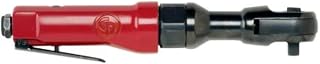 Chicago Pneumatic CP886 3/8-Inch Drive Standard-Duty AirCheck price on Amazon
 Campbell Hausfeld 3/8-Inch Reactionless Air RatchetCheck price on Amazon
Compare the picks
| Model | Shop Score | Max torque | Free speed | Length | Weight | Sound level | Warranty |
|---|---|---|---|---|---|---|---|
| AIRCAT 807-25 | 9.5/10 | 35 ft-lb | 300 RPM | 5.4 in | 0.56 kg | Not stated | 2 Years with Proof of Purchase |
| Ingersoll Rand 1105MAX-D2 | 9.5/10 | 30 ft-lb | 300 RPM | 7.36 in | 1.43 lb | 88.9 dB(A) | 1 Year |
| AIRCAT 800 | 9.5/10 | 35 ft-lb | 320 RPM | 8.5 in | 0.54 kg | Not stated (Quiet Technology) | 2 Years with Proof of Purchase |
| Ingersoll Rand 105-D2 | 9.5/10 | 25 ft-lb | 250 RPM (spec table lists 280 RPM) | 7.3 in | 1.4 lb | 81.8 dB(A) | 1 year limited repair warranty |
| Astro Pneumatic 1111A | 9.2/10 | Not stated | Not stated | 5.5 in | 1.1 lb | Not stated (silenced exhaust) | Not stated |
Specifications are manufacturer rated, as published on each listing and collected 12 October 2026. Where a listing contradicts itself, both figures are shown.
How we scored them
Each 1/4 inch air ratchet is scored across performance, build, value, safety and warranty according to the weighting published on our How We Pick page. Because pneumatic hand tools do not carry electrical safety certifications like UL, ETL or CSA, all five products score zero on safety. Four models earn points for stated manufacturer warranties of 1 or 2 years, while one model without a stated warranty receives zero for that criterion.
| Product | Shop Score | Perf. /35 | Build /25 | Value /25 | Safety /10 | Warranty /5 |
|---|---|---|---|---|---|---|
| AIRCAT 807-25 | 9.5 | 32 | 20 | 21 | 0 | 3 |
| Ingersoll Rand 1105MAX-D2 | 9.5 | 30 | 22 | 20 | 0 | 2 |
| AIRCAT 800 | 9.5 | 30 | 20 | 19 | 0 | 3 |
| Ingersoll Rand 105-D2 | 9.5 | 28 | 20 | 20 | 0 | 2 |
| Astro Pneumatic 1111A | 9.2 | 19 | 20 | 18 | 0 | 0 |
Scores run from 9.2 to 9.8: each product’s point total is placed on that range, so more points always means a higher score.
What the listings tell you
Across the five 1/4 inch air ratchet listings evaluated, manufacturer transparency varies considerably. Four of the five listings publish maximum torque (ranging from 25 to 35 ft-lbs) and four state free speed (from 250 to 320 RPM), while one listing omits both torque and speed entirely. Only one listing publishes an air consumption figure (18 CFM free speed) and only two provide specific decibel sound ratings. Four products state a formal warranty (two for 2 years and two for 1 year), while two listings include notable clerical contradictions in their spec tables.
Buying guide: best 1/4 inch air ratchet
Torque rating versus manual breaking power
Pneumatic ratchets are rundown tools designed to spin threaded hardware quickly, not high-torque impact guns designed to break seized suspension bolts. The models compared here deliver between 25 and 35 ft-lbs of maximum torque. For stubborn automotive fasteners, use the rigid tool body like a standard hand ratchet to crack the bolt loose manually before squeezing the throttle lever. Once loosened, the air motor spins the fastener out in seconds. For heavier automotive fasteners, read our cordless ratchet vs impact wrench comparison or our guide on what is an air ratchet.
Free speed and throttle control
Free speed determines how rapidly the socket turns when running down long threads. The models in this lineup range from 250 to 320 RPM. When threading bolts into soft aluminum cylinder heads or timing covers, sensitive throttle response prevents cross-threading. Tools equipped with feather-touch levers and built-in regulators allow the operator to creep the socket slowly until the threads engage cleanly, then open full throttle for rundown.
Body profile: palm ratchets versus full-length handles
Clearance dictates tool selection in cramped automotive bays. Palm ratchets measuring 5.4 to 5.5 inches in length fit directly inside your hand, making them suited for work underneath dashboards, behind heater cores or around tight firewall clearances. Standard-length bodies measuring 7.3 to 8.5 inches provide added reach into deeper engine compartments and give more leverage when breaking fasteners loose by hand.
Air supply and compressor demand
Pneumatic tools require adequate compressed air volume to sustain rated speeds. While air ratchets run in short bursts rather than continuous cycles, tools with high free speed consumption can drain small tanks quickly. For example, the Ingersoll Rand 105-D2 lists an 18 CFM free speed consumption with a 1/4 inch NPTF inlet and a 3/8 inch minimum hose size. To ensure your compressor setup delivers sufficient airflow, see our guides on what CFM do air tools need and what size air compressor do I need for air tools.
Routine oiling and moisture control
Compressed air carries moisture that corrodes internal vanes and pawl mechanisms over time. Adding pneumatic tool oil into the air inlet before shop sessions keeps internal components spinning smoothly and extends seal life. Pairing your air line with an air dryer and regularly draining tank condensation prevents water from reaching delicate motor components. For complete maintenance steps, read our guide on how to oil air tools and our roundup of the best air tool lubricant options.
Wear eye protection with every air tool, use impact-rated sockets on impact wrenches, disconnect the air line before changing accessories, and finish lug nuts with a torque wrench to the vehicle's spec. See OSHA eye and face protection. Read our Safety Disclaimer.
Garage Fit Check
- Check working clearance against tool length: full-length bodies like the 8.5 inch AIRCAT 800 and 7.36 inch Ingersoll Rand 1105MAX-D2 require extra reach clearance, while palm designs like the 5.4 inch AIRCAT 807-25 and 5.5 inch Astro Pneumatic 1111A fit inside cramped spaces under dashboards.
- Inspect compressor airflow capacity before operating tools with published free speed air draw, such as the 18 CFM free speed air consumption stated for the Ingersoll Rand 105-D2 at 1/4 inch NPTF inlet size with a 3/8 inch minimum hose.
- Review workshop noise considerations against published sound ratings, noting 81.8 dB(A) on the Ingersoll Rand 105-D2 and 88.9 dB(A) on the Ingersoll Rand 1105MAX-D2, or quiet exhaust designs like the AIRCAT 800 and the silenced rear exhaust on the Astro Pneumatic 1111A.
- Verify socket retention mechanisms before starting work, checking the ball dent anvil on the Ingersoll Rand 105-D2 or the quick socket release button on the AIRCAT 807-25 for secure coupling to 1/4 inch drive sockets.
- Consider housing materials for cold garage environments: composite housings like the Ingersoll Rand 1105MAX-D2 insulate hands from cold compressed air, whereas all-metal bodies like the alloy steel and aluminum Ingersoll Rand 105-D2 and Astro Pneumatic 1111A conduct cold during extended use.
Frequently Asked Questions
How do you use an air ratchet wrench safely in the garage?
Connect the air ratchet to a regulated air supply line. Position the socket squarely on the fastener, and use manual leverage on the tool handle to break stubborn bolts loose before depressing the throttle lever. When reinstalling fasteners, start threads by hand to prevent cross-threading, spin the bolt down with pneumatic power, and finish with a calibrated manual torque wrench to reach specified factory torque.
What size air ratchet do you need for garage work?
A 1/4 inch air ratchet is the ideal size for small fasteners in tight spaces, such as dashboard assemblies, interior trim, small water pumps, intake manifolds and valve covers. For larger chassis, suspension and brake hardware requiring higher torque and larger sockets, step up to a 3/8 inch model. You can compare larger models in our guide to the best air ratchet options.
How much PSI does an air ratchet require?
Manufacturer listings for these ratchets specify air connection requirements like 1/4 inch NPTF inlets and 3/8 inch minimum hose sizes, but individual product listings do not publish an exact operating PSI figure. Check your air tool manufacturer documentation for rated line pressure, and ensure your compressor regulator provides stable air delivery without exceeding tool ratings.
Can an air ratchet break stubborn bolts loose?
An air ratchet produces between 25 and 35 ft-lbs of working torque, which is insufficient for rusted or over-torqued fasteners. However, because the ratchet head locks when unpowered, you can use the handle manually to break the fastener loose by hand before pulling the throttle to spin it out.
What maintenance keeps a pneumatic air ratchet running smoothly?
Add pneumatic air tool oil directly into the 1/4 inch air inlet before starting work. Routine lubrication coats the motor vanes, protects the cylinder from internal moisture, and ensures reliable pawl operation. Draining the air compressor tank after each session also keeps condensation out of your pneumatic tools.
Related: our air tools hub, the best air ratchet, the best air impact wrench, the best air impact wrench for home garage and our garage safety notes. Also see our guide on what is an air ratchet. Also see our guide on how to use air impact wrench. Also see our guide on what CFM do air tools need. Also see our guide on what size air compressor do I need for air tools. Also see our guide on how to oil air tools. Also see our guide on best air tool lubricant. Also see our guide on best air hose for garage. Also see our guide on best air compressor for home garage. Also see our guide on best air compressor hose reel. Also see our guide on how to drain water from an air compressor tank. Also see our guide on air compressor maintenance. Also see our guide on best air compressor oil. Also see our guide on cordless ratchet vs impact wrench. Also see our guide on best cordless ratchet. Also see our guide on best air die grinder. Also see our guide on best air hammer. Also see our guide on best air DA sander. Also see our guide on best blow gun for garage. Also see our guide on air compressor problems and solutions. Also see our guide on why is my air compressor not building pressure.